 Autor Nicki Price, CEO
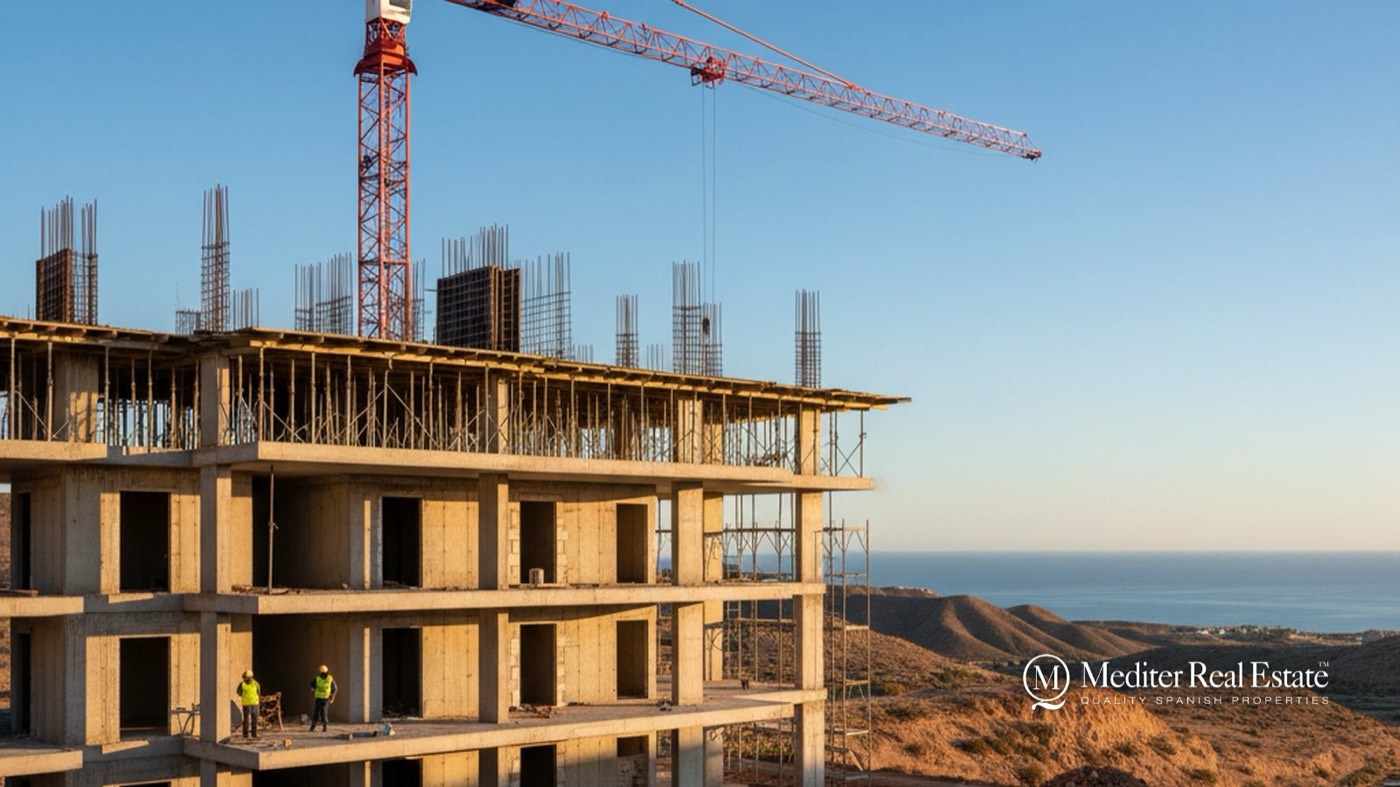
When you buy off-plan on the Costa Almería in 2026, you don't hand over the whole price at once, you pay in stages as the building goes up. The typical schedule is a small reservation deposit (around €6,000-€10,000), then about 10% of the price on signing the private purchase contract, a further 20-40% spread across construction milestones, and the remaining 60-70% at completion when you sign the title deed before the notary. On a €300,000 apartment that means roughly €30,000 at contract, about €60,000-€90,000 during the build, and the balance (plus taxes) at the end.
This guide explains each stage, exactly what you pay and when, how the 10% IVA plus 1.2% AJD stamp duty fall due in Andalucía, and the one legal protection you must insist on: the bank guarantee for off-plan payments.
A staged payment plan is simply the agreed schedule for releasing your money to the developer as the property is built, rather than in a single lump sum. Because the home does not yet exist, the developer funds construction partly with your instalments, so payments are tied to progress, foundations, structure, roof, and handover. You commit early and pay gradually over the (usually 12-24 month) build period.
This is the core difference between buying new and buying existing stock. If you want the fuller comparison of both routes, see our guide to off-plan vs resale on the Costa Blanca, the structure is the same across all four of our coasts, only the local tax rates change.
You pay a reservation fee, typically €6,000 to €10,000 on the Costa Almería, to take the unit off the market while your lawyer checks the developer's paperwork. It is a holding deposit, not a contract. Once paid, the developer stops marketing that specific plot or apartment for an agreed period (commonly 15-30 days) so your lawyer can carry out due diligence.
Before committing, your lawyer should confirm the developer owns the land free of charges, holds a valid building licence, and that the project is registered. The reservation amount is later deducted from your 10% contract payment. Understand exactly what is and isn't refundable here, our note on the reservation deposit and what's refundable explains the fine print that catches buyers out.
At the private contract stage (the contrato de compraventa) you normally pay 10% of the purchase price, with your reservation fee counted towards it, plus IVA. This is the binding agreement: it sets the price, the specification, the completion deadline and, critically, the full payment schedule for the rest of the build.
This 10% is a genuine commitment. From here, the developer relies on your staged payments to finish the building, which is why Spanish law requires them to guarantee your money (see below). Have an independent lawyer read the contract before you sign; the developer's own draft will protect the developer, not you.
For new builds the tax base is the price you pay plus IVA, so the Catastro valor de referencia issue that affects resales is less of a factor here. On resale purchases the tax is charged on the higher of the price or that reference value, worth knowing if you later sell or buy second-hand on the same coast.
Between the contract and completion you pay interim instalments, usually totalling 20% to 40% of the price, released against construction milestones. Each instalment carries its 10% IVA, and your lawyer should verify progress before releasing funds. A common Costa Almería structure splits these payments across the start of the structure, completion of the roof, and the start of finishes.
Payment plans vary by developer. Some front-load more during the build; others keep the majority until completion. Always read the schedule in the contract rather than assuming a standard split.
| Stage | % of price | Amount (excl. IVA) | IVA at this stage | When |
|---|---|---|---|---|
| Reservation | ~2-3% | €6,000-€10,000 | Usually invoiced at contract | On reserving the unit |
| Private contract (less reservation) | 10% | €30,000 | €3,000 | On signing the contrato |
| Milestone 1, structure | 10% | €30,000 | €3,000 | During build |
| Milestone 2, roof / finishes | 10% | €30,000 | €3,000 | During build |
| Completion balance | 70% | €210,000 | €21,000 | At the notary (title deed) |
In this example the IVA (€30,000 in total on a €300,000 price) is split across the stages because each developer invoice is subject to it. What falls due at completion, on top of the final balance, is the AJD stamp duty, covered next.
On a new build in Andalucía, which covers the Costa Almería and the Costa del Sol, you pay 10% IVA on the price plus AJD (Actos Jurídicos Documentados) stamp duty of 1.2%. The IVA is invoiced by the developer with each staged payment; the AJD is a one-off paid around completion when the deed is signed. Add notary, land registry, lawyer and gestoría fees, and total costs on a new build run roughly 12-15% on top of the price (Andalucía sits at the lower end thanks to its 1.2% AJD).
Note that these rates are set per autonomous community, so the AJD differs across our four coasts. New builds are never subject to ITP, that transfer tax only applies to resales.
| Coast | Autonomous community | IVA | AJD stamp duty |
|---|---|---|---|
| Costa Almería | Andalucía | 10% | 1.2% |
| Costa del Sol | Andalucía | 10% | 1.2% |
| Costa Cálida | Murcia | 10% | 1.5% |
| Costa Blanca | Comunidad Valenciana | 10% | 1.4% |
On top of tax you'll budget notary fees of roughly 0.2-0.5%, land registry of 0.1-0.25%, a lawyer at about 1% plus IVA, and a gestoría around €300. If you need finance, arrange it early: see our guides to the non-resident mortgage in Spain and the bank valuation (tasación), which is run close to completion rather than at contract on off-plan deals.
By law, every euro you pay the developer before the property is finished must be protected by a bank guarantee or insurance policy, backed by a separate ring-fenced account. If the developer goes bust or fails to deliver, you are entitled to your money back plus interest, this is the single most important protection in an off-plan purchase and you should never pay an instalment without it in place.
Insist on seeing the individual guarantee certificate (aval or insurance policy) covering your payments, not just a general statement that "the project is guaranteed". Check that every staged payment goes into the special account named in your contract. Our dedicated guide to developer insolvency and the off-plan bank guarantee explains how to enforce this if things go wrong.
At completion you pay the final balance, usually around 70%, and sign the title deed (escritura) before a notary, at which point ownership transfers to you and you receive the keys. Before this, the developer must have obtained the First Occupation Licence (Licencia de Primera Ocupación), and your lawyer will register the deed at the Land Registry afterwards.
Completion day is when the AJD stamp duty, notary and registry costs crystallise. For the mechanics of the signing itself, read notary and completion day in Spain, and don't skip the First Occupation Licence, without it you cannot legally connect utilities or, in many cases, obtain the cédula de habitabilidad. Do a thorough snagging inspection before you sign so defects are fixed on the developer's account.
Yes, the staged payments still come from you during the build. A mortgage on a new build is normally drawn down at completion against the final balance, not during construction, so you self-fund the reservation, the 10% contract payment and the interim instalments from your own capital. Plan your cash flow and currency transfers accordingly.
Across Mediter's current Costa Almería stock, new-build apartments and villas span a broad range, with many modern coastal apartments in the roughly €150,000-€350,000 bracket and larger detached villas above that. At these prices, the difference between Andalucía's 1.2% AJD and a higher stamp-duty region can save several thousand euros on an otherwise similar home, one more reason the Costa Almería appeals to value-focused buyers. For how the coast compares with its neighbours on price and lifestyle, see our four-coasts comparison.
Expect a reservation fee of around €6,000-€10,000 followed by about 10% of the price on signing the private contract. The reservation is usually deducted from that 10%, so your real upfront commitment is roughly 10% plus the IVA on it.
Budget 10% IVA plus 1.2% AJD stamp duty, then notary (~0.2-0.5%), land registry (~0.1-0.25%), lawyer (~1% + IVA) and gestoría (~€300). All in, allow roughly 12-15% on top of the purchase price, with the Costa Almería at the lower end.
It should be, provided every staged payment is covered by the legally required bank guarantee or insurance policy and paid into the designated special account. If the developer fails to deliver, you can reclaim your payments plus interest, but only if the guarantee is genuinely in place, so verify it in writing before each payment.
The AJD, 1.2% in Andalucía, is a one-off tax tied to signing the title deed, so it falls due around completion, not during the build. The 10% IVA, by contrast, is invoiced by the developer with each staged payment as you go.
You can arrange one in advance, but lenders typically release the mortgage funds at completion against the final balance. The reservation, contract payment and construction instalments usually come from your own funds, so plan your cash flow across the whole build period.
The reservation is a small holding fee (around €6,000-€10,000) that takes the unit off the market while your lawyer checks the developer. The contract payment of about 10% is the binding commitment to buy, with the reservation deducted from it. Only the contract makes the sale legally enforceable.
Mediter Real Estate sells new-build and resale property across the Costa Almería, Costa Cálida, Costa Blanca and Costa del Sol, and we guide international buyers through every stage, from reservation and bank guarantees to completion at the notary. Start with our non-resident buyer's guide, then get in touch with our team to discuss current new-build projects and payment plans on your chosen coast.
To, co nam tu napiszesz, wykorzystamy wyłącznie do odpowiedzi. Privacy
Używamy plików cookie niezbędnych do działania strony. Za Twoją zgodą używamy też plików cookie Meta (Facebook), aby mierzyć nasze reklamy i pokazywać Ci nieruchomości podobne do tych, które oglądałeś. Pliki cookie Google Analytics, również tylko za Twoją zgodą, liczą odwiedziny i pokazują nam, które strony pomagają.
Polityka cookie