 Автор Nicki Price, CEO
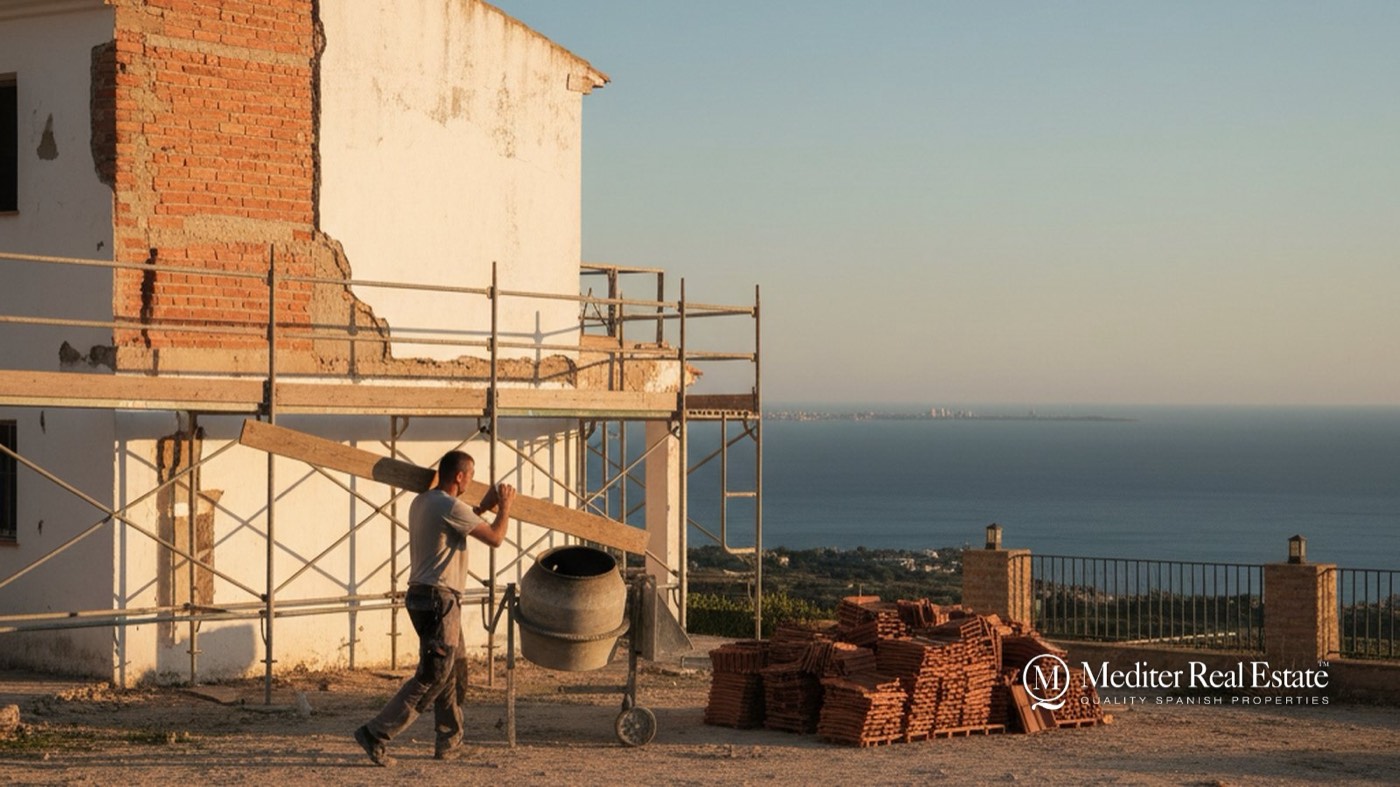
Can you still make money flipping property on the Costa del Sol in 2026? Yes, but the margins are tighter than the internet suggests: after you add the ~7% transfer tax (ITP) and buying costs on purchase, the renovation works, the selling costs, and capital gains tax on your profit, a realistic flip needs a gross spread of at least 25-30% between the "buy done up" price and your all-in cost just to clear a worthwhile net margin. On a €250,000 purchase in Andalucía you lose roughly €17,500 in ITP alone before a single wall is painted. The flips that work are the ones where the discount is real and the works are genuinely light-to-medium, not full structural rebuilds.
This guide gives the concrete 2026 numbers for the Costa del Sol and how they compare with the Costa Blanca, Costa Cálida and Costa Almería, so you can model a deal before you commit.
On a resale in Andalucía (which covers the Costa del Sol and Costa Almería) you pay 7% ITP (Impuesto de Transmisiones Patrimoniales), charged by the Junta de Andalucía, plus notary, land registry, lawyer and gestoría fees. All-in, budget roughly 10% on top of the purchase price at the lower, Andalucían end of the scale. Crucially, the tax base is the higher of the price you actually pay or the Catastro's official valor de referencia, so a bargain below "reference value" still gets taxed on the higher figure.
For a flipper this matters twice: once on the way in, and again because the valor de referencia can shape what the tax authority expects on the way out. The rates vary by region, which is why where you flip changes the sums:
| Costa (region) | Resale ITP | New-build (IVA + AJD) | Typical all-in buying cost |
|---|---|---|---|
| Costa del Sol (Andalucía) | 7% | 10% IVA + 1.2% AJD | ~10% |
| Costa Almería (Andalucía) | 7% | 10% IVA + 1.2% AJD | ~10% |
| Costa Cálida (Murcia) | 7.75% (Ley 3/2025) | 10% IVA + 1.5% AJD | ~11% |
| Costa Blanca (C. Valenciana) | 9% from 1 June 2026 (Ley 5/2025) | 10% IVA + 1.4% AJD | ~12% |
Note the Costa Blanca change: under Ley 5/2025 the C. Valenciana rate drops from 10% to 9% for deeds signed from 1 June 2026 (an 11% band applies above €1M), and it's the notary signing date that decides, not the arras date. The old Murcia 8% figure you'll still see on many sites is wrong, it is 7.75% under Ley 3/2025. For flippers, Andalucía's flat 7% is the cheapest entry point of the four, which is one reason the Costa del Sol maths can work where a Costa Blanca flip struggles. For the finer points of transfer tax and the valor de referencia, see our guide to buying property in Spain as a non-resident.
You pay capital gains tax on the gain (sale price minus allowable purchase and improvement costs), plus the municipal plusvalía on the land-value increase. For non-resident sellers the capital gains rate is 19% on the gain (within the EU/EEA band), declared via Modelo 210 to the Agencia Tributaria. The buyer of your flip must withhold 3% of the sale price (Modelo 211) as an advance on your CGT, so you don't receive the full price on the day.
Two points flippers routinely get wrong:
Our full breakdown of exit taxes, the 3% retention and plusvalía is in selling property in Spain 2026: taxes, costs and steps. If you flip repeatedly and it becomes a trade, the tax treatment can shift from occasional capital gain to business income, worth taking advice, and our note on buying jointly or via a company explains when a structure might help.
As a 2026 rule of thumb on the costas, a cosmetic refresh (paint, flooring, kitchen, bathroom, lighting) runs roughly €400-€700 per m², while a full gut renovation with new installations, re-plumbing and rewiring runs €900-€1,500+ per m². A tired 80 m² apartment therefore costs around €35,000-€55,000 to refresh, or well over €80,000 to rebuild internally. These are indicative ranges, get fixed quotes before committing.
Timescale is the margin killer most investors underestimate. A realistic flip timeline on the Costa del Sol:
Realistically, a cosmetic flip is a 6-9 month project and a heavier renovation can easily run 12-18 months, during which you carry IBI, community fees, utilities and insurance. Getting the permit right from the start is essential; our guide to renovating property in Spain explains obra menor vs obra mayor, and if the property is rural check the AFO certificate rules before you buy, because an unregularised build can sink a flip entirely.
A well-executed, realistically-bought flip targets a net margin of 10-18% of the end value, not the 30%+ headline numbers social media loves. The gross spread needs to be much larger than the net profit because taxes and costs eat 20%+ of the round trip. Here is a worked example on a Costa del Sol apartment.
| Line | Amount |
|---|---|
| Purchase price (tired resale) | €250,000 |
| Buying costs (~10%: 7% ITP + notary, registry, lawyer, gestoría) | €25,000 |
| Renovation (cosmetic-medium, ~€550/m² × 90 m²) | €50,000 |
| Holding costs (9 months: IBI, community, utilities, insurance) | €5,000 |
| Total invested | €330,000 |
| Resale price achieved | €400,000 |
| Selling costs (agency ~3-5%, energy certificate, plusvalía) | €18,000 |
| Gross gain | €52,000 |
| Capital gains tax (19% non-resident, on documented gain) | ~€9,900 |
| Net profit | ~€42,100 (~11% of sale price) |
Change two assumptions and the deal disappears: if the works overrun to €75,000 and the resale slips to €375,000, your net profit falls to roughly €5,000 for a year's risk. That is the reality flippers must model. The two biggest levers are buying below market and controlling the renovation budget. For the first, read how to negotiate property price, the technique travels to the Costa del Sol, and consider motivated-seller channels such as bank repossessions on the Costa Almería.
The best flip value sits where a desirable location meets a tired stock that the current owner can't or won't update, think 1970s-90s apartments a few streets back from the seafront in established towns. On the Costa del Sol, areas with strong resale demand and plenty of dated stock include Benalmádena, Fuengirola and parts of Estepona; our Benalmádena guide and Estepona investment guide cover the demand side.
Across the four costas, the flip logic shifts by region:
Across Mediter's current Costa del Sol stock you'll find renovation-candidate resale apartments priced well below headline new-build levels, alongside fully renovated and turnkey homes at a clear premium, the gap between the two is exactly the spread a flipper is trying to capture. Browse our live Costa del Sol and Costa Almería listings to benchmark "tired" versus "done" pricing street by street before you build a model.
Due diligence protects the whole margin. Before you exchange:
Yes, where the discount and the renovation scope are realistic. Expect a net margin of about 10-18% of the end value on a well-bought, well-controlled cosmetic-to-medium flip. Full structural rebuilds, long permit delays and over-paying on entry are what turn flips into losses.
On purchase, 7% ITP in Andalucía plus around 3% in notary, registry, lawyer and gestoría fees. On sale, 19% capital gains tax for non-residents on the documented gain (via Modelo 210), with a 3% retention held by the buyer, plus municipal plusvalía.
Only genuine improvements (mejoras) backed by proper invoices with IVA from registered contractors can be added to your acquisition cost to reduce the gain. Repairs and undocumented cash work generally cannot. Keep every factura.
Yes. Cosmetic work usually needs an obra menor licence from the town hall; structural or layout changes need an obra mayor, which can take 2-6 months. Working without the right licence risks fines and problems at resale.
The Costa del Sol offers the fastest resale and deepest buyer pool but the smallest entry discounts; the Costa Almería and Costa Cálida offer cheaper entry and bigger percentage spreads but slower sales. From June 2026 the Costa Blanca's 9% ITP makes it the most expensive of the four to buy into.
A cosmetic flip is realistically a 6-9 month project from purchase to resale completion; a heavier renovation can run 12-18 months. Budget holding costs, IBI, community fees, utilities and insurance, for the whole period.
Mediter Real Estate works across the Costa del Sol, Costa Blanca, Costa Cálida and Costa Almería, and we can help you source renovation-candidate properties, benchmark tired-versus-done pricing and understand the real tax and cost model before you commit. Talk to us about your exit strategy or get in touch to discuss current opportunities in these four regions.
Те, що ви розповісте тут, ми використовуємо лише щоб відповісти вам. Privacy
Ми використовуємо файли cookie, потрібні для роботи сайту. З вашої згоди ми також використовуємо cookie Meta (Facebook), щоб оцінювати нашу рекламу й показувати вам об’єкти, схожі на ті, що ви переглядали. Cookie Google Analytics, теж лише з вашої згоди, рахують відвідування й показують нам, які сторінки корисні.
Політика cookie