 Skrevet af Nicki Price, CEO
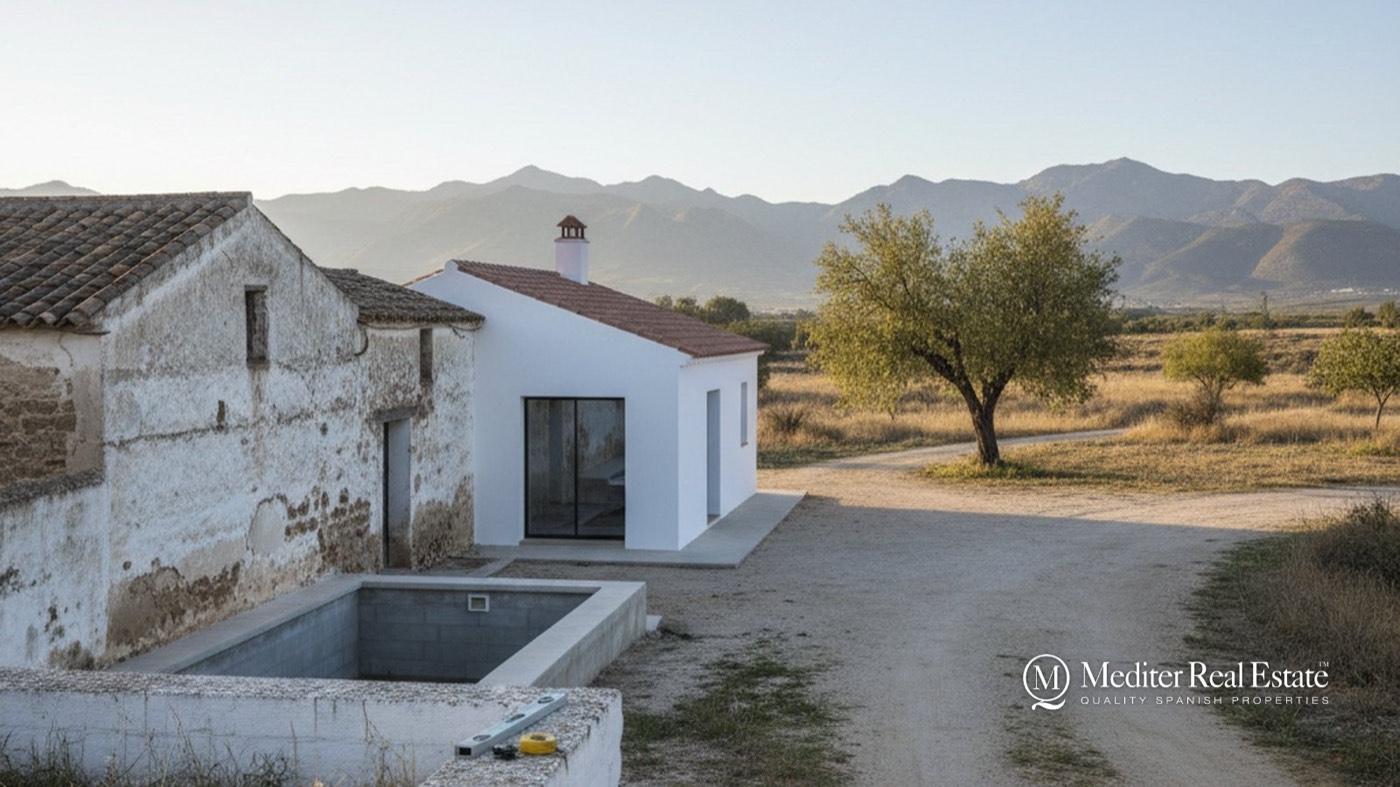
If the house, pool or extension in front of you does not match what the escritura (title deed) and the Registro de la Propiedad describe, you are looking at an unregistered or under-declared build, extremely common in rural Costa Almería around Albox, Arboleas, Vera, Taberno and Zurgena. You can usually still buy it, but you (or ideally the seller before completion) must regularise the discrepancy, which on the Costa Almería means one of three routes: a standard obra nueva declaration, an obra nueva por antigüedad for older works past the planning time limit, or an AFO certificate for builds on rural land that can never be fully legalised. Budget roughly €1,500-€4,000+ in architect, notary and registry fees depending on the route and the size of the works.
Below is exactly how to identify the problem on a Costa Almería property, which fix applies, what it costs, and how to protect yourself in the contract before you sign.
It means the physical property is bigger or different to its legal description. The deed and the Registro de la Propiedad might list a 90 m² house, but on the ground there is a 140 m² house, a 40 m² garage, a pool and a sun terrace that were never declared. Spain keeps two separate records, the Registro de la Propiedad (legal ownership) and the Catastro (physical description for tax), and on rural Almería property these two, plus the actual building, frequently disagree.
This matters because you cannot cleanly mortgage, insure, extend, or one day sell what is not properly registered. A lender's valuation surveyor (tasación) will value only the registered square metres, not the unofficial extension, which can wreck a non-resident mortgage. The discrepancy must be closed so the deed, the Catastro and the bricks finally tell the same story.
Compare three documents against the building itself: the nota simple from the Registro de la Propiedad, the cadastral certificate and plan from the Catastro, and a physical measurement. Any gap between them is a red flag to investigate before you pay a deposit.
Ask your lawyer to run all three checks during the reservation and arras period, before any non-refundable deposit changes hands.
On the Costa Almería the single most important question is whether the plot is suelo urbano (urban/buildable) or suelo rústico/no urbanizable (rural). An undeclared extension on urban land is usually straightforward to regularise; the same work on protected rural land may never be fully legal and can only be recorded through an AFO. Our guide to suelo rústico vs urbano explains the categories, and much of inland Almería is precisely this rural land.
Confirm the land classification at the Catastro and with the town hall (ayuntamiento) before deciding which route applies.
There are three legal routes, and which one applies depends on when the work was done and what the land is classified as. The table below compares them for Andalucía, which governs the Costa Almería.
| Route | When it applies | Key document | Typical cost (fees only) |
|---|---|---|---|
| Obra nueva (new declaration) | Recent legal works on buildable (urban) land, with a current building licence | Architect's certificate + building licence + first occupation licence | €1,500-€3,500+ (architect, notary, registry, AJD 1.2%) |
| Obra nueva por antigüedad | Works finished long enough ago that the planning authority can no longer act, and no open disciplinary file exists | Architect's certificate dating the build + cadastral certification | €1,200-€3,000+ (architect, notary, registry) |
| AFO (Declaración de Asimilado a Fuera de Ordenación) | Builds on rural/non-urbanisable land that cannot be fully legalised but can be recognised | AFO resolution from the ayuntamiento + technical project | €2,000-€4,000+ plus municipal fees |
This records an existing building whose planning infringement is time-barred. The architect certifies the age of the construction (usually from Catastro aerial photo history), the notary signs a new obra nueva por antigüedad declaration, and the Registro de la Propiedad enters the real square metres. Crucially this regularises the registration, not the legality of a build on protected land, on genuinely rural land you often still need an AFO on top.
Many inland Almería properties sit on suelo no urbanizable, where a dwelling was never licensable. The AFO (Asimilado Fuera de Ordenación) is Andalucía's mechanism to recognise such a house so it can have utilities and be sold, without ever being "legal" in the planning sense. We cover this in detail in our AFO certificate guide, essential reading for any rural Almería purchase.
Expect the professional and official fees to land somewhere between €1,500 and €4,000+, on top of the purchase. The main components are the architect's certificate, the notary, the Registro de la Propiedad, and, for a true new declaration, AJD stamp duty of 1.2% in Andalucía on the declared construction value, payable via the Junta de Andalucía.
Remember these sit on top of your normal purchase costs. A Costa Almería resale carries ITP at 7% in Andalucía, charged on the higher of the price or the cadastral valor de referencia, so if you later declare extra square metres you may also raise the tax base.
Negotiate for the seller to complete the regularisation before completion, at their cost, because it is their undeclared work. Where that is not practical, agree a price reduction reflecting the fees and the risk, written into the arras contract with a clear deadline. A good negotiation here can save thousands, and your lawyer should make completion conditional on the paperwork being in order.
Usually not until it is regularised, because the bank lends against the registered area only. If the extension is unregistered, the tasación ignores it, the loan-to-value falls, and the deal can collapse. Non-resident buyers in particular should read our non-resident mortgage guide and plan to close the discrepancy before or at completion. Many rural Almería purchases of this kind end up as cash buys precisely because of these registration issues.
Registration is only part of the picture. On a rural Almería property also confirm the water supply, access and habitability status.
Mediter currently lists properties across six Spanish coastal regions including Costa de Almería, with 9,965 homes for sale in total today. Our Costa Almería stock mixes titled village houses with rural cortijos where exactly these escritura and cadastral questions arise, which is why we check the nota simple, Catastro and land classification on every one before we take it to market.
Yes, but only with proper legal checks. Have your lawyer compare the nota simple, Catastro and physical building, confirm whether the land is urban or rural, and make completion conditional on the correct regularisation route being completed, ideally by the seller at their cost.
An obra nueva (including por antigüedad) records a building in the Registro de la Propiedad, which is about registration. An AFO is Andalucía's recognition of a build on rural land that can never be made fully legal in the planning sense, letting it have utilities and be sold. Rural Almería properties often need both.
Typically €1,500-€4,000+ in architect, notary and Registro de la Propiedad fees, plus AJD stamp duty of 1.2% in Andalucía on any newly declared construction value and any municipal AFO fees set by the ayuntamiento.
It can. Declaring extra square metres can raise the cadastral value used for IBI, and if the extra area raises the valor de referencia, it can affect the ITP base (7% in Andalucía) on any future purchase.
Generally no, because the bank values only the registered area and the tasación ignores undeclared works. Close the discrepancy first, or expect a lower loan-to-value, many such rural Almería purchases are completed in cash.
Buying a non-standard or unregistered build on the Costa Almería is entirely doable with the right checks and the right regularisation route, and getting it wrong is expensive. If you have found a rural cortijo, a village house or a coastal home and want someone to read the nota simple, the Catastro and the land classification before you commit, contact Mediter Real Estate at info@mediter.com or on +34 744 719 499. We work across Costa Blanca, Costa Cálida, Costa del Sol and Costa Almería and will tell you honestly what a property needs before you sign.
Det du fortæller os her, bruger vi kun til at svare dig. Privacy
Vi bruger cookies, som siden har brug for for at virke. Med dit samtykke bruger vi også cookies fra Meta (Facebook) til at måle vores annoncer og vise dig boliger, der ligner dem, du har set på. Cookies fra Google Analytics, også kun med dit samtykke, tæller besøg og viser os, hvilke sider der hjælper.
Cookiepolitik