 Skrevet af Nicki Price, CEO
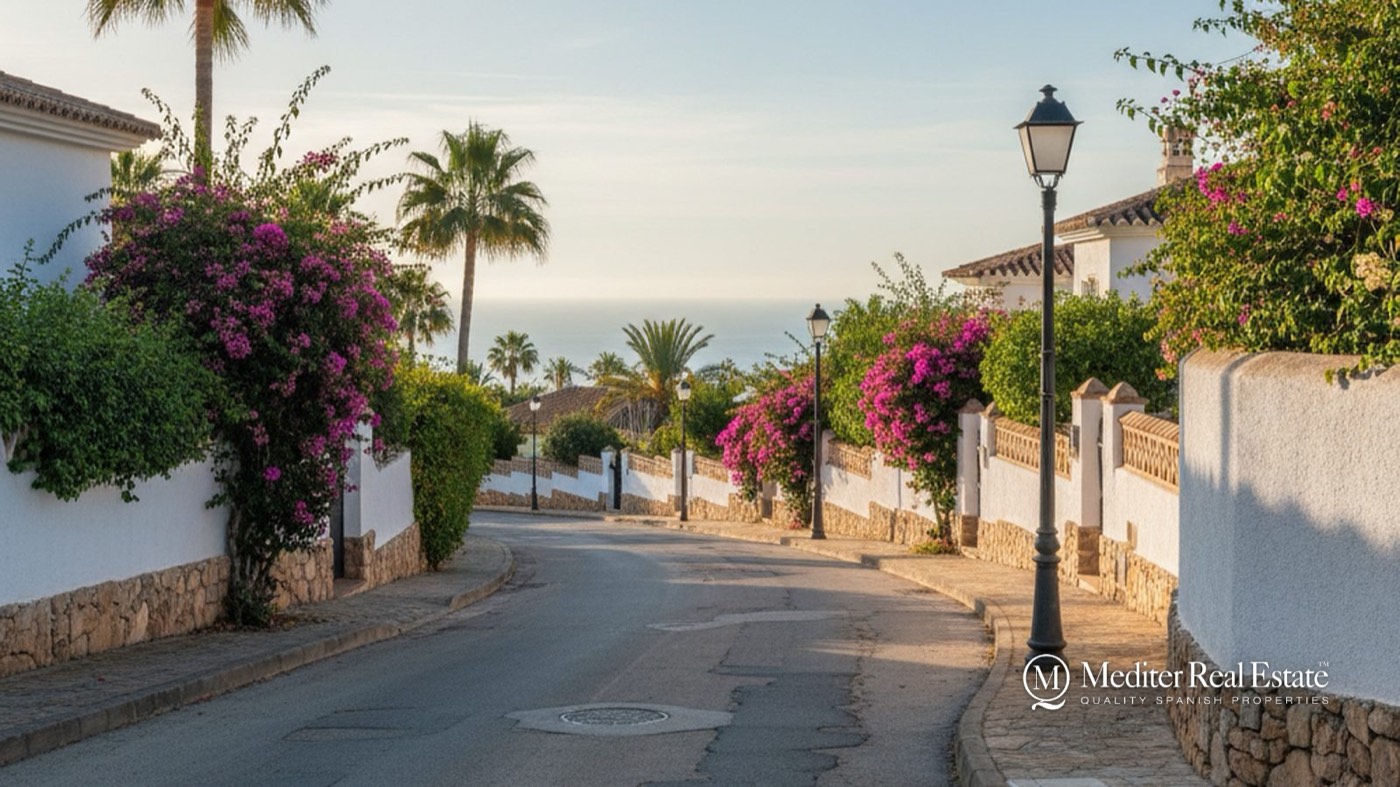
On a Costa Blanca urbanisation, the road to your gate is often not owned or maintained by the town hall, it is private, shared between the owners, and the cost of resurfacing, lighting and drainage falls on them, not the municipality. Ownership usually sits with either an entidad urbanística de conservación (a legally obligatory maintenance body set up under the Ley Reguladora de la Actividad Urbanística of the Comunidad Valenciana) or with the owners jointly via a servidumbre de paso (right of way) written into each escritura. Before you buy, the single most important check is to confirm in the nota simple and the Catastro whether the access road is public (adopted), private-and-shared, or an undefined strip with no clear owner at all, because that determines who pays and who is liable if someone is injured.
This guide, grounded in the Costa Blanca, Costa Cálida, Costa del Sol and Costa Almería, explains the three ownership models you will meet, how to read the paperwork, what the annual cost looks like, and the traps that turn a dream villa into a legal headache.
You cannot assume. A huge share of Costa Blanca and Costa Cálida urbanisations built from the 1970s onwards were never formally handed over ("recepcionadas") to the town hall, so their roads remain private and unadopted. That means the ayuntamiento does not resurface them, does not fix the street lights and does not clear the drains. To find out which category your property falls into, your lawyer checks three things: the nota simple from the Registro de la Propiedad (does your plot carry a servidumbre or membership obligation?), the Catastro map (is the road a separate public parcel or part of the private development?), and the ayuntamiento's planning department (has the urbanisation been officially received?).
There are, broadly, three situations:
Our deeper Urbanisation Costa Blanca 2026: Roads & Upkeep Guide and the related Suelo Rústico vs Urbano guide cover the broader land-status questions that sit behind all of this.
An entidad urbanística de conservación is a public-law body (not the same as your residential comunidad) whose sole job is to maintain the common infrastructure of an urbanisation, roads, street lighting, green zones, storm drains, until (and sometimes after) the development is received by the ayuntamiento. On the Costa Blanca it is created under the Comunidad Valenciana's urban planning legislation (the LUV/LOTUP framework), and membership is compulsory and automatic for every plot owner inside its perimeter. You cannot opt out, and the obligation runs with the land, so when you buy you inherit it whether or not the seller mentioned it.
Crucially, an entidad can enforce unpaid quotas against the property itself, similar to how community debts attach under the Ley de Propiedad Horizontal, so always ask the seller for a certificate of payments up to date before completion. This is separate from your ordinary community fees; a villa can belong to both a comunidad de propietarios and an entidad de conservación, with two annual bills.
There is no fixed rate, the entidad sets quotas each year to cover its actual budget, apportioned by each plot's coefficient. As a practical range on Costa Blanca and Costa Cálida resorts, annual road-and-infrastructure charges commonly run from roughly €150 to €600 per property, and considerably more on large gated resorts with extensive private roads, lighting and landscaping. Ask for the last two years' approved accounts rather than relying on a quoted figure.
A servidumbre de paso is a legal right of way allowing you to cross land you do not own in order to reach your property. On the Costa Blanca this appears constantly on inland and rural-edge plots, on small private cul-de-sacs and on older subdivisions where the access strip was never transferred to anyone collectively. It is governed by the Código Civil, and it should be registered against both properties, the one that benefits (yours) and the one that bears the burden (the neighbour's), in the Registro de la Propiedad.
The danger is a road you use every day that is legally owned by a developer who has since dissolved, or by a neighbour with no obligation to maintain it. If the servidumbre is only "used in practice" but never registered, you have no guaranteed right at all. Your lawyer must confirm it appears on your nota simple and should define, where possible, who pays for upkeep, the Código Civil default is that the cost of maintaining a servidumbre falls on the owner(s) who benefit from it, unless the deed says otherwise.
If the road is private and unadopted, the owners or the entidad de conservación are liable, not the town hall. A pothole that damages a car, a broken street light, or a loose drain cover that trips a visitor can all generate a civil claim against whoever is responsible for maintenance. Where an entidad de conservación exists, it should hold public liability insurance and the claim goes to it. Where access is only a servidumbre with no body behind it, liability can land directly on the benefiting owners, which is why clarifying the arrangement before purchase is not a formality but genuine risk management.
Ask two questions during due diligence: (1) Is there a current public liability (responsabilidad civil) policy covering the shared access? and (2) Who is the named responsible party? If nobody can answer, treat that as a red flag, not a detail.
| Point | Adopted public road | Private road / entidad de conservación |
|---|---|---|
| Who owns it | The ayuntamiento | The owners collectively / the entidad |
| Who pays for resurfacing | Municipal budget | Every owner, by coefficient |
| Street lighting & drains | Town hall | The entidad or the owners |
| Annual cost to you | Covered by your IBI | Typically ~€150-€600+ extra per year |
| Liability for accidents | Municipality | Owners / entidad (needs insurance) |
| Can you opt out | N/A | No, obligation runs with the plot |
| Appears on nota simple | Not as a charge | As a membership/servidumbre obligation |
The underlying principle, unadopted private roads are maintained by owners, not the town hall, applies on all four coasts, but the legal framework differs by autonomous community. On the Costa Blanca the entidad de conservación is created under Comunidad Valenciana planning law; on the Costa del Sol and Costa Almería it falls under Andalucía's LISTA planning legislation; on the Costa Cálida under the Región de Murcia's framework. The documents and the body's name are broadly equivalent, and the servidumbre de paso rules come from the national Código Civil everywhere. Transaction costs, however, vary significantly by region, which matters because road liabilities ride along with the purchase.
| Coast / region | Resale ITP | New build |
|---|---|---|
| Costa Blanca (C. Valenciana) | 9% (deeds signed from 1 June 2026, Ley 5/2025; 11% above €1M) | 10% IVA + 1.4% AJD |
| Costa Cálida (Murcia) | 7.75% (Ley 3/2025) | 10% IVA + 1.5% AJD |
| Costa del Sol (Andalucía) | 7% | 10% IVA + 1.2% AJD |
| Costa Almería (Andalucía) | 7% | 10% IVA + 1.2% AJD |
Remember the tax base is the higher of the agreed price or the Catastro's valor de referencia, which can push your bill above what the price alone suggests. On top of tax, budget notary ~0.2-0.5%, Registro de la Propiedad ~0.1-0.25%, lawyer ~1% + IVA and gestoría ~€300, a rule-of-thumb total of ~10-13% over the price for a resale.
Do all of this before you pay the reservation deposit or arras, because on the Costa Blanca it is the notary signing date that fixes your ITP rate, not the arras date, and you do not want to be locked in before the road status is clear:
If the property is on hillier terrain or a rural edge, pair this with our guides on rural water connections and the cédula de habitabilidad, since unadopted developments often raise all three issues at once.
Across the Costa Blanca South, Costa Blanca North, Costa Cálida, Costa del Sol and Costa Almería we currently have 8,553 properties for sale, and a large proportion of the villa and townhouse stock sits on exactly these kinds of urbanisations, gated resorts around Orihuela Costa, Cabo Roig, Rojales, Algorfa and San Miguel de Salinas where private access and entidad or community maintenance are the norm rather than the exception. For every one of those homes we can obtain the nota simple and confirm the road status before you commit.
Sometimes. If the urbanisation meets the planning conditions, owners (often through the entidad de conservación) can press for formal reception by the ayuntamiento, after which the municipality takes over maintenance. In practice this can take years and may require the infrastructure to be brought up to standard first, at the owners' cost.
Often yes. A comunidad de propietarios (under the Ley de Propiedad Horizontal) maintains shared elements of a building or complex, while an entidad de conservación maintains the wider urbanisation infrastructure including roads. They are legally separate, so you can receive two annual bills.
No. Use in practice is not the same as a registered right. Under the Código Civil the servidumbre should be recorded in the Registro de la Propiedad against both the benefiting and the burdened property. If it is not registered, your access is legally vulnerable, so insist your lawyer verifies it on the nota simple.
You do, as one of the owners, apportioned by your plot's coefficient through the entidad de conservación, or shared among the benefiting owners under a servidumbre. This is why requesting the entidad's accounts and any planned works before completion is essential.
It can. Some lenders and valuers treat unclear access as a risk factor, which may influence the tasación. A clearly registered right of way or a functioning entidad de conservación reassures both lender and buyer.
Shared access and private roads are one of the most common hidden issues on Costa Blanca, Costa Cálida, Costa del Sol and Costa Almería urbanisations, and one of the easiest to clear up before you sign if you check early. Contact Mediter Real Estate on +34 744 719 499 or at info@mediter.com, and we will pull the nota simple, confirm the road status and explain exactly who owns and maintains the access on any property you are considering.
Det du fortæller os her, bruger vi kun til at svare dig. Privacy
Vi bruger cookies, som siden har brug for for at virke. Med dit samtykke bruger vi også cookies fra Meta (Facebook) til at måle vores annoncer og vise dig boliger, der ligner dem, du har set på. Cookies fra Google Analytics, også kun med dit samtykke, tæller besøg og viser os, hvilke sider der hjælper.
Cookiepolitik