 Skrevet af Nicki Price, CEO
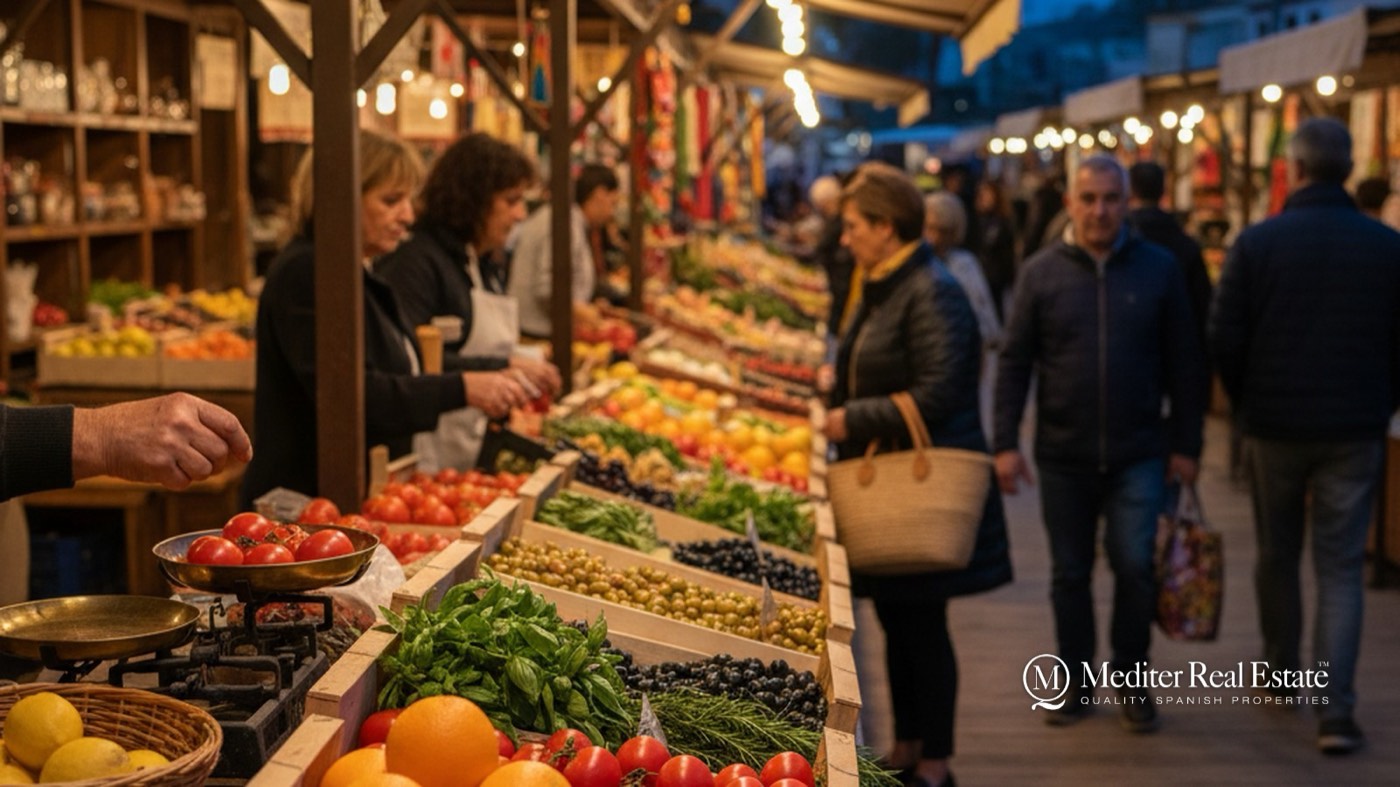
Every one of Mediter's four coasts has its own weekly street market (mercadillo) and year-round indoor market hall (mercado municipalpescaíto), tropical avocado and mango; and the Costa Almería grows a vast share of Europe's winter salad vegetables under glass. Below we map the markets, the signature produce and the real food culture of each coast so you can picture your weekly routine before you own a home there.
Because food is the part of coastal life you'll touch every single day, and it tells you how "Spanish" a town still is. A town with a busy Tuesday mercadillo and a working indoor market usually has a real resident community, not just a seasonal strip of holiday lets. Food shopping is also a line in your monthly budget: eating from markets and local shops is one of the reasons the Spanish coast still works out cheaper than northern Europe, as we set out in our cost of living on Spain's costas 2026 guide. If you're still weighing areas against each other, pair this with our Costa Blanca vs Costa del Sol comparison.
The Costa Blanca, the Alicante coast and the inland Vega Baja, is rice-and-citrus country. This is the home of the paella tradition and the many rice dishes of the region (arroz a banda, arroz del senyoret), fed by the citrus groves and market gardens of the Segura valley. Salt from the Torrevieja and Santa Pola salt lakes has cured fish here for centuries, which is why salazones (salt-cured tuna, mojama, dried roe) sit on every market counter.
Weekly street markets are the rhythm of the week in towns like Torrevieja, Orihuela Costa, Guardamar del Segura and Santa Pola, each has its own day, so expats quickly learn a little circuit. If you're researching a specific town, our area guides for Torrevieja, Guardamar del Segura and Santa Pola describe daily amenities alongside current prices.
The Costa Cálida (Murcia) calls itself the "Huerta de Europa", the market garden of Europe, and with good reason: the Segura basin and the Campo de Cartagena grow an enormous volume of peppers, tomatoes, lemons, artichokes and melons. For a food-loving buyer this is one of the most rewarding coasts, because the produce travels only a few kilometres from field to market stall.
Murcia city's covered market and the weekly mercadillos of towns along the Mar Menor are packed with this huerta produce, plus the region's famous caldero (a rice-and-fish dish of the Mar Menor), michirones (broad bean stew) and local Jumilla and Bullas wines inland. Buyers who like a quieter, more authentically Spanish coast often end up here, see how the numbers stack up in our Costa Cálida and Almería buy-to-let yields guide, and note the holiday-home running costs in our Costa Cálida holiday home taxes (IBI & Modelo 210) piece.
Andalusian to the core, the Costa del Sol runs on pescaíto frito (lightly fried fresh fish), espetos (sardines skewered and grilled over driftwood on the beach), gazpacho and salmorejo in summer, and jamón and fino sherry all year. Málaga's historic Mercado Central de Atarazanas is one of Spain's finest market halls, and every town from Estepona to Benalmádena keeps its own indoor market and weekly street market.
What surprises many buyers is the tropical farming of the Axarquía just east of Málaga: Spain grows avocados, mangoes and custard apples (chirimoya) here thanks to the microclimate. If the Costa del Sol is on your shortlist, our guides to Estepona and Benalmádena cover daily life and local amenities in detail.
Yes, profoundly. The Campo de Níjar and El Ejido form one of the largest greenhouse farming areas in the world, the "mar de plástico" (sea of plastic), supplying a very large share of Europe's winter tomatoes, peppers, cucumbers and courgettes. For a resident this means produce is astonishingly cheap and fresh, and the inland economy is agricultural rather than touristic, which keeps property prices among the lowest of the four coasts.
On the coast itself, the fishing ports of the Cabo de Gata and Almería city deliver red prawns (gambas de Garrucha are prized nationally), while the inland pueblos blancos keep a slower, traditional food culture built around pork, bread and local wine. If an authentic village base appeals, read our Costa Almería pueblo blanco buyer's guide.
At a glance, here is what defines each coast's table and its market rhythm. Market days vary town by town, so always confirm locally, but the signature produce below is reliable year after year.
| Coast | Region | Signature produce | Classic dishes | Market style |
|---|---|---|---|---|
| Costa Blanca | C. Valenciana | Citrus, rice, artichokes, salt-cured fish | Paella, arroz a banda, fideuà | Big weekly mercadillos + indoor halls |
| Costa Cálida | Murcia | Peppers, tomatoes, lemons, melons | Caldero, michirones, zarangollo | Huerta-fed markets, very fresh |
| Costa del Sol | Andalucía | Fresh fish, avocado, mango, jamón | Pescaíto frito, espetos, gazpacho | Grand market halls (Atarazanas) + street markets |
| Costa Almería | Andalucía | Greenhouse salad veg, red prawns | Gurullos, trigo, fresh seafood | Cheapest produce, agricultural economy |
Most residents end up using a mix: the weekly street market for fruit, vegetables and the odd bargain, the indoor mercado municipal for fish, meat and cheese, a Spanish supermarket (Mercadona, Consum, Aldi, Lidl) for the weekly shop, and small specialist shops (fruterías, panaderías, carnicerías) for daily bits. International supermarkets like Iceland and specialist British shops exist across the Costa Blanca South and parts of the Costa del Sol for homesick staples, usually at a premium.
Mediter has 8,393 properties for sale today across Costa Blanca South, Costa Blanca North, Costa Cálida, Costa del Sol, Costa de Almería and Mallorca, which is exactly why food culture is worth thinking about before you choose a coast. In the Costa Blanca South, many of our towns, Torrevieja, Orihuela Costa, Guardamar, Rojales, San Miguel de Salinas, sit within a short drive of each other, so you can genuinely tour a different weekly market every day while house-hunting. Browse all our properties for sale or the areas we cover to match a coast's food culture to your budget.
It can tip a close decision. If you want the richest restaurant and market scene with tropical produce, the Costa del Sol around Málaga leads. If you want the freshest, cheapest fruit and vegetables and a working-Spanish feel, the Costa Cálida and Costa Almería win. The Costa Blanca sits in between, big established market towns, strong rice-and-citrus traditions, and the widest international-food availability for expats who want a soft landing. Whatever you choose, build a weekend market visit into any viewing trip; it tells you more about a town than a show home does. When you're ready to turn a taste of life into an actual purchase, our non-resident buyer's guide 2026 walks you through the process.
Generally yes for fresh fruit and vegetables, street markets (mercadillos) on all four coasts are often noticeably cheaper than the international supermarkets, especially for in-season produce. Prices are best near the end of the morning. Bring cash, as many stalls don't take cards.
The Costa Almería and Costa Cálida, because they are major agricultural regions, Almería's greenhouses and Murcia's huerta grow produce that reaches local markets within hours, keeping prices low. The Costa del Sol's tourist towns tend to be the dearest.
Yes. The Costa Blanca South and parts of the Costa del Sol have the widest choice, including British supermarket chains and international aisles in mainstream supermarkets. Expect to pay a premium versus local Spanish products.
Costa Blanca: rice dishes such as paella and arroz a banda. Costa Cálida: caldero (Mar Menor rice and fish). Costa del Sol: pescaíto frito and beach-grilled espetos. Costa Almería: fresh seafood and inland wheat-and-pork dishes like gurullos.
Weekly market days usually stay the same all year, but some stalls thin out in the quietest winter weeks in very seasonal resort towns. Indoor market halls (mercados municipales) stay open year-round. Always confirm the day with your local town hall or a neighbour.
The best way to know whether a town feels like home is to shop its market, eat its local dish and watch its daily life, then look at the homes for sale around it. Mediter Real Estate covers the Costa Blanca, Costa Cálida, Costa del Sol and Costa Almería, and we'll happily plan viewings around the local markets so you experience the real thing. Contact us at info@mediter.com or +34 744 719 499 to start your search.
Det du fortæller os her, bruger vi kun til at svare dig. Privacy
Vi bruger cookies, som siden har brug for for at virke. Med dit samtykke bruger vi også cookies fra Meta (Facebook) til at måle vores annoncer og vise dig boliger, der ligner dem, du har set på. Cookies fra Google Analytics, også kun med dit samtykke, tæller besøg og viser os, hvilke sider der hjælper.
Cookiepolitik