 Written by Nicki Price, CEO
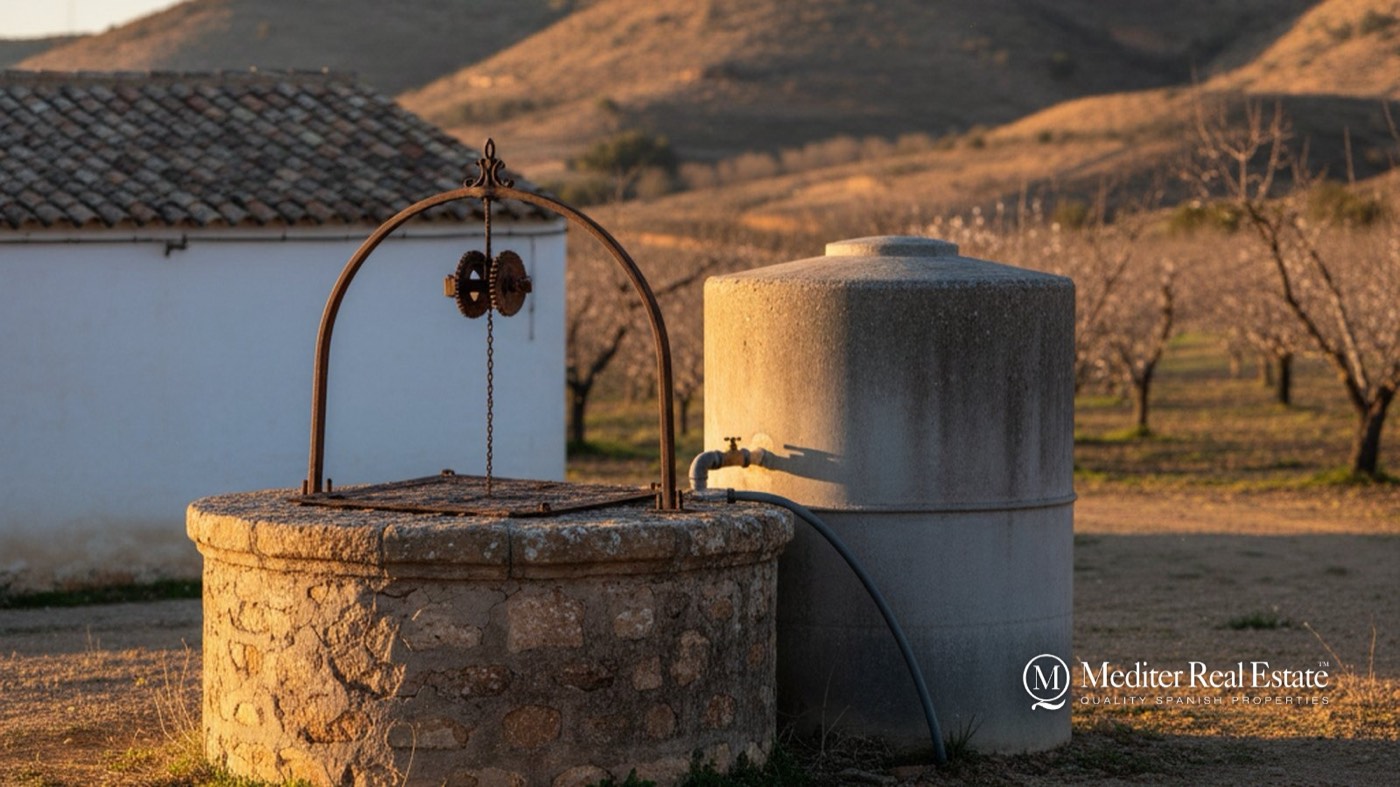
If a Costa Cálida property relies on a private well (pozo) or a shared water deposit (depósito or aljibe) instead of the mains, the key question is whether that water supply is legally registered. In inland Murcia a private well is only legal if it holds a water concession or registration from the Confederación Hidrográfica del Segura (CHS), and a shared deposit needs a documented agreement between the owners it serves. Before you buy, make your lawyer confirm the well or deposit is registered with the CHS and that your rights to it are written into the deeds, an unregistered borehole can be fined and cannot be legalised retroactively on much rural land.
This is one of the most common surprises on inland Costa Cálida sales around Fuente Álamo, Mazarrón, Totana and the Guadalentín valley, where mains water simply does not reach many fincas. Below is exactly what to check, what the different supply types mean for you, and how it affects the price you should pay.
Because the Costa Cálida is one of the driest regions in Europe and much of its rural land was never connected to a municipal network. Inland Murcia, the Guadalentín valley, Fuente Álamo, Campo de Cartagena and the hills behind Mazarrón, is dominated by agricultural land where farmers sank boreholes for irrigation long before anyone built a villa there. When a plot sits on suelo rústico (rural land) far from a town, the mains pipe often stops a kilometre or more away, so the house depends on a private well, a tanker-filled deposit, or a shared supply between neighbours.
This pattern repeats on the Costa Almería (the Almanzora valley, Arboleas, Albox), on the inland Costa Blanca around Hondón and Pinoso, and on parts of the Costa del Sol's rural hinterland. If you are weighing rural against urban plots, our guide to suelo rústico vs urbano on the Costa Blanca explains why the land classification governs almost everything, including water.
There are four you will meet in practice, and they are not equally safe to buy. In short: a mains connection is the gold standard; a well with a CHS concession is fine if the paperwork is in order; a shared deposit works if there is a written agreement; and a tanker-filled deposit is legal but adds running cost and hassle.
| Supply type | What it is | Key document to verify | Buyer risk |
|---|---|---|---|
| Municipal mains (agua potable de red) | Connected to the town network | Water bill / contract with the supplier | Low |
| Private well (pozo / sondeo) | Borehole drawing groundwater | CHS concession or registration (concesión / inscripción de aguas) | High if unregistered |
| Shared deposit (depósito comunitario) | Tank serving several homes, fed by a well or tanker | Written sharing agreement + deeds reference | Medium, disputes & upkeep |
| Aljibe / tanker fill (cuba) | Storage tank refilled by water lorry | Supplier invoices; tank capacity & access | Low legally, higher running cost |
Mediter's deeper reference piece on rural property water in Spain: boreholes and connections walks through how each is set up; this article focuses on the legal rights that transfer to you when you buy.
Only if it is registered with the Confederación Hidrográfica del Segura, the basin authority that governs water across almost all of Murcia and the southern Costa Blanca. Spanish water belongs to the public domain under the Ley de Aguas (the consolidated Real Decreto Legislativo 1/2001), so you do not "own" groundwater simply because the well is on your land, you hold a right to use it, and that right must come from the CHS.
Two categories matter:
An unregistered borehole is an administrative offence. The CHS can impose sanctions and order it sealed, and crucially it cannot always be legalised later, on an over-exploited aquifer the authority may simply refuse new rights. Never assume "everyone round here has one" means yours is safe. On the Costa Almería the equivalent body is the Confederación Hidrográfica del Sur / Demarcación Hidrográfica, and on the Andalucían Costa del Sol it falls under the regional water administration, the same principle applies everywhere.
Your lawyer should confirm, in writing, that the water right exists and transfers to you. The due diligence runs in parallel with the standard property checks. Start with the nota simple from the Registro de la Propiedad to see what the land is and whether any easement (servidumbre) for a pipe or shared tank is recorded.
Where a borehole, septic tank and structure all need checking, a full structural survey is money well spent on an older rural property.
A shared deposit is legal when the owners it serves have a written agreement setting out who pays for what and who has the right to use the water, relying on a handshake is where disputes begin. On inland Murcia and Almería urbanisations it is common for several villas to draw from one tank fed by a communal well or refilled by tanker.
What you want to see documented:
If the deposit is purely informal, "the owner next door lets us fill up", treat it as a serious risk. That right can disappear the day the neighbour sells.
Running costs are the hidden figure. A private well means paying for the pump's electricity and periodic maintenance; a tanker-filled deposit means buying water by the load, which adds up over a dry Costa Cálida summer, especially with a pool and garden. A legal, registered well generally adds value; an unregistered one should pull the price down because you are inheriting a problem.
Use the uncertainty as a negotiating point. If the water situation is murky, factor the cost of legalisation (or of bringing in an alternative supply) into your offer, our price-negotiation guide explains how to turn a defect into a discount. Remember too that the purchase tax base is the higher of the price or the Catastro's valor de referencia, so a low price does not automatically mean low tax.
A resale rural property on the Costa Cálida (Región de Murcia) carries transfer tax (ITP) of 7.75% under Ley 3/2025, note the old 8% figure still shown on many websites is out of date. A new build instead pays 10% IVA plus 1.5% AJD stamp duty in Murcia. On top sit the usual costs: notary (~0.2-0.5%), Registro de la Propiedad (~0.1-0.25%), lawyer (~1% + IVA) and a gestoría (~€300), so budget roughly 10-13% over the price for a resale.
| Region | Autonomous community | Resale ITP |
|---|---|---|
| Costa Cálida | Región de Murcia | 7.75% (Ley 3/2025) |
| Costa Blanca | Comunidad Valenciana | 9% from 1 June 2026 (Ley 5/2025); 11% above €1M |
| Costa del Sol | Andalucía | 7% |
| Costa Almería | Andalucía | 7% |
For the ongoing bills once you own, IBI, rubbish, and the non-resident tax via Modelo 210, see our Costa Cálida holiday-home taxes guide.
Mediter currently has 9,749 properties across the Costa del Sol, Costa Blanca South, Costa Cálida, Costa Blanca North, Costa de Almería and Mallorca. Rural homes with private wells and shared deposits sit mostly in our Costa Cálida and Costa de Almería inland stock, while the bulk of our Costa Blanca South listings around Torrevieja, Orihuela Costa and Pilar de la Horadada are on mains supply, a useful contrast if independent water sounds romantic but you would rather avoid the paperwork.
Sometimes, but not always. You would apply to the Confederación Hidrográfica del Segura for a concession, and on an over-exploited aquifer the authority can refuse. Never buy on the assumption that legalisation is a formality, treat an unregistered well as potentially unfixable until the CHS confirms otherwise.
Not automatically. The right must be attached to the property and the transfer documented. If the concession is held personally by the seller or by a neighbouring farm, you could complete the purchase and find you have no legal right to the water. Have your lawyer confirm the transfer before signing the escritura.
Not without testing. Groundwater quality varies hugely across inland Murcia and Almería, and some wells are suitable only for the garden and pool. Commission a potability test and, if needed, budget for a filtration or treatment system before using it for drinking.
The notary records the sale, and any water concession, easement or sharing agreement should be referenced in the escritura you sign. Our guide to notary and completion day explains the sequence; make sure your water rights are not left as a loose end to sort out afterwards.
The principle is identical everywhere, groundwater is public, so a well needs a registered right from the relevant basin authority, and a shared deposit needs a written agreement. The difference is which body you deal with: the CHS for Murcia and southern Alicante, and the Andalucían and Sur basin administrations for Almería and the Costa del Sol.
Water rights make or break the value of a rural property, and the paperwork is not something to take on trust. Mediter Real Estate works across the Costa Blanca, Costa Cálida, Costa del Sol and Costa Almería and can help you check that a well or shared deposit is properly registered before you commit. Contact our team to discuss a specific property or to see rural and mains-supplied homes that match what you need.
We use what you tell us here only to answer you. Privacy
We use cookies the site needs to work. With your OK we also use Meta (Facebook) cookies to measure our ads and show you homes like the ones you looked at. Google Analytics cookies, also only with your OK, count visits and show us which pages help.
Cookie policy