 Written by Nicki Price, CEO
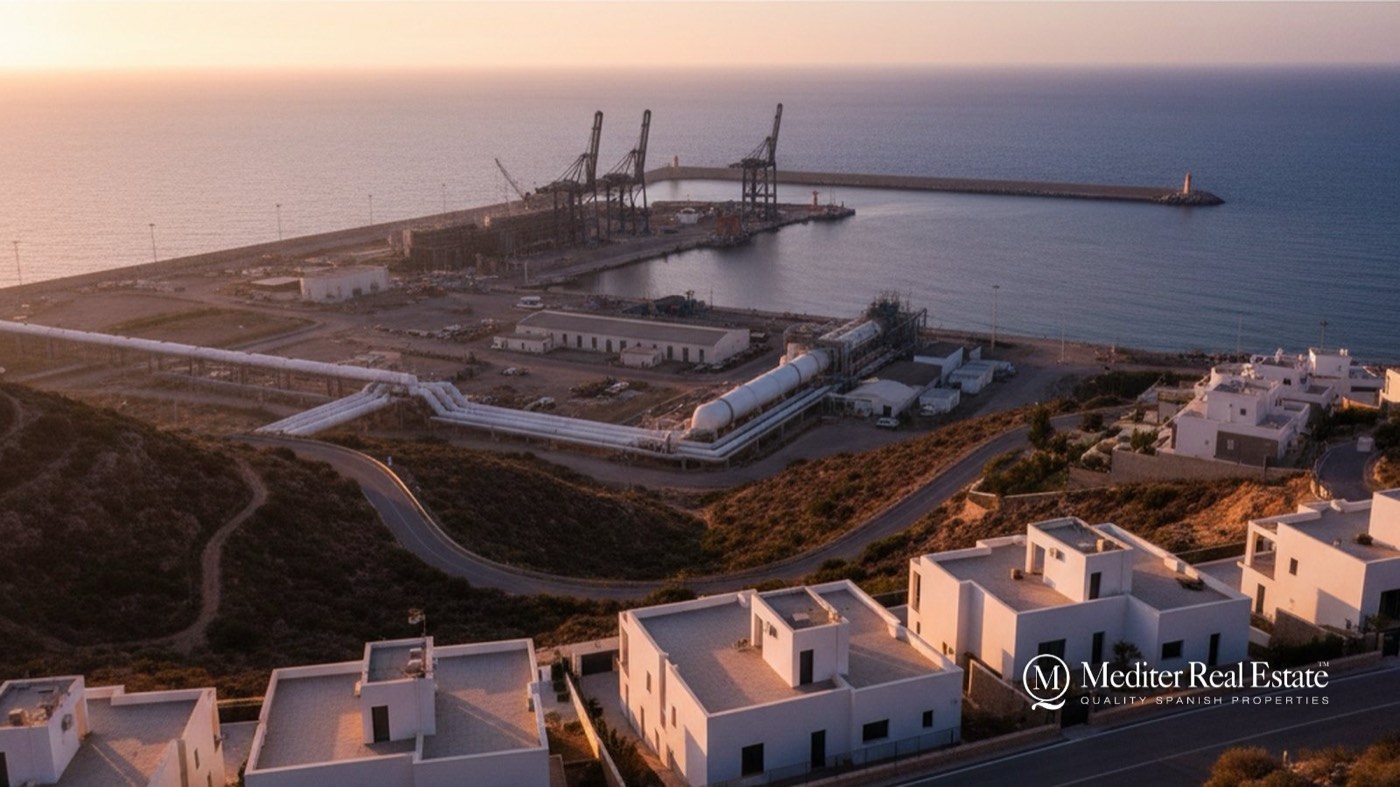
Can you safely buy a home near a desalination plant, fishing port or industrial estate on the Costa Almería? Yes, but only after you check what the land next door and across the valley is zoned for, because the price you pay may already reflect a nuisance (noise, smell, HGV traffic, light pollution) or a future one. The single most important document costs a few euros: the municipal PGOU (Plan General de Ordenación Urbana), which tells you whether neighbouring plots are suelo industrial, portuario or protected. Do that before you sign any arras, and budget the usual Andalucía buying costs on top of the price, 7% ITP on a resale and roughly 10-13% all-in.
The Costa Almería is Spain's great contradiction: some of the cleanest, emptiest beaches in the country (Cabo de Gata, Mojácar, Vera) sit a short drive from Europe's largest greenhouse farming belt, the port of Almería, and strategic desalination plants that keep the whole arid province supplied with water. Both realities can be within sight of the same hillside. This guide walks you through the surroundings checks that protect you, and they apply equally on the Costa Blanca, Costa Cálida and Costa del Sol.
Because Almería's economy is built on things that need space, water and lorries. The province grows a huge share of Europe's winter vegetables under plastic, exports them through its port, and depends on desalination because rainfall is among the lowest in Spain. That means working infrastructure, ports, packing plants, polytunnels and desal facilities, sits closer to residential and tourist areas than it does on the more purely leisure-driven stretches of the Costa del Sol or Costa Blanca North.
None of this makes the Costa Almería a bad place to buy; the value-for-money and the scenery are exactly why many of our clients choose it. It simply means the gap between a beautiful listing photo and the reality next door can be wider here, so the due diligence is non-negotiable. If you are weighing it against other regions, our comparison of the four coasts puts the trade-offs side by side.
The honest answer is that each facility carries a different profile, and a 500-metre difference in distance can change everything. Here is how the main risks break down.
| Facility | Main concerns | What to check |
|---|---|---|
| Desalination plant (e.g. Carboneras, Rambla Morales) | Low-frequency hum from pumps, brine discharge pipelines, occasional odour, large outfall structures | Distance to plant and to the brine outfall; prevailing wind; whether the plant is expanding |
| Fishing/commercial port (Almería, Garrucha, Carboneras) | Early-morning activity, HGV and crane noise, fuel/fish smell, light at night, dust from bulk cargo | Working hours, type of cargo, port expansion plans in the PGOU and port authority plans |
| Industrial/polígono estate | Lorry traffic, packing-plant noise, chemical or organic smell, visual impact | Zoning of adjacent plots, permitted industrial categories, hours of operation |
| Greenhouse (invernadero) belt | Plastic glare, agrochemical smell, irrigation and pesticide activity, seasonal labour traffic | Whether neighbouring rústico land is actively farmed or zoned for greenhouses |
Smell and noise travel on the wind, so a plant that is invisible in a listing photo can still reach a terrace two kilometres away on the wrong afternoon. Visit at different times of day and, if you can, in different seasons.
Two documents do most of the work: the municipal PGOU and the nota simple from the Registro de la Propiedad. The nota simple tells you who owns the plot you are buying and whether it carries charges; our guide to the nota simple explains how to read it. But the nota simple describes your plot, it will not tell you that the field opposite is earmarked for a logistics warehouse. For that you need the planning layer.
On rural plots the distinction between suelo rústico and urbano matters doubly, because rústico land next door can legally host greenhouses, farm buildings or even, with the right permit, infrastructure. If the home itself is a rural build, read our AFO certificate guide too.
There is no single national "buffer distance" that guarantees peace. What governs you instead is a mix of the municipal PGOU setbacks, the environmental authorisation's noise limits, and, right on the shore, the Ley de Costas (Ley 22/1988) public-domain and setback zones, which also apply to port and outfall infrastructure. Our guides to Ley de Costas setback zones and coastal flood and Ley de Costas risk cover the seafront side of this in detail.
In practice, treat distance as a spectrum rather than a line. A home that is noticeably cheaper than comparable properties a kilometre away is often priced for a reason the photos don't show. Ask your lawyer to confirm, in writing, the classification and any live planning applications on every plot within line of sight and earshot.
It can cut both ways. A working port like Garrucha gives a town life, jobs and a fish market that buyers love; a bulk-cargo quay with dust and night lighting a few streets away is a different matter. For holiday lets, guests rate quiet and views above almost everything, so a desal hum or lorry route can dent your reviews and therefore your yield, worth modelling before you count on rental income (see our buy-to-let yields guide for the Costa Cálida and Almería).
On resale, the key risk is a future change you didn't foresee: a port expansion, a new polígono, or greenhouses creeping towards your plot. That is why the planning check protects not just your enjoyment but your exit price.
Costa Almería sits in Andalucía, so the transfer tax is among the lowest on the Spanish Mediterranean. Crucially, the tax base is the higher of the agreed price or the official valor de referencia published by the Catastro, if you negotiate hard on a "nuisance discount", the tax may still be calculated on the reference value, not your lower price, so check it before you sign.
| Region | Resale ITP | New build | Rough all-in on top of price |
|---|---|---|---|
| Costa Almería (Andalucía) | 7% | 10% IVA + 1.2% AJD | Resale ~10-12% · New ~12-13% |
| Costa del Sol (Andalucía) | 7% | 10% IVA + 1.2% AJD | Resale ~10-12% · New ~12-13% |
| Costa Cálida (Murcia) | 7.75% (Ley 3/2025) | 10% IVA + 1.5% AJD | Resale ~11-13% · New ~13-14% |
| Costa Blanca (C. Valenciana) | 9% from 1 June 2026 (Ley 5/2025; 11% above €1M) | 10% IVA + 1.4% AJD | Resale ~11-13% · New ~13-15% |
On top of the tax, budget notary ~0.2-0.5%, land registry ~0.1-0.25%, a lawyer at ~1% + IVA (money very well spent on a surroundings check) and a gestoría around €300. For the Costa Blanca, remember the 9% rate depends on the signing date at the notary, not the arras date, our notary and completion day guide explains why.
For a buyer who is new to the process, this slots into the wider non-resident buying process, and if you are financing, a lender's own valuation (tasación) will often flag industrial proximity too.
Across our stock today we list 9,402 properties on the Spanish Mediterranean, including the Costa de Almería alongside Costa Blanca, Costa Cálida, Costa del Sol and Mallorca. Because we publish honest area guides rather than just photos, our team can tell you which listings sit near working infrastructure and which don't, and we would rather lose a sale than let you buy a hum you can't live with. Contact us for the straight answer on any specific property.
Yes, where the PGOU zones that land as residential. Desalination plants operate under an environmental authorisation from the Junta de Andalucía that sets noise and discharge limits, but there is no single national buffer distance, the municipal plan and the authorisation conditions govern how close homes can be.
Ask the ayuntamiento for the planning classification (calificación urbanística) of that plot, or request a cédula urbanística. The free Catastro viewer shows current land use. The nota simple from the Registro de la Propiedad only describes the plot you are buying, not the surroundings.
It depends on the type and distance. A lively fishing port can add value; dust, HGV routes, night lighting and future expansion can reduce it and hurt holiday-let reviews. The main risk is an unforeseen future change, which is exactly what the PGOU check guards against.
Not necessarily. ITP in Andalucía (7%) is charged on the higher of the price or the Catastro valor de referencia. If you negotiate a low price because of a nuisance, the tax may still be calculated on the reference value, so confirm that figure before signing.
The municipal PGOU planning classification of neighbouring plots. It is the only document that tells you whether the land around you is residential, industrial, portuario or protected, and whether that could change.
If you are considering a home on the Costa Almería, or anywhere on the Costa Blanca, Costa Cálida or Costa del Sol, let us run the surroundings checks with you before you sign anything. We will tell you honestly what sits next door and what the planning maps show. Contact Mediter Real Estate at info@mediter.com or +34 744 719 499 to find the right property, with no unwelcome surprises.
We use what you tell us here only to answer you. Privacy
We use cookies the site needs to work. With your OK we also use Meta (Facebook) cookies to measure our ads and show you homes like the ones you looked at. Google Analytics cookies, also only with your OK, count visits and show us which pages help.
Cookie policy