 Skrevet af Nicki Price, CEO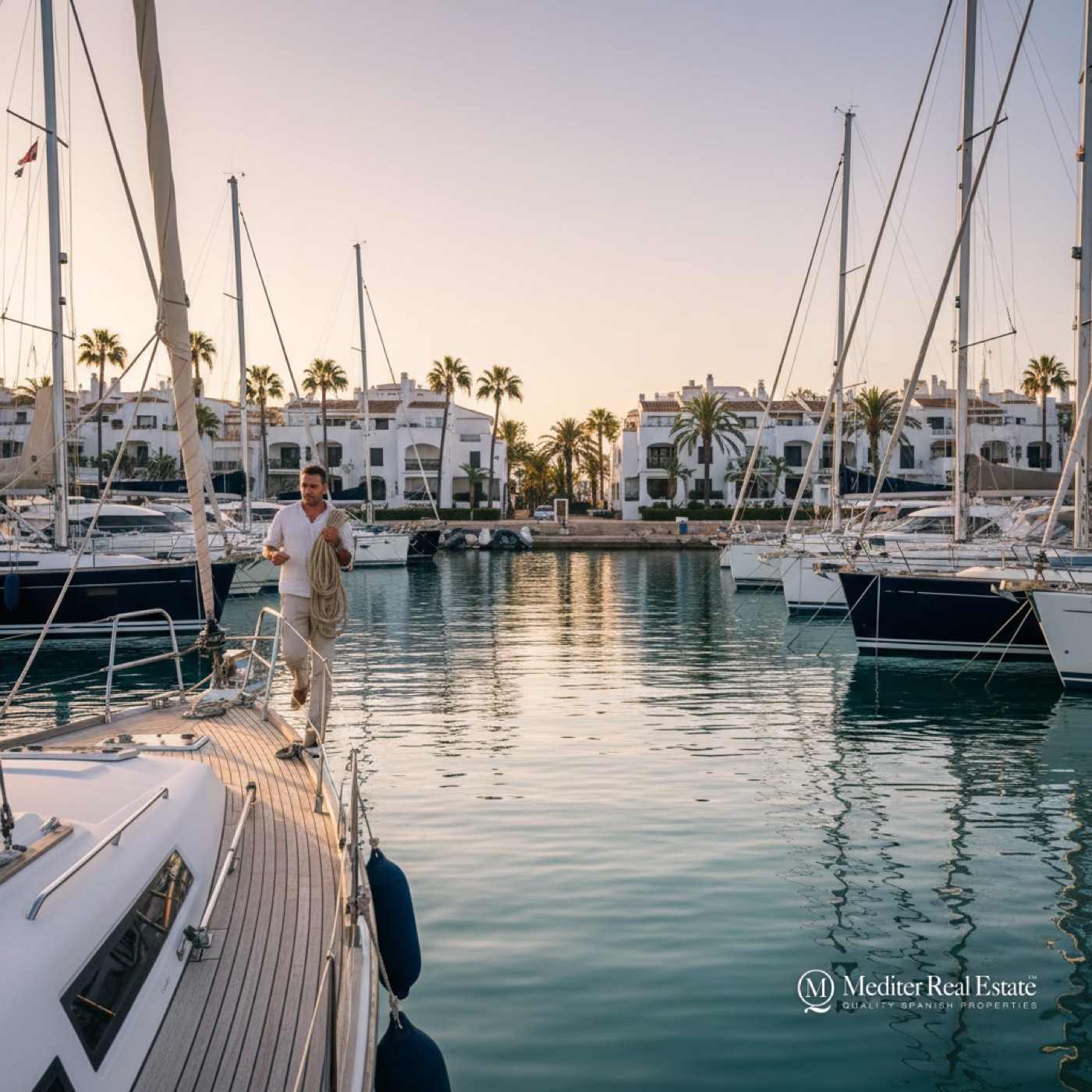
If you dream of stepping off your terrace, walking five minutes to a pontoon and casting off into the Mediterranean, the Costa Blanca and Costa Cálida are two of the best-value places in Europe to make it happen. A permanent annual berth for a mid-sized yacht (around 10–12 metres) typically runs from roughly €2,500 to €7,000 per year on the Costa Blanca and Costa Cálida, rising to €8,000+ at the most prestigious Costa del Sol marinas such as Puerto Banús. Buying the boat is the easy part — securing the right berth, registering the vessel and understanding the running costs is where planning pays off.
This guide gives you the practical numbers first: what a marina berth actually costs across the four costas Mediter covers (Costa Blanca, Costa Cálida, Costa del Sol and Costa Almería), how to buy and register a boat as an expat, and why the Mar Menor makes the Costa Cálida one of Europe's finest cruising and learn-to-sail grounds. We finish with the waterfront property angle — because the smartest buyers match the home to the mooring, not the other way round.
Berth pricing depends on three things: the length overall (LOA) of your boat, the beam (width), and the marina's prestige and facilities. Prices are usually quoted per year for a permanent berth, or per day/week for transit. Rates below are typical 2026 guide figures for annual private-use berths — always confirm directly with the marina, as availability drives the price more than any published list.
| Region / example marinas | 8 m | 10–12 m | 15 m+ |
|---|---|---|---|
| Costa Blanca (Alicante, Dénia, Torrevieja, Marina Greenwich) | €1,800–3,000 | €3,000–6,000 | €7,000–14,000 |
| Costa Cálida (Mar Menor, Cartagena, Mazarrón, San Pedro) | €1,500–2,800 | €2,500–5,500 | €6,000–12,000 |
| Costa Almería (Almerimar, Aguadulce, Garrucha) | €1,600–2,900 | €2,800–5,500 | €6,500–12,000 |
| Costa del Sol (Marbella, Benalmádena, Estepona, Puerto Banús) | €2,500–4,500 | €4,000–9,000 | €10,000–25,000+ |
Beyond the annual fee, budget for:
Some Spanish marinas sell long concessions (typically 20–35 years, occasionally longer) rather than freehold — because the seabed is public maritime domain under the Ley de Costas, you never truly own it outright. A transferable concession for a 12 m berth can cost anywhere from €25,000 to well over €100,000 on the Costa del Sol, considerably less on the Costa Cálida. If you buy a waterfront home with a berth "included", confirm whether it is an owned concession, a lease attached to the property, or simply a priority right to rent. This distinction affects value and resale — the same due-diligence mindset you would apply to any Spanish title, which is exactly why a specialist real estate lawyer is worth their fee.
The Costa Blanca coastline from Dénia down to the Mar Menor is dotted with sheltered ports and modern marinas. Highlights include:
The Costa Blanca's appeal is the combination of reliable sailing weather, short cruising hops between ports, and a huge English- and German-speaking boating community. For the wider lifestyle picture, our complete Costa Blanca guide for 2026 covers living costs, climate and the best towns.
The Mar Menor is Europe's largest saltwater lagoon — around 170 km² of shallow, warm, wind-blessed water separated from the Mediterranean by the narrow La Manga strip. For sailors it is close to ideal:
Note that the Mar Menor is also a protected and ecologically sensitive lagoon; environmental regulations on the surrounding land and water can be strict, so if you are buying nearby it is worth understanding local Ley de Costas setback zones and coastal flood risk before you commit. For the tax side of a lagoon-side holiday home, see our guide to Costa Cálida holiday-home taxes.
South of the Mar Menor, the historic naval city of Cartagena offers a superb natural harbour and a modern marina in the heart of a Roman-era port. From here, and from Mazarrón and Águilas, you reach dramatic, less-developed coastline stretching toward Costa Almería — some of the quietest cruising grounds on the Spanish Mediterranean.
Buying a boat as a foreign resident is straightforward, but the paperwork and taxes catch people out. The essentials:
A practical tip: buying a used, EU-VAT-paid boat already lying in a Spanish marina — ideally with an existing berth contract — sidesteps the biggest tax and import headaches and often comes with the mooring you actually want.
The most sought-after coastal homes fall into three broad types, each with a different relationship to the water:
| Type | What you get | Typical location |
|---|---|---|
| Marina-front apartment | Berth walking distance, restaurants below, easy lock-up-and-leave | Alicante, Dénia, Torrevieja, Tomás Maestre |
| Canal / mooring villa | Private pontoon at the garden's edge | Selected La Manga & Mar Menor developments |
| Sea-view home near a port | Coastal views, short drive to a berth | Altea, Jávea, Los Alcázares, Cartagena |
Marina-front apartments usually sit within an urbanisation or comunidad, so factor in community fees — pontoons, dredging and shared facilities can push these higher than an inland flat. If the property is beachfront or right on the water, run through our beachfront buying checklist and confirm the coastal-domain position before signing.
Purchase taxes vary by region, and the correct 2026 rates matter — plenty of websites still quote the old ones:
| Region | Resale ITP | New build |
|---|---|---|
| Costa Blanca (C. Valenciana) | 9% (from deeds signed 1 June 2026; 11% above €1M) | 10% IVA + 1.4% AJD |
| Costa Cálida (Murcia) | 7.75% | 10% IVA + 1.5% AJD |
| Costa del Sol & Costa Almería (Andalucía) | 7% | 10% IVA + 1.2% AJD |
Two things to remember. First, the tax is calculated on the higher of the purchase price or the cadastral valor de referencia — if the reference value exceeds your price, you pay tax on the reference value. Second, add roughly 10–13% on top of a resale price and 12–15% for a new build once you include notary (~0.2–0.5%), land registry (~0.1–0.25%), lawyer (~1% + IVA) and gestoría (~€300). The lower end applies in Andalucía, the higher end in Valencia. On the Costa Blanca, note the signing rule: it is the notary signing date, not the arras date, that sets whether the new 9% rate applies.
If you are weighing regions, our comparison of the four costas is a useful starting point, and non-residents should read our guides to buying as a non-resident and non-resident mortgages.
Owning a boat is a lifestyle choice, not an investment — running costs are real and berths in the top marinas hold their value better than boats do. But the Costa Blanca and Costa Cálida remain remarkably good value against the French Riviera or the Balearics, with milder winters that keep boats in the water most of the year. If you sail only in summer, chartering or joining a sailing club on the Mar Menor can deliver most of the pleasure for a fraction of the cost. Whichever route you choose, factor mooring availability into the property search from day one — a home with a secured berth is far rarer, and more valuable, than the home alone.
For a typical 10–12 m yacht, expect roughly €3,000–6,000 per year on the Costa Blanca, or €2,500–5,500 on the Costa Cálida. Prices rise sharply for larger boats and prestige marinas, and all fees carry 21% IVA. Availability, more than any price list, determines what you actually pay.
Spain recognises RYA, ICC and equivalent qualifications for most leisure vessels. Small dinghies can often be sailed without a formal licence, but for a keelboat or motor yacht you will need a valid certificate. Sailing schools on the Mar Menor and in Alicante run recognised courses in English.
A used, EU-VAT-paid boat already in Spain is simplest. New or non-EU boats attract 21% IVA (and possibly import duty), and boats over 8 m used privately by a Spanish resident are generally liable to a 12% matriculation tax. Always take specialist advice before buying a larger vessel.
Yes — canal and marina developments around the Mar Menor, La Manga and several Costa Blanca ports include private or allocated berths. Because the seabed is public maritime domain, confirm whether the berth is an owned concession, a lease tied to the property, or a rental priority, as this materially affects value and resale.
Excellent. Its shallow, sheltered, warm water and consistent afternoon breezes make it one of Europe's best learn-to-sail lagoons, with numerous schools and clubs around Los Alcázares, Santiago de la Ribera and Los Nietos.
Whether you want a marina-front apartment in Alicante, a mooring villa on the Mar Menor or a sea-view home a short walk from a Costa Almería port, Mediter Real Estate can match the property to the boating lifestyle you have in mind — across the Costa Blanca, Costa Cálida, Costa del Sol and Costa Almería. Get in touch with our team to discuss waterfront homes and berth availability in your chosen area.
Det du fortæller os her, bruger vi kun til at svare dig. Privacy
Vi bruger cookies, som siden har brug for for at virke. Med dit samtykke bruger vi også cookies fra Meta (Facebook) til at måle vores annoncer og vise dig boliger, der ligner dem, du har set på. Cookies fra Google Analytics, også kun med dit samtykke, tæller besøg og viser os, hvilke sider der hjælper.
Cookiepolitik