 Skrevet af Nicki Price, CEO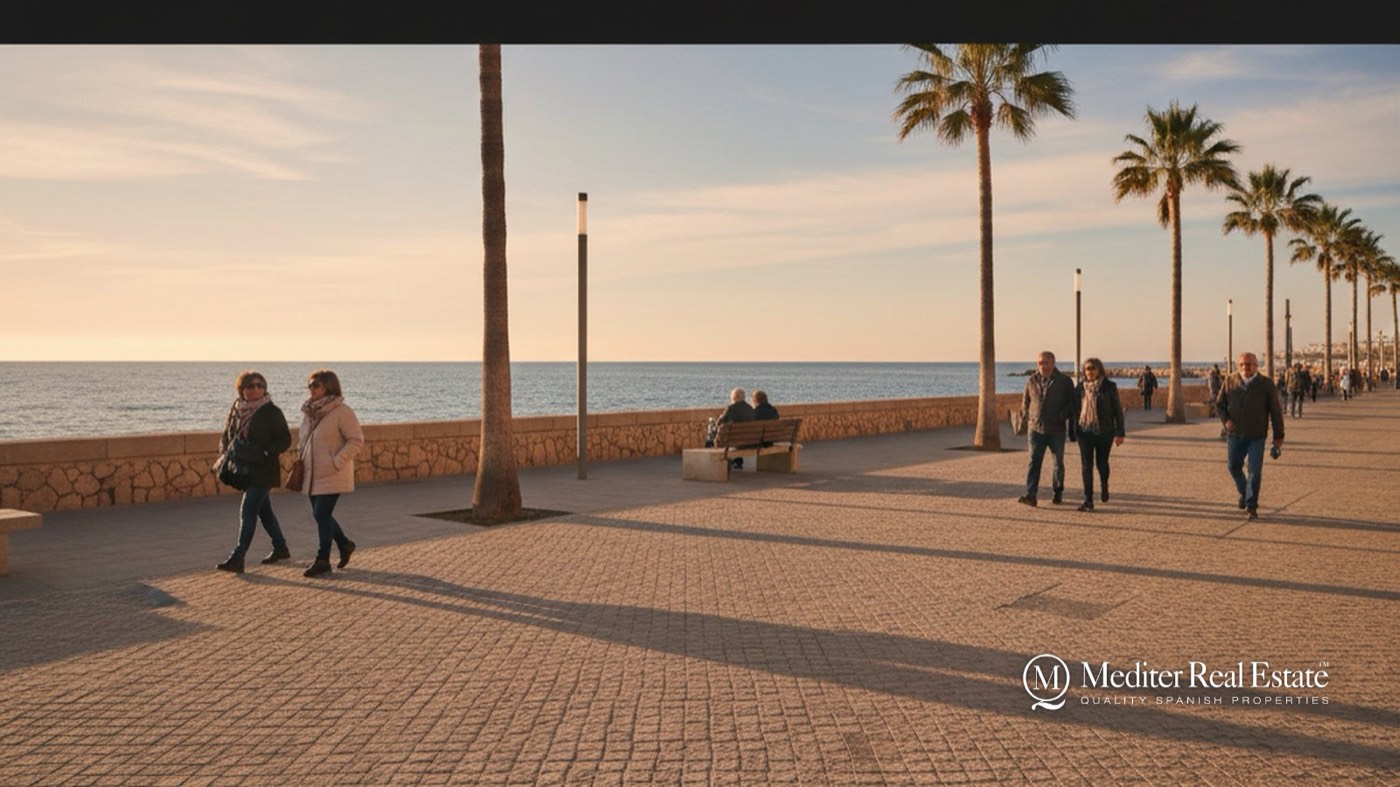
If you plan to live in Spain all year rather than just visit in August, winter is the season that really decides where you should buy. Both the Costa Blanca (Alicante province, Valencian Community) and the Costa Cálida (Murcia) are among the mildest winter climates in mainland Europe, with the southern Costa Blanca around Torrevieja and the Costa Cálida around the Mar Menor sharing a near-identical semi-arid microclimate: roughly 320 days of sunshine, January daytime highs of 16–18°C and very little rain. For year-round living, the practical differences come down to how much damp your specific home suffers, not the headline temperature.
The short answer: for buyers who want the warmest, driest winters, the southern Costa Blanca (Torrevieja to Orihuela Costa) and the Costa Cálida (Mar Menor, Mazarrón) are the strongest picks — both are shielded and semi-arid. The northern Costa Blanca (Dénia, Jávea, Calpe) is a touch greener, wetter and cooler in winter, while Costa Almería further south is arguably the single driest spot of all four coasts. Below we set out the real figures, the damp issue nobody warns you about, and how to choose.
Winter here is genuinely mild, but "mild" varies by 30–40 km. The southern Costa Blanca and the Costa Cálida sit in a rain shadow created by the mountains behind them, which keeps them drier and slightly warmer than the northern Costa Blanca. Here is how the four Mediter coasts compare in the depths of winter.
| Coast | Jan daytime high | Jan night low | Sunshine days/year | Winter rain |
|---|---|---|---|---|
| Costa Blanca (north — Dénia, Jávea) | ~15–16°C | ~6–8°C | ~300 | Moderate; autumn/winter showers |
| Costa Blanca (south — Torrevieja, Orihuela Costa) | ~16–18°C | ~7–9°C | ~320 | Very low; semi-arid |
| Costa Cálida (Mar Menor, Mazarrón) | ~16–18°C | ~7–9°C | ~315–320 | Very low; semi-arid |
| Costa del Sol (Málaga, Marbella) | ~17–18°C | ~8–9°C | ~300+ | Wetter Nov–Feb than the others |
| Costa Almería | ~17–19°C | ~8–10°C | ~320+ | Lowest in mainland Spain |
The headline figures are close, but the felt experience differs. On the southern Costa Blanca and Costa Cálida, a bright January day at 17°C in still air feels shirt-sleeves warm in the sun; the same temperature on the greener northern Costa Blanca can feel cooler because of higher humidity and more cloud. Almería, drier and further south, edges everyone on winter warmth. For a broader lifestyle comparison across all four coasts, see our Costa Blanca vs Costa del Sol four-coast comparison.
This is the single biggest surprise for northern-European buyers, and it is worth more than any temperature chart. Spanish coastal homes are built to keep summer heat out, not winter warmth in. Traditional construction uses solid masonry, single-glazed or basic aluminium windows, terrazzo or tiled floors and often no central heating — so on a 10°C January morning the inside of the house can feel every bit as cold as the outside, and stay cold long after the sun is up.
The result: buyers who dismissed heating as unnecessary in "sunny Spain" end up running electric heaters and racking up bills. When you view in July the property feels blissfully cool. That same feature makes it feel like a fridge in January. Always ask what heating exists, whether there is any insulation, and check the property's energy certificate — a poor rating (E, F or G) is a direct warning of high winter running costs.
Damp is the quiet villain of winter living on both coasts, and it has almost nothing to do with rainfall. It is caused by cold, uninsulated walls meeting humid coastal air. When warm, moist indoor air (from cooking, showering and breathing) hits a cold north-facing wall, it condenses — leaving black mould in corners, behind wardrobes and around window reveals.
Modern new-builds and recently renovated homes with double glazing, thermal breaks in the frames, insulation and aeroterma (air-source) heat pumps are dramatically drier and cheaper to run in winter. This is a real advantage of buying newer stock — weigh it up in our off-plan vs resale comparison. If you are renovating an older property, factor insulation, ventilation and heating into your budget from the outset — see our renovation permits and costs guide.
Rank them for pure winter warmth and dryness and the order is roughly: Costa Almería (driest, warmest) → southern Costa Blanca and Costa Cálida (near-tied, semi-arid, very sunny) → Costa del Sol (warm but noticeably wetter November–February) → northern Costa Blanca (mild but greenest and coolest).
The Costa Cálida's name literally means "the warm coast", and around the Mar Menor lagoon the water moderates temperatures, keeping nights a shade milder. The southern Costa Blanca's Torrevieja area benefits from its salt lakes, which the WHO has historically cited for a healthy, stable microclimate. In practice the difference between these two is small — lifestyle, budget and airport access matter more. Compare access in our airports guide.
| Factor | Costa Blanca | Costa Cálida |
|---|---|---|
| Winter climate | South very dry/warm; north cooler & greener | Uniformly dry, warm, sheltered |
| Off-season community | Large established year-round expat base | Growing but quieter out of season |
| Airport | Alicante (major, year-round routes) | Murcia RMU (smaller, more seasonal) |
| Amenities in winter | Many resorts stay busy year-round | Some coastal spots quieten sharply |
| Resale property tax (ITP) | 9% (from 1 June 2026) | 7.75% |
| Property prices | Slightly higher in prime south | Generally lower entry point |
For most year-round buyers the deciding factors are not the 1–2°C climate gap but community, amenities and cost. The Costa Blanca offers a bigger established expat network that keeps restaurants, clubs and clinics open through winter; the Costa Cálida is quieter and often cheaper to buy into. If you value liveliness in January, lean Costa Blanca south; if you want value and calm, the Costa Cálida is compelling.
Budget realistically for heating. A poorly insulated resale villa can cost €150–€300 a month in electricity across the coldest months if you rely on electric heaters, while a modern, well-insulated apartment with a heat pump may cost a fraction of that. Community fees, IBI and general living costs also vary by region — see our coastal cost-of-living guide and community fees explained.
Whichever coast you choose, factor transaction costs on top of the purchase price. The single biggest line is the transfer or VAT charge, and the tax base is the higher of your purchase price or the cadastral "valor de referencia" — a point many competitor articles miss and one that can push your bill above expectations.
| Coast | Resale ITP | New build |
|---|---|---|
| Costa Blanca (C. Valenciana) | 9% (deeds signed from 1 June 2026; 11% above €1M) | 10% IVA + 1.4% AJD |
| Costa Cálida (Murcia) | 7.75% | 10% IVA + 1.5% AJD |
| Costa del Sol & Costa Almería (Andalucía) | 7% | 10% IVA + 1.2% AJD |
Add notary (~0.2–0.5%), land registry (~0.1–0.25%), lawyer (~1% + IVA) and gestoría (~€300). As a rule of thumb, budget roughly 10–13% on top of the price for a resale and 12–15% for a new build — the lower end in Andalucía, the higher end on the Costa Blanca. Note that the Costa Blanca's ITP drop to 9% depends on the notary signing date from 1 June 2026, not when you signed the arras. Non-residents should also read our guides to buying as a non-resident and the NIE number.
They are almost identical in the southern Costa Blanca (Torrevieja) and the Costa Cálida (Mar Menor), both around 16–18°C by day in January. The northern Costa Blanca (Dénia, Jávea) is slightly cooler and greener. Costa Almería is marginally the warmest and driest of all four coasts.
Yes — condensation and damp are common, driven not by rainfall but by cold, uninsulated walls meeting humid air. North-facing rooms, ground floors and closed-up holiday homes are worst affected. Modern insulated properties with heat pumps largely avoid it.
Yes. Winters are mild but homes are built to stay cool, so indoor temperatures can feel cold from December to February. Budget for heating and, ideally, buy a well-insulated property with double glazing to keep running costs down.
The southern Costa Blanca has the largest established year-round community and busiest off-season amenities, plus Alicante airport. The Costa Cálida is quieter and often better value. Both have excellent winter climates; the choice is mostly about lifestyle and budget.
Generally yes. The Costa del Sol is warm but sees more November–February rainfall than the semi-arid southern Costa Blanca, Costa Cálida and Costa Almería, which are among the driest spots in mainland Spain.
Choosing the right coast for year-round living is about matching the climate, the community and the right property to how you actually want to spend your winters. Mediter Real Estate specialises in the Costa Blanca, Costa Cálida, Costa del Sol and Costa Almería, and we can help you find a warm, dry, well-insulated home that works in January as well as July. Compare the coasts, then get in touch with our team to arrange winter viewings and honest local advice.
Det du fortæller os her, bruger vi kun til at svare dig. Privacy
Vi bruger cookies, som siden har brug for for at virke. Med dit samtykke bruger vi også cookies fra Meta (Facebook) til at måle vores annoncer og vise dig boliger, der ligner dem, du har set på. Cookies fra Google Analytics, også kun med dit samtykke, tæller besøg og viser os, hvilke sider der hjælper.
Cookiepolitik