 Skrevet af Nicki Price, CEO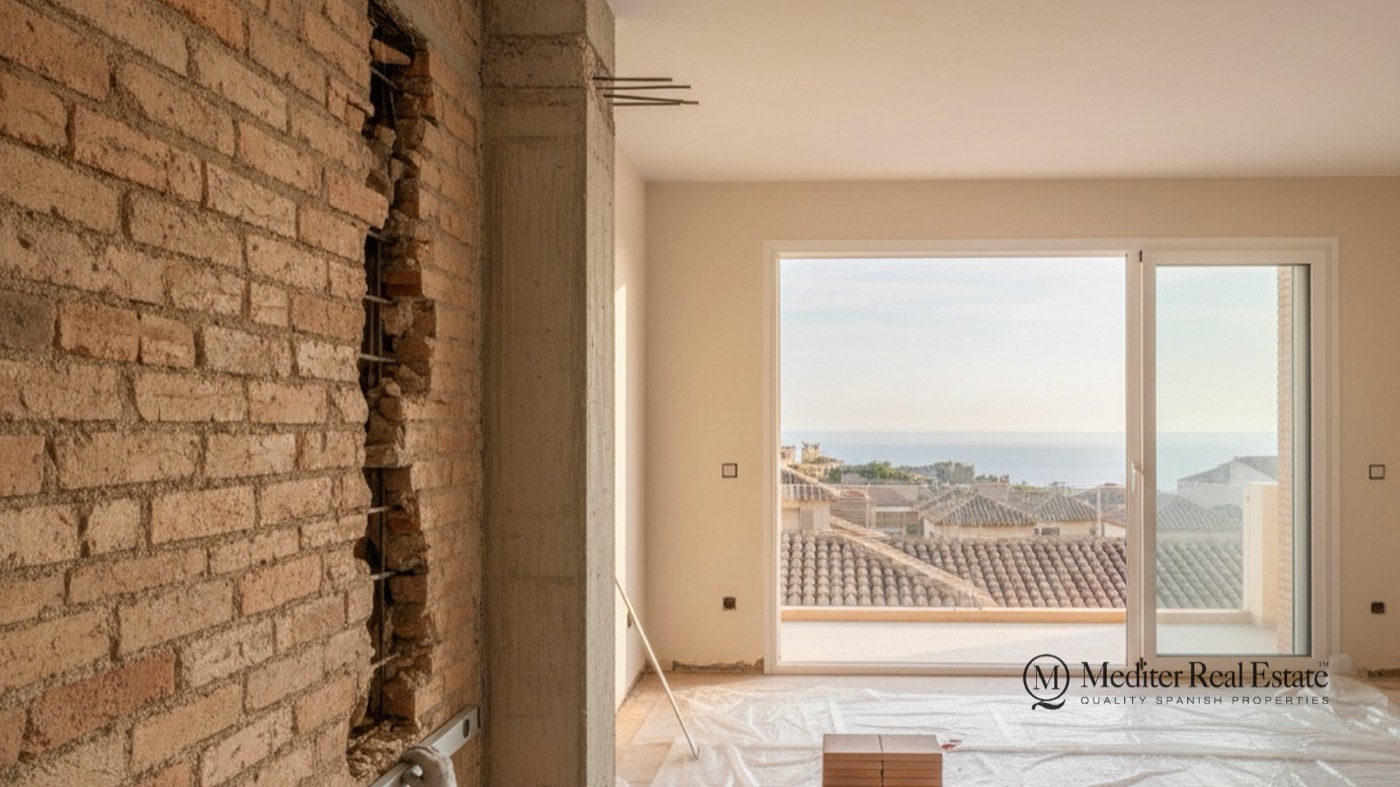
Before you knock down a single wall in your Costa del Sol apartment, two questions decide whether the project is legal: does the work need a licence from the town hall, and does it need consent from the community of owners? As a rule, cosmetic works inside your own four walls (new kitchen, bathroom, flooring, painting) need only a simple obra menor licence and no community vote. But anything that touches a shared structural element — a load-bearing wall, the façade, a terrace enclosure, the building's plumbing risers — triggers an obra mayor licence and a formal decision by the comunidad de propietarios.
This applies right along the coast — Marbella, Estepona, Fuengirola, Benalmádena and the rest of the Costa del Sol, as well as Costa Blanca, Costa Cálida and Costa Almería — because the framework comes from national law (the Horizontal Property Law) layered with each town hall's building ordinances. Below we set out exactly when you need each licence, what the community can and cannot stop, the rules on load-bearing walls, and the real 2026 costs.
Every reform in Spain falls into one of two licence categories. Getting this wrong is the single most common cause of fines and stop-work orders on the coast, so it is worth understanding before you brief a builder.
| Aspect | Obra menor | Obra mayor |
|---|---|---|
| Typical works | Kitchen/bathroom refit, flooring, painting, rewiring, like-for-like windows | Removing/moving load-bearing walls, enclosing a terrace, changing façade, adding a bathroom that reroutes drains |
| Architect project | Not usually required | Required and signed off |
| Town hall procedure | Declaración responsable / simple licence | Full building licence application |
| Community consent | Not needed if wholly private & non-structural | Needed if it touches common elements |
| Typical approval time | Days to a few weeks | 1–4 months (longer in Marbella) |
| ICIO construction tax | ~2–4% of budget | ~2–4% of budget (higher base) |
The ICIO (Impuesto sobre Construcciones, Instalaciones y Obras) is a municipal construction tax charged on the declared budget of the works — the rate is set locally and typically sits between roughly 2% and 4% on the Costa del Sol. On top of that you pay the licence fee (tasa urbanística) and, for an obra mayor, the architect's fees. For a broader look at permits and price ranges, see our guide to renovating property in Spain 2026: permits and costs.
This is where apartment reforms differ fundamentally from renovating a detached villa. In a block or urbanisation, you own your apartment but you co-own the common elements (elementos comunes) — and Spain's Horizontal Property Law (Ley 49/1960, as amended) protects them.
You do not need community consent for genuinely private, non-structural interior work. You do need it whenever your reform affects, alters or attaches to a common element. Common elements typically include:
The classic Costa del Sol trigger is enclosing a terrace (an acristalamiento or building a wall to gain a room). Because the façade is communal and the works change the building's external appearance, this almost always needs community approval — and often a qualified majority, not a simple one. Air-conditioning units and awnings fixed to the façade fall into the same category.
The required majority depends on what the work does:
Always read the community's statutes (estatutos) and internal rules first — some coastal urbanisations have stricter aesthetic rules than the law requires (uniform blinds, no visible A/C on the front façade, approved terrace-glazing systems only). Our overview of community fees and the comunidad explains how these bodies work and how decisions are taken.
The phrase buyers worry about most is the muro de carga — the load-bearing wall. Here is the reality for a Costa del Sol apartment:
How do you tell which is which? Do not guess. In many 1970s–1990s Costa del Sol blocks the structure is a concrete frame with brick infill, so interior walls are often non-structural — but this is exactly the kind of assumption that causes disasters. Commission a technical architect to inspect before you design an open-plan layout. If you are still at the buying stage, a proper structural survey on the Costa del Sol can flag which walls you will realistically be able to move.
Labour and materials are broadly comparable along the Mediterranean, but municipal taxes and processing speed differ. The ICIO rate and the licence fee are set by each town hall, so a reform in Marbella is not costed identically to one in Torrevieja, Cartagena or Mojácar. As a very rough 2026 guide, a full interior refit of a two-bedroom apartment (kitchen, two bathrooms, flooring, rewiring, but no structural work) commonly lands somewhere in the region of €600–€1,200 per m² depending on finish level, with structural interventions and terrace enclosures adding significantly on top.
Two practical points worth remembering:
If you are choosing between buying a tired resale to reform or a turnkey new build, our comparison of off-plan vs resale weighs the trade-offs — reform gives you control and value, but time, licences and community consent are the price.
Not usually. A like-for-like kitchen or bathroom refit inside your own apartment is an obra menor and needs no community vote — as long as you do not touch load-bearing walls or the communal plumbing/drainage stacks. Check your community's statutes, as some still require you to notify the administrator first.
If it is a non-structural partition (tabique), generally no. If it is a load-bearing wall (muro de carga), yes — it is a common element affecting the building's structure, so you need an architect's project, an obra mayor licence and community consent, and the community can refuse on safety grounds.
Only with community approval and, usually, an obra mayor licence, because the façade is a common element and glazing changes the building's exterior appearance. Many urbanisations also mandate a single approved glazing system. Doing it without permission risks a fine and an order to remove it.
The ICIO is the municipal construction tax on the declared budget of your works. The rate is set by each town hall and typically runs from about 2% to 4% on the Costa del Sol, payable in addition to the licence fee.
Expect roughly one to four months for approval once the architect's project is submitted, longer in busy municipalities such as Marbella. An obra menor via declaración responsable is usually much faster — days to a few weeks.
Town halls can impose fines and stop-work orders, and unlicensed structural or terrace changes will show up when you sell — on the nota simple, in a survey or against the cadastre — potentially blocking the sale or forcing you to legalise or reinstate the works retrospectively.
Mediter Real Estate helps international buyers across the Costa del Sol, Costa Blanca, Costa Cálida and Costa Almería find properties with genuine reform potential — and flags the community, licence and structural issues before you commit. Get the right checks done early and buy with confidence. Contact Mediter Real Estate today to discuss apartments and renovation projects in these four regions.
Det du fortæller os her, bruger vi kun til at svare dig. Privacy
Vi bruger cookies, som siden har brug for for at virke. Med dit samtykke bruger vi også cookies fra Meta (Facebook) til at måle vores annoncer og vise dig boliger, der ligner dem, du har set på. Cookies fra Google Analytics, også kun med dit samtykke, tæller besøg og viser os, hvilke sider der hjælper.
Cookiepolitik