 Skriven av Nicki Price, CEO
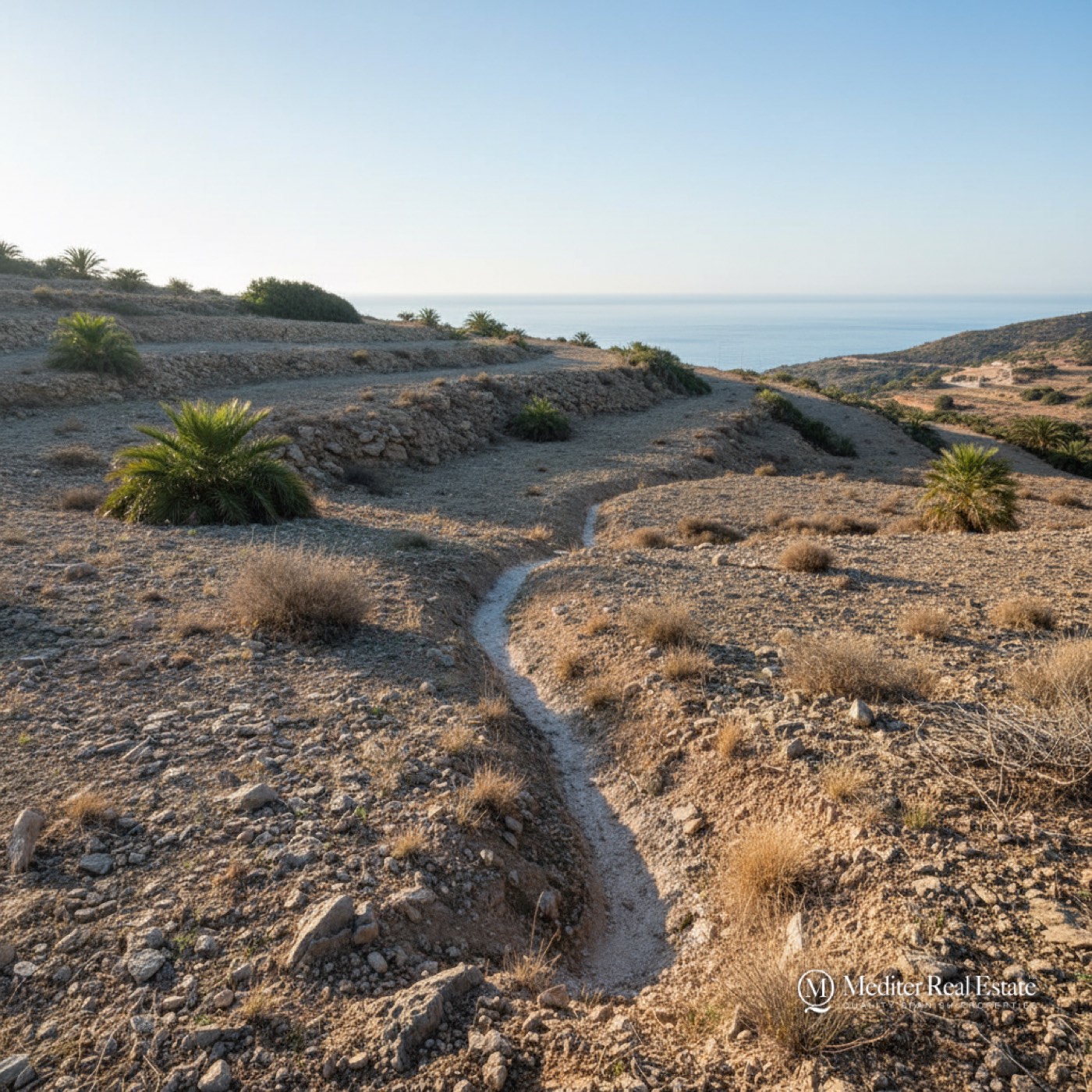
If you want the driest of the four Costas, the Costa Almería and the Costa Cálida win outright: parts of Almería (Cabo de Gata, the Tabernas interior) see under 250 mm of rain a year, the lowest in Europe, while Murcia's coast averages roughly 300-350 mm. The Costa Blanca South sits around 300 mm but is more exposed to autumn DANA storms, and the Costa del Sol is the wettest of the four at roughly 500-600 mm, mostly falling in winter. But "driest region" and "driest plot" are not the same thing. A high, south-facing plot on the Costa del Sol can stay drier than a low, flat plot on a dry Costa Blanca ramblas floor. This guide gives you the rainfall numbers, the microclimate quirks and, most importantly, the drainage checks that decide whether your specific plot stays dry.
On average annual rainfall, the order from driest to wettest is: Costa Almería, then Costa Cálida, then Costa Blanca South, then Costa del Sol. Almería's south-east corner is the driest inhabited area in continental Europe, shielded by mountain ranges that block Atlantic weather. The Costa del Sol gets more rain because it sits open to Atlantic systems sweeping through the Strait of Gibraltar.
These figures are indicative long-term averages (from AEMET, Spain's national weather agency); any single year varies, and climate records are regularly broken in both directions.
| Region | Avg annual rainfall | Rainy days/yr | Sunshine hours/yr | Main rain season |
|---|---|---|---|---|
| Costa Almería | ~200-300 mm | ~30 | ~3,000+ | Autumn/winter, very sporadic |
| Costa Cálida (Murcia) | ~300-350 mm | ~35 | ~2,900 | Autumn (Sept-Nov) |
| Costa Blanca South | ~300 mm | ~40 | ~2,800 | Autumn DANA peaks |
| Costa Blanca North | ~450-550 mm | ~45 | ~2,700 | Autumn/winter |
| Costa del Sol | ~500-600 mm | ~45-50 | ~2,900 | Winter (Nov-Feb) |
Notice the Costa Blanca split: the North (Dénia, Jávea, Calpe) is noticeably greener and wetter than the South (Torrevieja, Orihuela Costa, Pilar de la Horadada), which shades into the semi-desert conditions that continue down through Murcia and Almería. If maximum dryness and sunshine is your priority, you are looking south of Alicante.
A microclimate is a pocket where local geography, mountains, a bay, altitude, a sheltering headland, makes conditions noticeably milder, drier or less windy than the regional average a few kilometres away. On the Costas these pockets are real and can swing temperatures and rainfall by a meaningful margin.
For most buyers the best orientation on the Costas is south or south-east: south-facing (orientación sur) gives the most winter sun across the lowest-angle months, keeps terraces usable in winter and dries a plot faster after rain. South-east catches the morning sun and avoids the fierce afternoon heat; south-west gets long evening sun but can overheat in summer. North-facing homes stay cooler in August but feel damp and dark in winter, fine for a summer-only holiday flat, a drawback for year-round living.
Orientation also affects moisture directly. A south-facing wall and terrace dry out within hours; a shaded north wall holds damp, grows mould and feels cold. When you view, use a compass app and check where the sun lands at midday. If you are buying a top-floor home where the terrace is the main asset, orientation matters even more, our guide to buying a penthouse or top-floor apartment on the Costa Blanca covers how solariums and roof terraces behave through the seasons.
Because south-east Spain's rain does not fall gently, it arrives as the DANA (an isolated high-altitude depression, or gota fría) that can dump a season's worth of water in a few hours each autumn. Dry, baked ground sheds water rather than absorbing it, so the very dryness that makes Almería and Murcia attractive also makes flash flooding worse when storms do hit. The dry riverbeds you see, ramblas and barrancos, are empty for 360 days a year and torrents for the other five.
This is the single biggest climate due-diligence issue for Costa buyers, and it directly affects insurance and even mortgage approval. We cover the specifics in flood-zone and DANA insurance pricing on the Costa Blanca and DANA, flooding and Consorcio cover on the Costa Cálida. The Consorcio de Compensación de Seguros is the state body that pays out on catastrophic flood damage, provided you hold a valid home policy.
Regional averages are a starting point, but the plot itself decides. Before you sign the arras, run these checks, ideally with your lawyer and, for a build plot, a surveyor (arquitecto técnico):
If you are buying land to build, drainage, slope and ground conditions feed straight into your build budget and licence, see our guide to plot ratio, buildability and licence checks on the Costa Blanca. All of this belongs on your pre-purchase legal due diligence checklist.
A well-drained Costa plot, whether a villa garden or a build site, typically shows some or all of the following:
On flatter, low-lying land near the Mar Menor or the Guardamar and La Marina salt flats, ask specifically about the water table, a high water table makes basements and some pools impractical and can cause rising damp.
Yes, and it is one of the most under-appreciated factors. A south-facing home in a sheltered, dry microclimate needs far less heating in winter and stays drier inside, meaning lower energy bills and less mould. Almería and the Costa Blanca South routinely offer terrace living through the winter months, which is a large part of their appeal to year-round residents rather than summer-only owners. The wetter, cooler winters of the Costa del Sol interior or the Costa Blanca North mean you will run heating and dehumidifiers more.
If you plan to live year-round and work remotely, pair your climate check with connectivity, see fibre broadband and mobile coverage for remote workers on the Costa Blanca and Almería. And if year-round sea swimming and coastal walks are part of the dream, our guide to the best year-round coastal walks and Blue Flag towns maps where the mild microclimates line up with the best beaches.
As of 27 November 2026, Mediter has 7,232 properties for sale across the Costa Blanca South, Costa Blanca North, Costa Cálida, Costa del Sol, Costa de Almería and Mallorca. The concentration of our Costa Blanca South stock, around Torrevieja, Orihuela Costa, Pilar de la Horadada, Guardamar del Segura and inland Vega Baja towns such as Rojales, Algorfa and Los Montesinos, reflects exactly the dry, high-sunshine, south-of-Alicante belt this article describes. Our area guides, such as Living in Torrevieja and Living in Guardamar del Segura, note the salt-lake microclimate and coastal setting town by town so you can match a plot to the conditions you want.
The Costa Almería, especially the Cabo de Gata and Tabernas side, is the driest, with some areas under 250 mm of rain a year, the lowest in continental Europe. The Costa Cálida (Murcia) is a close second. The Costa del Sol is the wettest of the four.
No. At roughly 500-600 mm a year it is still a dry, sunny climate by northern European standards, with rain concentrated in winter. A well-oriented, well-drained plot on the Costa del Sol can be very comfortable; you simply get more green and more winter rain than in Almería.
South or south-east is best for most buyers: maximum winter sun, usable terraces, and faster drying after rain. North-facing suits summer-only use because it stays cooler, but it feels damp and dark in winter.
Yes. Autumn DANA storms drop huge volumes of rain in hours onto dry, hard ground that cannot absorb it, causing flash floods in ramblas and low-lying land. Always check the SNCZI flood maps and avoid plots on or below a dry watercourse.
It can. Spanish lenders and insurers price flood-zone property more cautiously, and catastrophic flood damage is covered by the Consorcio de Compensación de Seguros only if you hold a valid home policy. Check both before committing.
Have a surveyor (arquitecto técnico) assess slope, ground type and the nearest watercourse, pull the SNCZI flood map, and ideally view the plot after heavy rain. These checks belong in your pre-purchase due diligence.
Whether you want the near-desert sunshine of the Costa Almería, the sheltered Torrevieja salt-lake belt, a south-facing villa on the Costa Cálida or a mild Costa del Sol microclimate, Mediter Real Estate can match a dry, well-oriented plot to how you plan to live. Talk to our multilingual team on +34 744 719 499 or email info@mediter.com, we cover all four Costas and will walk the drainage and orientation questions through with you before you commit.
Det du berättar här använder vi bara för att svara dig. Privacy
Vi använder cookies som behövs för att webbplatsen ska fungera. Med ditt samtycke använder vi också cookies från Meta (Facebook) för att mäta våra annonser och visa dig bostäder som liknar dem du har tittat på. Cookies från Google Analytics, också bara med ditt samtycke, räknar besök och visar oss vilka sidor som hjälper.
Cookiepolicy