 Autor Nicki Price, CEO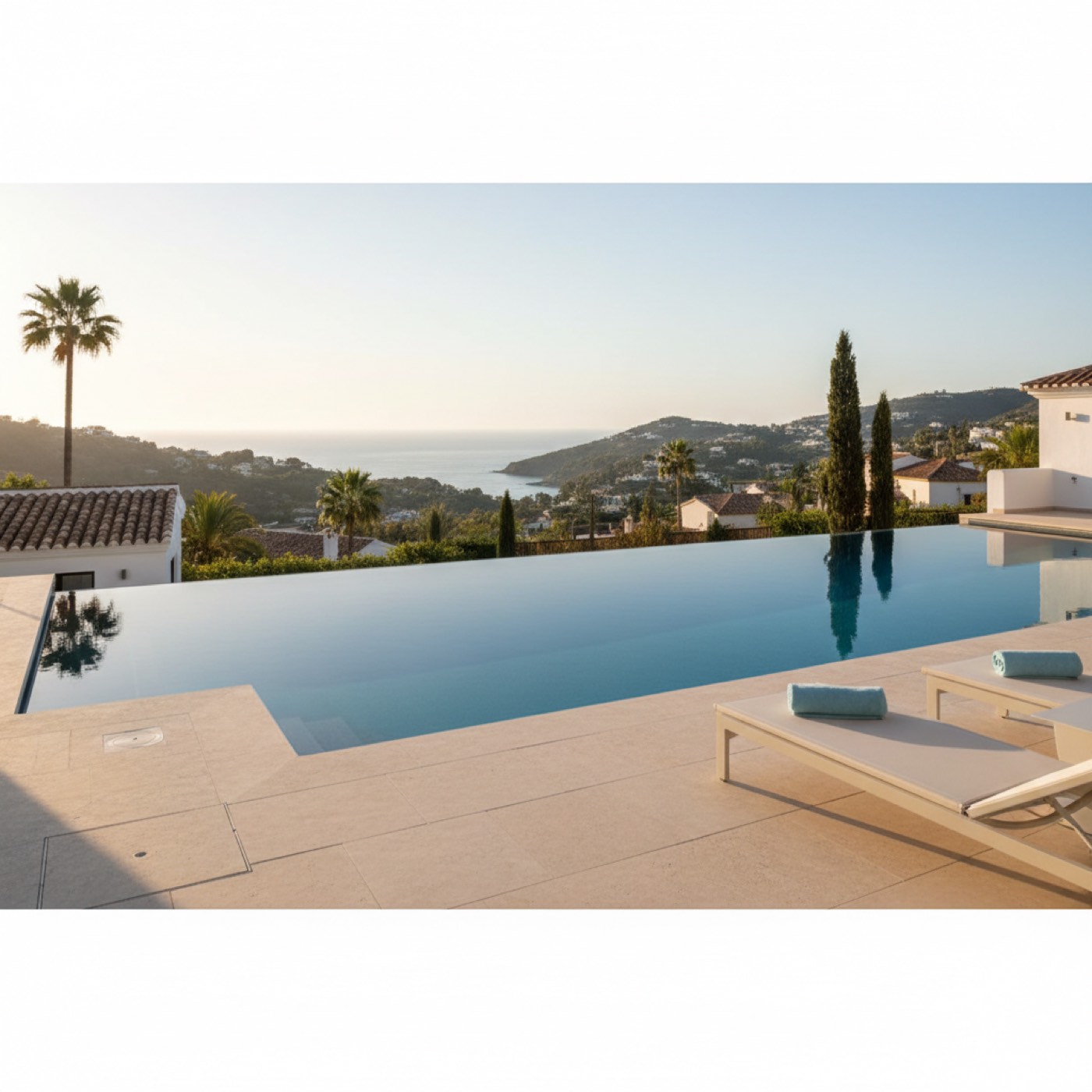
A private pool is one of the most requested features for international buyers on Spain's southern coasts — and one of the most common sources of legal trouble at completion. The single most important thing to know before you sign is this: a pool is a construction, and every legal pool in Spain must have had a building licence (licencia de obra) and be declared on the property's escritura and cadastral record. If the pool was built without permission, you inherit that problem the moment you buy — including possible fines, demolition orders on rural land, and difficulty reselling.
The good news is that on the Costa del Sol (Andalucía) and Costa Cálida (Murcia), as well as the Costa Blanca and Costa Almería, an undeclared pool is usually fixable — provided the plot is legally buildable and your lawyer catches it before you commit. This guide covers exactly what to check, what a pool costs to run each year, and the licences that apply if you plan to add one yourself.
When your lawyer runs the nota simple and cross-references it against the physical property, the pool should appear as a declared construction. Three documents need to agree with each other and with reality:
If a pool exists on the ground but not on paper, it was either built without a licence or simply never declared. On urban land (suelo urbano) — most villas in Marbella, Estepona, Torrevieja, Los Alcázares or Mazarrón — this is usually regularisable by declaring the works and paying the outstanding tax and fees. On rural land (suelo rústico/no urbanizable), it can be far more serious: an unlicensed pool on protected rural land may face a demolition order, and on the Costa del Sol this often ties into the wider issue of the AFO certificate for irregular rural builds.
Remember that Spanish transfer tax is calculated on the higher of the price or the cadastral valor de referencia. If you later declare the pool, the cadastral value rises, which increases your annual IBI and, when you eventually sell, potentially your gain. It is far better to know all of this before you negotiate — an undeclared or unlicensed pool is a legitimate reason to negotiate the price down or make the seller regularise it before completion.
Running costs surprise a lot of first-time owners, especially those coming from northern Europe where pools are rare. A private pool on the Costa del Sol or Costa Cálida is used far more of the year — the season runs roughly May to October — so the equipment works harder. Below is a realistic annual budget for a typical 8m × 4m residential pool.
| Cost item | Typical annual range | Notes |
|---|---|---|
| Chemicals (chlorine/salt, pH) | €200–€450 | Salt-chlorination systems reduce this over time |
| Electricity (pump & filtration) | €250–€600 | Higher in summer; variable-speed pumps cut this sharply |
| Water top-up & refills | €100–€300 | Evaporation is significant in Almería & inland Murcia |
| Professional maintenance (pool boy) | €600–€1,500 | Weekly in season; essential for absentee owners |
| Winterising & equipment servicing | €150–€400 | Filter media, seals, occasional pump repairs |
| Typical total | €1,300–€3,250 | Larger or heated pools run higher |
Two variables push costs up sharply. Heating (heat pump or solar) can add €500–€1,500 a year but extends your swimming season by months. Absentee ownership is the other: if the property is a holiday home you visit occasionally, professional maintenance is not optional — a neglected pool turns green fast in the Andalusian heat, and repairs cost more than upkeep. Factor a maintenance contract into your broader property management arrangements.
If your pool is a community pool rather than private, these costs are folded into your community fees instead — often the cheaper and lower-hassle option for apartment and townhouse buyers.
If you buy a plot or a villa without a pool and want to build one, you need a municipal building licence before starting work. The rules and costs vary by region and town hall, but the framework is consistent across the four Mediter coasts.
In Andalusian municipalities such as Marbella, Estepona, Benalmádena and Mijas, a private pool almost always requires a licencia de obra mayor (major works licence), because it involves excavation and structural building. You submit a project drawn up by an architect or technical architect, along with structural and drainage details. The town hall charges a construction tax (ICIO, typically around 3–4% of the budgeted works cost) plus a licence fee. Approval times vary widely between town halls — allow two to four months.
In Murcia (Cartagena, Mazarrón, Los Alcázares, San Javier), a pool building permit follows the same logic — a technical project and a licencia de obra from the ayuntamiento, plus ICIO. Murcia has been streamlining minor-works via a declaración responsable (responsible declaration) system for smaller jobs, but a full in-ground pool remains a major-works permit in almost all cases. Coastal plots near the Mar Menor also face stricter environmental scrutiny on drainage and discharge, so budget for that in your project.
The Costa Blanca (Valencian Community) and Costa Almería (Andalucía) mirror their larger neighbours: an architect's project, a major-works licence, and ICIO. On all four coasts, the key trap is plot classification — you can only build a pool where the land permits it, and setback rules apply near boundaries and near the coast under the Ley de Costas setback zones.
| Coast / Region | Permit to build a pool | Construction tax (ICIO) | Key local watch-point |
|---|---|---|---|
| Costa del Sol (Andalucía) | Licencia de obra mayor | ~3–4% of works budget | Rural AFO issues; slope/retaining walls |
| Costa Almería (Andalucía) | Licencia de obra mayor | ~3–4% of works budget | Water supply on rural plots; evaporation |
| Costa Cálida (Murcia) | Licencia de obra (major) | ~variable by ayuntamiento | Mar Menor environmental discharge rules |
| Costa Blanca (C. Valenciana) | Licencia de obra mayor | ~variable by ayuntamiento | Plot classification; boundary setbacks |
ICIO rates are set by each town hall within a national ceiling, so always confirm the current figure locally rather than assuming. Once the pool is built, you must declare it via an escritura de obra nueva before the notary and update the Catastro — the same process discussed in our guide to renovating property in Spain.
A pool holds a lot of water, and it needs topping up throughout the season. On urban plots connected to mains water this is a straightforward utility question. On rural properties — common inland from the Costa Almería and Costa Cálida — you must confirm you have a legal, reliable water supply before assuming you can fill and maintain a pool. Boreholes, wells and shared supplies each carry their own rules and permits, as we explain in our guide to rural property water in Spain. Never buy a rural villa with a pool without verifying where the water legally comes from.
Spain does not impose a single national pool-fencing law for private homes the way some countries do, but community-owned and rental pools face stricter safety rules, and municipal bye-laws can apply. If you intend to let the property, safety compliance becomes central to your tourist rental licence obligations. A few practical points:
Yes. An in-ground private pool is major construction (obra mayor) on the Costa del Sol, Costa Cálida, Costa Blanca and Costa Almería. You need a technical project and a municipal building licence, and you pay construction tax (ICIO). You must then declare the finished pool on the escritura and Catastro.
On urban land the pool can usually be regularised by declaring it and paying outstanding fees and tax. On protected rural land — a real risk inland on the Costa del Sol and Costa Almería — an unlicensed pool can face fines or even a demolition order. Always have a lawyer confirm the pool's legal status before completion.
Budget roughly €1,300–€3,250 a year for a standard 8m × 4m pool, covering chemicals, electricity, water, professional cleaning and servicing. Heated pools cost more, and absentee owners should assume a weekly maintenance contract during the season is essential in the southern Spanish climate.
Yes. A declared pool raises the cadastral value, which increases your annual IBI. Because transfer tax is charged on the higher of the price or the valor de referencia, an undeclared pool that you later legalise can also nudge up costs — so understand the full picture before you buy.
Usually, yes. Community pool costs are shared across the development through your comunidad fees, so you avoid the licence process, individual maintenance and large water bills. A private pool offers exclusivity and higher rental appeal, but carries all the running costs and legal responsibilities yourself.
Whether you want a private infinity pool on the Costa del Sol or a family home with a garden pool on the Costa Cálida, Mediter Real Estate can help you find the right property — and make sure every licence, deed and cost checks out before you commit. Contact Mediter Real Estate today to discuss pool properties across the Costa Blanca, Costa Cálida, Costa del Sol and Costa Almería.
To, co nam tu napiszesz, wykorzystamy wyłącznie do odpowiedzi. Privacy
Używamy plików cookie niezbędnych do działania strony. Za Twoją zgodą używamy też plików cookie Meta (Facebook), aby mierzyć nasze reklamy i pokazywać Ci nieruchomości podobne do tych, które oglądałeś. Pliki cookie Google Analytics, również tylko za Twoją zgodą, liczą odwiedziny i pokazują nam, które strony pomagają.
Polityka cookie