 Autor Nicki Price, CEO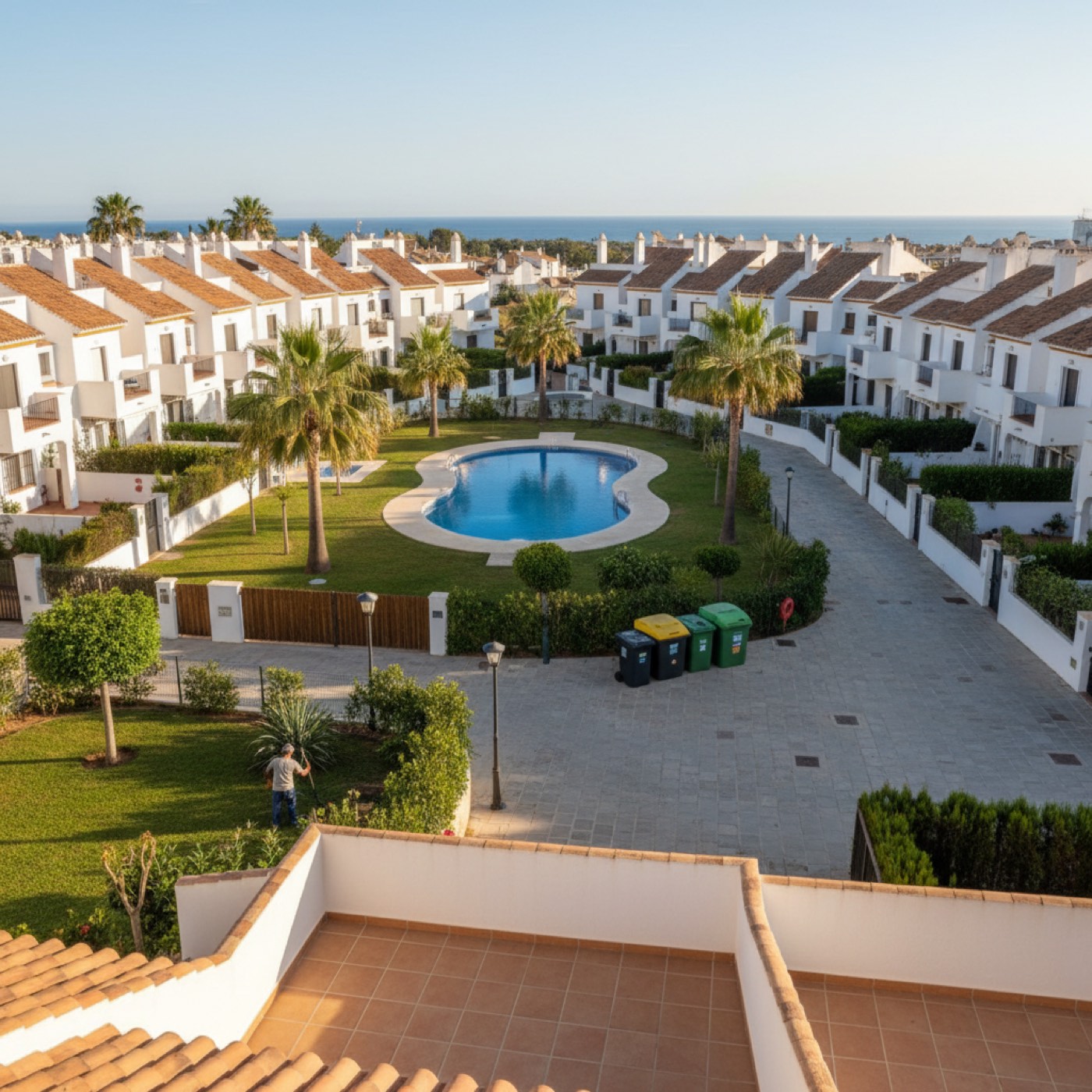
If you buy an apartment, townhouse or villa on a shared development anywhere on the Costa Blanca, Costa Cálida, Costa del Sol or Costa Almería, you will almost certainly join a comunidad de propietarios — the Spanish equivalent of a homeowners' association (HOA) — and pay community fees. In practical terms, expect to budget roughly €30–€150 per month for a modest apartment, €80–€250 per month for a townhouse or property on a mid-range urbanisation, and €200–€600+ per month for villas on high-end resorts with extensive shared facilities. These charges pay for the pool, gardens, lifts, communal lighting, cleaning and insurance of the shared parts of the building or urbanisation.
Community fees are a running cost, not a purchase tax, so they sit outside the ~10–13% resale / ~12–15% new-build acquisition costs — but they matter enormously for your monthly budget and for resale value. This guide explains what the comunidad is, what your fees cover, what they typically cost across our four coastal regions, and the exact questions to ask before you sign.
Whenever a building or development is divided into separately owned units that share common elements — an entrance hall, roof, pool, gardens, private roads, a lift — Spanish law automatically creates a community of owners. Every owner is a compulsory member; you cannot opt out. The comunidad is governed by the Ley de Propiedad Horizontal (Horizontal Property Law), the framework that decides how decisions are made and how costs are shared.
The rules are the same nationwide because this is state law, so a community on the Costa del Sol runs on the same legal skeleton as one on the Costa Blanca. If you want the full legal detail, we cover it in our guide to the Horizontal Property Law and communities of owners. This article focuses on the money and the practicalities.
Your monthly or quarterly fee funds the ordinary budget — the day-to-day cost of keeping shared areas running. Typical items include:
Note that the community insurance covers the shared structure, not the contents or interior of your own home — you still need your own policy, as we explain in our property insurance guide.
Each property carries a cuota de participación — a percentage coefficient set in the building's founding deed (escritura de división horizontal), roughly proportional to the size and value of your unit. A penthouse pays more than a small ground-floor studio. Your share of every community cost is calculated on this coefficient, so always check it before buying — it appears in the deed and the community accounts.
There is no single national figure — fees depend entirely on the facilities. A bare block of flats with no lift and a small garden might cost €30 a month; a luxury resort with 24-hour security, several pools, a gym, padel courts and landscaped gardens can exceed €600 a month. The table below gives realistic 2026 ranges by property type across our four regions.
| Property type | Typical facilities | Monthly fee | Annual fee |
|---|---|---|---|
| Basic apartment, no lift | Small garden, communal lighting | €30–€60 | €360–€720 |
| Apartment with pool & lift | Pool, lift, gardens, cleaning | €60–€130 | €720–€1,560 |
| Townhouse on urbanisation | Communal pool, gardens, parking | €80–€200 | €960–€2,400 |
| Villa on resort development | Security, multiple pools, sports | €200–€600+ | €2,400–€7,200+ |
Broadly, the type of development matters far more than the region. That said, a few patterns are worth knowing:
Golf and beachfront properties deserve special attention because their shared facilities push fees up — we flag the extra costs in our golf property guide and our beachfront buying checklist.
Ordinary fees cover routine running costs. When the community needs to fund something the budget and reserve fund cannot absorb — replacing a roof, resurfacing private roads, installing a lift, repairing a swimming pool, complying with new energy or accessibility rules — the junta can approve a derrama, a one-off special levy shared among owners according to their coefficient.
Derramas are the single biggest financial surprise for new buyers. A large structural repair on an older Costa del Sol block can run into thousands of euros per owner. This is why, before you buy, you should ask for:
Community obligations transfer with the property, so you inherit both the running cost and any problems. Before completion, your lawyer should obtain a certificate of no debt (certificado de estar al corriente de pago) from the administrator, confirming the seller owes nothing.
This matters because of a crucial rule: under the Horizontal Property Law, a new owner is liable for unpaid community fees from the current year and the previous three years. If you buy without checking, you could be pursued for the previous owner's arrears. A good conveyancing lawyer will not let this slip — see our guide on whether you need a Spanish property lawyer.
That tourist-rental point is increasingly important. Since 2022, a community can restrict or prohibit holiday letting with a three-fifths majority vote, and new 2026 rules strengthen that power. If you plan to let, read our tourist rental licence guide and check the community statutes before buying — the licence rules also interact with community consent.
Beyond fees, the comunidad sets rules (the estatutos and internal regulations) that bind every owner. Common restrictions on Costa developments include pool opening hours, limits on structural or external alterations, parking allocation, and — increasingly — short-term rental bans. You can normally do what you like inside your own home, but anything affecting the shared appearance or structure usually needs community approval. If you're planning works, factor this into our renovation permits and costs guide.
Community fees are one of several recurring costs of owning a Spanish home. Budget also for:
For non-resident buyers weighing all these outgoings, our non-resident buyer's guide puts the full picture together.
Yes. If your property forms part of a building or development with shared elements, membership of the comunidad de propietarios is automatic and legally binding under the Horizontal Property Law. You cannot opt out or refuse to pay your share.
Most communities on the Costa Blanca, Cálida, del Sol and Almería bill monthly or quarterly by direct debit from a Spanish bank account. Some smaller communities bill twice a year. The junta sets the schedule when it approves the annual budget.
Yes — a buyer inherits unpaid community charges from the current year plus the three preceding years. This is why your lawyer must obtain a no-debt certificate from the administrator before completion.
Non-payers lose their voting rights at meetings, and the community can pursue the debt through a fast-track court procedure and register a charge against the property. Persistent debtors can ultimately face enforcement against the property itself.
A fully independent, standalone villa on its own plot with no shared roads, gates or services usually has no comunidad. But many "villas" sit on gated urbanisations with shared roads, security and green areas — in which case community fees still apply. Always confirm exactly what is shared.
Not by yourself. A three-fifths majority of owners can restrict or prohibit short-term holiday lets. If letting income is central to your plans, check the community statutes and recent AGM minutes before you buy, and read our tourist rental licence guides.
On average, premium gated resorts are more concentrated on the Costa del Sol, which pushes typical fees higher there. But the deciding factor is the facilities on your specific development, not the coast — a luxury Costa Blanca resort can cost more than a basic Costa del Sol block.
Community fees can make or break the numbers on a Spanish home — and the right questions before you sign save real money later. At Mediter Real Estate we help international buyers understand exactly what they're taking on across the Costa Blanca, Costa Cálida, Costa del Sol and Costa Almería, from checking community accounts to reviewing statutes and derramas. Explore our regional guides and get in touch to discuss the properties and developments that fit your budget and lifestyle.
To, co nam tu napiszesz, wykorzystamy wyłącznie do odpowiedzi. Privacy
Używamy plików cookie niezbędnych do działania strony. Za Twoją zgodą używamy też plików cookie Meta (Facebook), aby mierzyć nasze reklamy i pokazywać Ci nieruchomości podobne do tych, które oglądałeś. Pliki cookie Google Analytics, również tylko za Twoją zgodą, liczą odwiedziny i pokazują nam, które strony pomagają.
Polityka cookie