 Autor Nicki Price, CEO
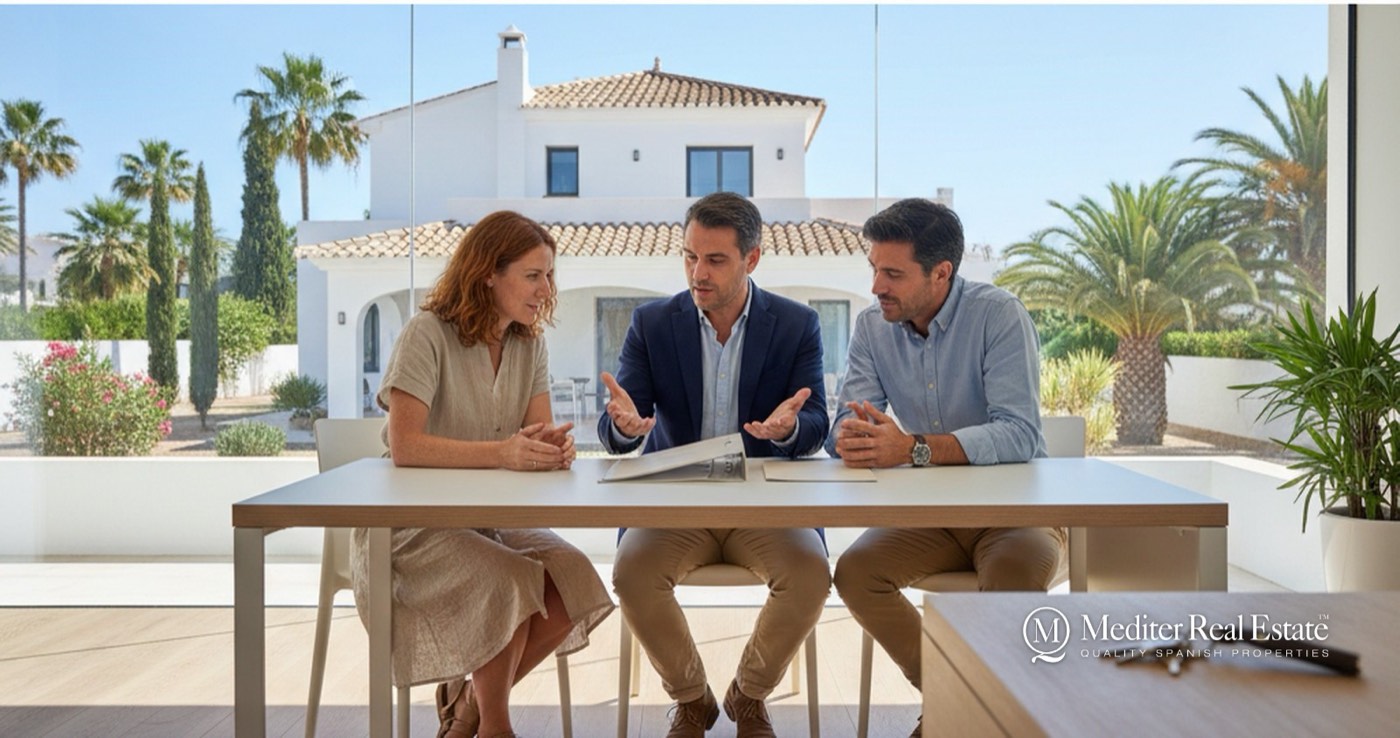
Before you sign the arras (private purchase contract) on the Costa Blanca, your lawyer must verify at least eight things: that the seller legally owns the property, that it is free of mortgages, embargos and tax debts, that what is built matches what is registered, that it has a valid occupation/habitation certificate and energy certificate, that community fees and the IBI are paid, and that the valor de referencia from the Catastro is known so you can budget transfer tax correctly. On the Costa Blanca (Comunidad Valenciana) resale ITP is 9% for deeds signed from 1 June 2026 (Ley 5/2025), so a missed charge or a surprise tax base is expensive. This checklist walks through every document, and the same logic applies in Costa Cálida, Costa del Sol and Costa Almería, with the regional differences flagged.
Due diligence is the legal investigation your independent lawyer (abogado) runs between agreeing a price and signing the private contract, to confirm the property is safe to buy. Unlike the UK, there is no equivalent of a Land Registry "search bundle" handed over automatically, in Spain you (or your lawyer) must actively pull each document from the Registro de la Propiedad, the Catastro, the town hall (ayuntamiento) and the community of owners. Skipping it is the single most common cause of expensive surprises for international buyers on all four Costas.
Instruct a lawyer who is independent of both the seller and the agent, and do it before you pay any reservation deposit if possible, see our guide to the reservation deposit and what's refundable.
Below is the core checklist. Each line is a document your lawyer should physically obtain and read, not just "ask the seller about".
| # | Document / check | Where it comes from | What it proves |
|---|---|---|---|
| 1 | Nota simple | Registro de la Propiedad | Legal owner, boundaries, mortgages, embargos |
| 2 | Escritura (title deed) | Seller / notary | How and when the current owner acquired it |
| 3 | Valor de referencia | Catastro | Minimum tax base for ITP/AJD |
| 4 | Cédula / licence of occupation | Ayuntamiento | The home is legally habitable |
| 5 | Energy performance certificate | Registered technician | Legally required to sell |
| 6 | IBI receipt (latest) | Owner / SUMA (Alicante) | Council tax is paid up to date |
| 7 | Community fee certificate | Administrador de fincas | No outstanding comunidad debt |
| 8 | Utility bills | Owner | Water/electricity connected and paid |
| 9 | Planning / licence check | Ayuntamiento, Catastro | No illegal extensions or rural-build issues |
| 10 | Tourist licence (if relevant) | Regional tourism registry | Legal short-term letting |
The nota simple is a short extract from the Registro de la Propiedad and the most important single document in Spanish conveyancing. It names the registered owner, describes the property, and lists any cargas, mortgages, embargos (seizures by creditors or the tax office), easements and legal disputes. A fresh nota simple (dated within days of signing) confirms you are buying from the real owner and that the property is free of debt, because in Spain some charges follow the property, not the previous owner.
Your lawyer should request it at the start and again just before completion. For a full walkthrough of reading charges and embargos, see our dedicated guide to the nota simple and how to check mortgages and embargos. If the property is a repossession, extra care applies, read our bank repossession guide for Costa Almería.
Since 2022 the tax base for transfer tax is the higher of the agreed price or the Catastro's valor de referencia, a notional value the Catastro assigns to most properties. If the valor de referencia is higher than your price, you pay tax on that higher figure, or risk a complementary assessment and surcharge from the regional tax office. Many competitor articles still ignore this; your lawyer must pull the figure from the Catastro before you commit.
Apply the correct 2026 resale ITP rate to that base:
| Region (Costa) | Resale ITP 2026 | New build: IVA + AJD |
|---|---|---|
| Costa Blanca (Com. Valenciana) | 9% (11% above €1M; from 1 June 2026, Ley 5/2025) | 10% IVA + 1.4% AJD |
| Costa Cálida (Murcia) | 7.75% (Ley 3/2025) | 10% IVA + 1.5% AJD |
| Costa del Sol (Andalucía) | 7% | 10% IVA + 1.2% AJD |
| Costa Almería (Andalucía) | 7% | 10% IVA + 1.2% AJD |
On the Costa Blanca the notary signing date, not the arras date, decides whether the old 10% or new 9% applies, so timing a completion from June 2026 can genuinely save money. Add notary (~0.2-0.5%), land registry (~0.1-0.25%), lawyer (~1% + IVA) and gestoría (~€300): budget roughly 10-13% on top of a resale price and 12-15% on a new build, the lower end in Andalucía. For the valuation side, see our tasación guide.
A home is only legally habitable with a valid occupation document, and the name and body differ by region, which trips up many buyers. On the Costa Blanca this is the cédula de habitabilidad or, for resales, the licencia de segunda ocupación from the ayuntamiento; for brand-new homes it is the licence of first occupation. Without it you cannot reliably connect utilities in your own name.
| Costa | Typical document |
|---|---|
| Costa Blanca / Costa Cálida | Cédula de habitabilidad / licencia de segunda ocupación |
| Costa del Sol / Costa Almería | Licencia de ocupación / primera ocupación |
Read our detailed guides on the cédula de habitabilidad for Costa Blanca and the first occupation licence for new builds. The energy performance certificate (certificado de eficiencia energética) is separately required to sell, see energy certificate and solar panel rules.
Your lawyer must cross-check the escritura, the nota simple and the Catastro against what physically exists. Discrepancies are common on the Costas: an unregistered pool, a glazed terrace, a converted garage or a whole extra storey that never received planning permission. If the building doesn't match the register, you may inherit a problem you cannot easily sell on, insure or legalise.
This matters most for rural and country properties. On rustic land an illegal or semi-legal build may need an AFO certificate to be regularised, and the whole purchase hinges on the suelo rústico vs urbano classification. For pools specifically, confirm the licence exists, see private pool licences and costs. If the home is coastal, also check the Ley de Costas setback zones, as some seafront builds sit on public maritime domain.
Unpaid IBI (annual council tax) and community (comunidad) fees can attach to the property, meaning the new owner can be chased for arrears. Your lawyer should obtain the most recent IBI receipt, paid through SUMA in Alicante province, and a certificate from the administrador de fincas stating the community account is clear, which the notary will require at signing anyway. Ask too whether any special derrama (extra levy) has been voted for upcoming works.
Budget the ongoing cost before you buy: see our guide to community fees in Spain 2026. For urbanisations where roads and shared areas may not be adopted by the town hall, read the Costa Blanca urbanisation upkeep guide.
Off-plan (new-build) and rural properties carry their own due diligence layer. For off-plan, verify the developer's building licence and, crucially, the bank guarantee or insurance policy protecting your stage payments under Ley 20/2015, without it your deposit is unprotected if the developer fails. For rural homes, confirm legal water and electricity supply, because many country properties rely on wells or non-mains connections.
Due diligence isn't only about the property, your own paperwork must be ready for the notary. You will need an NIE number, and ideally a Spanish bank account to run utilities and taxes. Non-residents should also plan how funds arrive, as banks require proof of the source of funds.
See our guides to the NIE and NIF numbers, opening a Spanish bank account as a non-resident, and sending money to Spain to buy property. When everything checks out, the purchase completes at the notary, see notary and completion day: signing the escritura.
Mediter currently has around 10,010 properties for sale across Costa Blanca South, Costa Blanca North, Costa Cálida, Costa del Sol and Costa de Almería. In practice that mix spans everything from resale apartments in established urbanisations around Torrevieja and Orihuela Costa, where community fee certificates and the licencia de segunda ocupación are the key checks, to off-plan villas inland in towns like Rojales and Algorfa, where the building licence and bank guarantee matter most. The right due diligence depends on which of these you're buying, and we flag it on every listing.
Typically one to three weeks between agreeing the price and signing the arras, depending on how quickly the ayuntamiento, Registro de la Propiedad and community administrator respond. Rural and off-plan cases take longer.
You can read a nota simple yourself, but a non-independent reliance on the seller's or agent's lawyer is risky. An independent abogado typically costs around 1% + IVA and is the cheapest insurance you will buy, a missed embargo or illegal extension costs far more.
The buyer's lawyer usually obtains the nota simple and the Catastro/valor de referencia check as part of their fee. The seller must provide a valid energy performance certificate and, in most cases, the occupation document.
The rule is national, tax is paid on the higher of price or valor de referencia, but the figure is set per property by the Catastro, and the tax rate applied differs by region (9% Costa Blanca, 7.75% Costa Cálida, 7% Costa del Sol and Costa Almería in 2026).
Your lawyer will advise whether the discrepancy can be regularised (for example a new declaration of works, or an AFO certificate on rustic land) before you commit, or whether to walk away. Never complete on an unregularised illegal build.
Thinking about buying on the Costa Blanca, Costa Cálida, Costa del Sol or Costa Almería? We work alongside independent lawyers every day and make sure the documents are ready before you sign. Contact Mediter Real Estate, call +34 744 719 499 or email info@mediter.com, and we'll help you buy with the right checks in place.
To, co nam tu napiszesz, wykorzystamy wyłącznie do odpowiedzi. Privacy
Używamy plików cookie niezbędnych do działania strony. Za Twoją zgodą używamy też plików cookie Meta (Facebook), aby mierzyć nasze reklamy i pokazywać Ci nieruchomości podobne do tych, które oglądałeś. Pliki cookie Google Analytics, również tylko za Twoją zgodą, liczą odwiedziny i pokazują nam, które strony pomagają.
Polityka cookie