 Scritto da Nicki Price, CEO
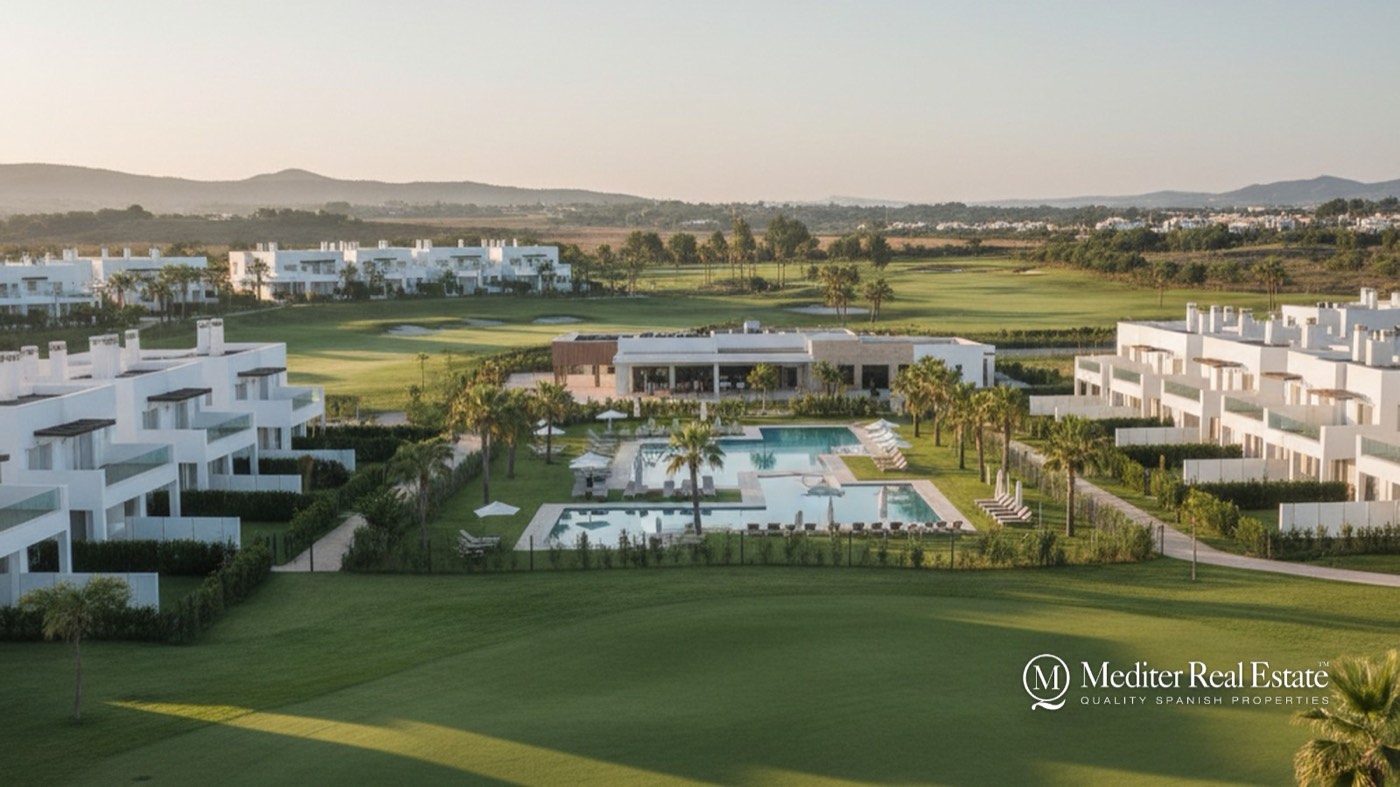
On a Costa Cálida golf resort you own your own apartment or villa plus an undivided share (cuota) of the communal areas, the pools, gardens, roads and clubhouse surrounds, set out in your deed and the community statutes under the Ley de Propiedad Horizontal (Ley 49/1960). You do not own the golf course or most sporting facilities: those usually belong to a separate operator and are paid for with separate membership or green fees. Expect to pay monthly community fees (typically €40-€150 depending on how much the resort maintains) and, on many resorts, a second charge to an entidad urbanística de conservación for the private roads and open landscaping. The buying taxes are the normal Murcia resale ITP of 7.75% (Ley 3/2025) or 10% IVA + 1.5% AJD on a new build, your share of the pool is already baked into the price.
Resorts like those around Los Alcázares, Roda, Mar Menor and the Murcia inland courses are some of the most popular buys on the Costa Cálida, precisely because the pools, padel courts and golf are on your doorstep. But "shared facilities" hides a lot of structure. This guide explains exactly what you own, who pays, and what to check before you sign.
You own your elemento privativo (your private home) plus an undivided share of the elementos comunes, the communal pools, gardens, lifts, parking areas and often a clubhouse terrace. You never own a specific slice of the pool; you own a percentage (your cuota de participación) of the whole lot, which also fixes your share of the bills and your vote at the community meeting.
This is standard Spanish horizontal property law (Ley de Propiedad Horizontal, Ley 49/1960), the same framework explained in our general guide to community fees in Spain for 2026. The key point on a golf resort is that there are often two or three overlapping layers:
Before you offer, ask the agent precisely which pools and facilities your property has guaranteed rights to use, and which require a separate paid membership. The answer should be in the community statutes, not a verbal promise.
All the registered owners pay, in proportion to their cuota, through the monthly or quarterly community fee. The community budget, approved each year at the general meeting (junta), covers pool cleaning and chemicals, lifeguard or safety compliance, gardening, water, electricity, insurance and the administrator's fee. If a resort has large landscaped grounds and several pools, this is why fees are higher than in a small block.
Each pool itself must meet the usual Spanish health and safety rules for communal pools, water treatment, barriers and signage, and the cost of that compliance sits in the community budget. Our separate guide on a private pool property in Spain covers the licensing side; on a resort that burden is shared rather than yours alone, which is one of the genuine advantages of resort living.
Yes, within limits. The junta can set opening hours, close pools out of season, and pass rules on guests and short-term rental tenants using the facilities. These rules are valid if approved by the required majority under Ley 49/1960 and recorded in the minutes. What the community cannot do is simply strip an owner of their legal right to the communal areas their deed grants them. If you plan to let the property, confirm in writing that holiday tenants may use the pools, some resorts restrict this, and check the wider tourist rental licence rules first.
Many Costa Cálida golf resorts sit on private urbanisations where the roads, street lighting, main gates and large open green spaces are not adopted by the town hall. In that case an entidad urbanística de conservación (EUC), a legally mandated conservation entity, maintains them, and membership is compulsory for every property owner. This is a separate bill on top of your building's community fee, and it is one of the most commonly missed costs by first-time resort buyers.
The EUC charge pays for resurfacing private roads, maintaining the perimeter, security patrols and shared infrastructure the council never took over. Our guide to the upkeep of urbanisation roads on the Costa Blanca explains the same mechanism in neighbouring Alicante, it works identically on the Costa Cálida. Always ask whether an EUC exists and what its annual fee is before you commit.
On the vast majority of Costa Cálida resorts, the golf course and clubhouse are owned and run by a private operator, completely separate from the owners' community. You buy a home on the resort, not a share of the course. That matters for two reasons:
For the wider picture of buying around fairways across our regions, see our golf property Spain 2026 guide.
The purchase taxes on a resort home are the same as any other Costa Cálida property, the facilities are already included in the price and your cuota. Resale homes pay Murcia's regional ITP of 7.75% (reduced under Ley 3/2025, many websites still quote the old 8%, so check carefully). New-build resort apartments pay 10% IVA plus 1.5% AJD stamp duty. In every case the tax base is the higher of the agreed price or the Catastro's valor de referencia, which is why a low "paper" price does not always cut your tax bill.
| Region | Resale ITP | New build | Rule-of-thumb total on top of price |
|---|---|---|---|
| Costa Cálida (Murcia) | 7.75% (Ley 3/2025) | 10% IVA + 1.5% AJD | Resale ~10-12% · New ~12-14% |
| Costa Blanca (C. Valenciana) | 9% from 1 June 2026 (Ley 5/2025; 11% above €1M) | 10% IVA + 1.4% AJD | Resale ~11-13% · New ~12-15% |
| Costa del Sol (Andalucía) | 7% | 10% IVA + 1.2% AJD | Resale ~10-12% · New ~12-14% |
| Costa Almería (Andalucía) | 7% | 10% IVA + 1.2% AJD | Resale ~10-12% · New ~12-14% |
On top of tax, budget notary ~0.2-0.5%, Registro de la Propiedad ~0.1-0.25%, lawyer ~1% + IVA and a gestoría around €300. The ongoing running costs, community fee, any EUC fee, IBI, rubbish tax and non-resident income tax, are covered in our Costa Cálida holiday home taxes guide (IBI & Modelo 210).
Resort due diligence is ordinary Spanish conveyancing plus the community layer. Your lawyer should confirm the property is free of debt and the facilities are genuinely yours to use. Work through this checklist:
If you are buying off-plan on a new resort phase, weigh it against a finished unit using our off-plan vs resale analysis, the principles apply across the Costa Cálida too.
At the time of writing (November 2026) Mediter Real Estate has 7,203 properties for sale across the Spanish costas, including a large stock on the Costa Cálida and Costa Blanca South resorts near the Mar Menor and Orihuela Costa golf courses. Many of the resort-style homes we list in areas such as Algorfa (La Finca Golf), Orihuela Costa and Rojales come with shared pools and gardens maintained through a community, the exact set-up this article describes. We can pull the community and any EUC fee figures for any specific property you are considering before you make an offer.
You own an undivided share of it, proportional to your cuota de participación under Ley 49/1960, along with the other owners. You cannot sell or fence off a part of the pool, but you have a legal right to use it under the community rules.
It varies widely with the facilities maintained, typically €40-€150 a month for the building community, and more on resorts with large grounds and several pools. On private urbanisations there is often a separate entidad urbanística de conservación fee on top for roads and shared infrastructure. Always ask for both figures in writing.
Almost never. The course is usually owned by a private operator, and you pay green fees or a separate membership to play. Buying a home on a resort does not give you ownership of, or a permanent guarantee of, the golf course.
The junta can set rules on guest and tenant use if approved by the required majority and recorded in the minutes. If you plan to let the property, confirm in writing that tenants may use the facilities before you buy, and check the tourist rental licensing rules for the region.
Unpaid community charges can attach to the property for the current year and part of the previous years under Ley 49/1960, so you could inherit them. This is why your lawyer must obtain a certificate of no debt from the administrator, for both the community and any EUC, before completion at the notary.
The Murcia resale ITP is 7.75% (Ley 3/2025), charged on the higher of the price or the Catastro valor de referencia. A new-build resort home pays 10% IVA plus 1.5% AJD stamp duty instead.
Shared pools, golf and an easy-living community can make a Costa Cálida resort home one of the best buys on the Spanish coast, as long as you know exactly what you own and what you pay. Mediter Real Estate covers the Costa Cálida, Costa Blanca, Costa del Sol and Costa Almería, and we can check the community fees, EUC charges and facility rights on any resort property before you commit. Get in touch at info@mediter.com or +34 744 719 499 and tell us which resort you have in mind.
Ciò che ci racconti qui lo usiamo solo per risponderti. Privacy
Usiamo i cookie necessari al funzionamento del sito. Con il suo consenso usiamo anche i cookie di Meta (Facebook) per misurare i nostri annunci e mostrarle immobili simili a quelli che ha guardato. I cookie di Google Analytics, anch’essi solo con il suo consenso, contano le visite e ci mostrano quali pagine sono utili.
Politica dei cookie