 Scritto da Nicki Price, CEO
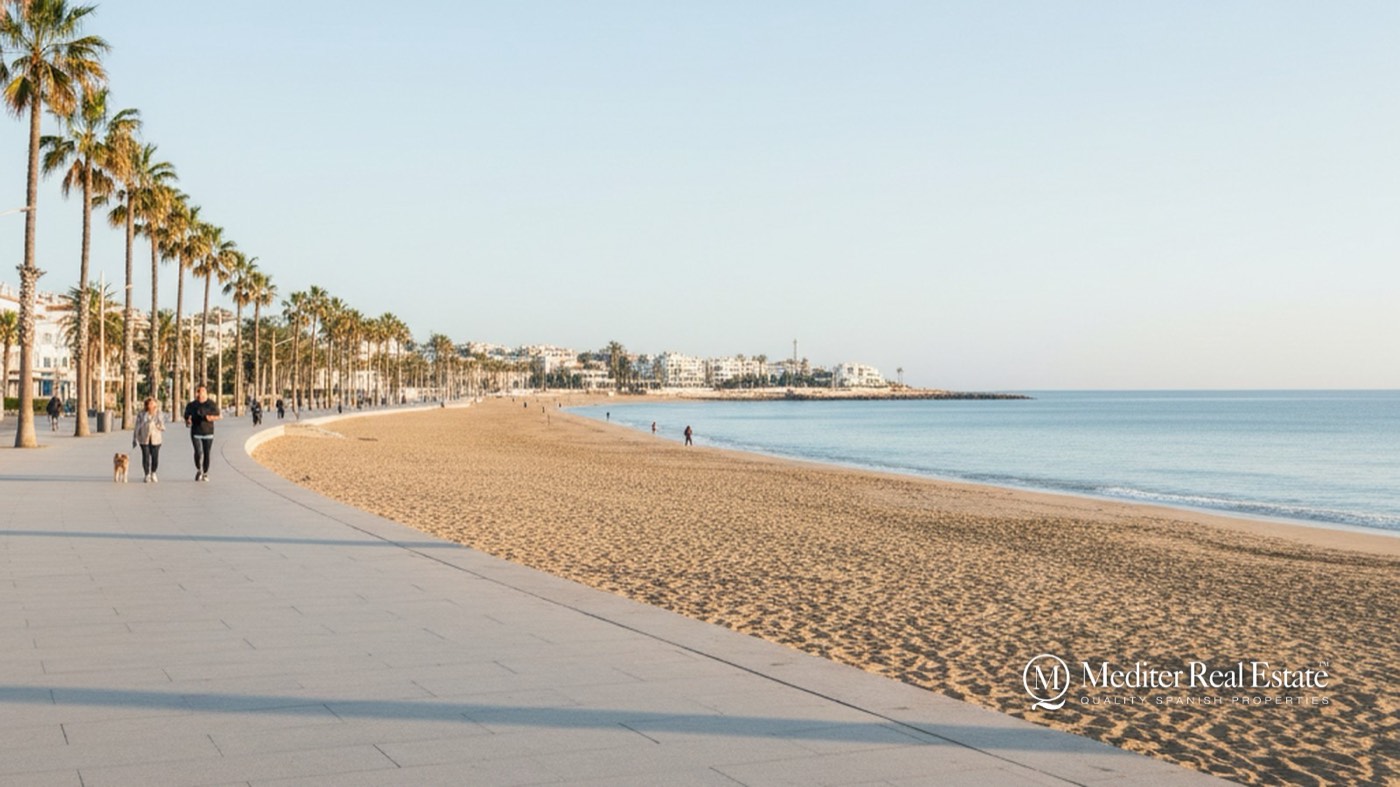
Which Spanish coast has the best year-round beach life for a future buyer? For warm, swimmable water the longest, Costa del Sol and Costa Almería win on winter mildness, while Costa Blanca holds the most Blue Flag beaches of the four regions and Costa Cálida offers the calmest, shallowest bathing around the Mar Menor. All four give you a paved seafront promenade you can walk in December in shirtsleeves. Below we map the best beaches, the walks that stay open all year, and, because this is still a property decision, what it costs to buy near each one in 2026.
A Blue Flag is an annual award run by the Foundation for Environmental Education (FEE), given to beaches and marinas that meet set standards for water quality, safety, facilities and environmental management. Spain wins more Blue Flags than any country on earth, and three of our four regions sit near the top of the national table. For a buyer it is a useful shorthand: a town with several Blue Flag beaches has invested in lifeguards, accessible boardwalks, clean water testing and a maintained promenade, the exact amenities that hold a holiday-home value and keep a rental booked outside July and August.
The province of Alicante (Costa Blanca) is consistently one of the most awarded in all of Spain, typically carrying dozens of Blue Flags along a single coastline. Málaga (Costa del Sol) and Almería (Costa Almería) are both strong year on year, while Murcia (Costa Cálida) wins a smaller but high-quality cluster concentrated around La Manga and the Mar Menor. Flags are reissued each season, so treat the pattern, not a single year's exact count, as what matters.
The Costa Blanca is the Blue Flag heartland of the four regions, split into a greener, rockier north and a flatter, sandier, sunnier south. For year-round walkability and wide sandy bathing, the south is hard to beat: Torrevieja, Orihuela Costa, Guardamar del Segura and Santa Pola string together long promenades, salt-lake nature reserves and sheltered coves.
If you are weighing the two halves, our guides to living in Orihuela Costa, Torrevieja, Guardamar del Segura and Santa Pola give honest, listing-based pricing for each.
The south coast's flat seafront promenades run uninterrupted for kilometres and are walkable every month of the year. In the north, the cliff-top paths between coves around Jávea and Dénia are spectacular but steeper, pleasant in winter, hot in midsummer. The Orihuela Costa coastal path linking Cabo Roig to Campoamor is the classic daily walk for owners there.
The Costa Cálida ("warm coast") in Murcia centres on the Mar Menor, Europe's largest saltwater lagoon, warm, shallow and almost waveless, which makes it ideal for families, older swimmers and anyone nervous of open-sea currents. La Manga, a thin strip of land, has the Mediterranean on one side and the lagoon on the other, so you can quite literally choose your sea by the hour. Blue Flag awards here cluster around La Manga and the surrounding resorts.
South-west towards Cartagena and Mazarrón you find quieter, more Spanish seaside towns and dramatic, less developed coastline. The Costa Cálida is the value coast of the four for beachside buying, and it holds that reputation for yield too, as we set out in our Costa Cálida and Almería buy-to-let guide. If you plan to use the home as a holiday let, read the Costa Cálida holiday-home taxes guide on IBI and Modelo 210 before you commit.
The Costa del Sol's standout for walkers is the Senda Litoral, an ambitious boardwalk-and-promenade project stitching together a continuous coastal path along much of Málaga province, you can walk long, flat, sea-hugging stretches around Estepona, Marbella, Fuengirola and Benalmádena in any month. This is the mildest-winter coast of the four, so the promenade cafés stay open and the water is swimmable later into autumn than most of Spain.
The Costa Almería is the wild card, the driest, emptiest and most unspoilt coast of the four. The Cabo de Gata-Níjar Natural Park protects whole stretches of volcanic coast where you can still find near-empty Blue Flag beaches and coves reached only on foot: San José, Los Genoveses, Mónsul. Resort life concentrates further along at Mojácar, Vera and Roquetas de Mar, each with its own promenade. Almería's climate is semi-desert, giving it some of the mildest winters and lowest rainfall in Europe, the practical upside being a genuinely long swimming season.
Buyers here often combine a coastal base with an inland village home; see our Costa Almería village house guide and, for distressed-price opportunities, the bank repossession guide.
A beach is a lifestyle choice, but buying is a cost choice, and the purchase tax differs by region because each sits in a different autonomous community. Here is the honest comparison.
| Coast | Autonomous community | Signature beach / walk | Resale purchase tax (ITP) 2026 | New-build stamp duty (AJD) |
|---|---|---|---|---|
| Costa Blanca | Comunidad Valenciana | Guardamar dunes; Jávea coves | 9% (reduced from 10% for deeds signed from 1 June 2026, Ley 5/2025; 11% band above €1M) | 1.4% + 10% IVA |
| Costa Cálida | Murcia | Mar Menor lagoon; La Manga | 7.75% (Ley 3/2025) | 1.5% + 10% IVA |
| Costa del Sol | Andalucía | Senda Litoral boardwalk | 7% | 1.2% + 10% IVA |
| Costa Almería | Andalucía | Cabo de Gata coves | 7% | 1.2% + 10% IVA |
Two points competitor articles routinely get wrong. First, the Costa Cálida rate is 7.75% under Ley 3/2025, not the 8% still shown on many sites. Second, on the Costa Blanca the notary signing date decides whether you pay 9% or the old 10%, not the date of your arras (deposit) contract. On top of the tax, budget for the notary (~0.2-0.5%), Land Registry (~0.1-0.25%), a lawyer (~1% + IVA) and a gestoría (~€300). Rule-of-thumb totals on top of the price come to roughly 10-13% on a resale and 12-15% on a new build, with Andalucía at the lower end and the Comunidad Valenciana higher.
Remember the tax base, too: ITP and AJD are charged on the higher of your price or the cadastral "valor de referencia" set by the Catastro. If you negotiate a beachfront bargain below that reference value, you are still taxed on the reference figure, something to check before you celebrate a low price.
Seafront homes carry a specific legal risk under Spain's coastal law. The Ley de Costas setback-zone rules can limit, or in extreme cases remove, private rights on the strip closest to the sea, and the coastal flood and Ley de Costas risk guide explains how to screen a specific address. For any beach-adjacent purchase, read our dedicated beachfront property checklist before you sign, it is the single most important page on this list.
Across the four coasts Mediter currently lists 8,354 properties for sale, spanning Costa Blanca South, Costa Blanca North, Costa Cálida, Costa del Sol and Costa Almería, with written area guides for each seaside town. If you want to compare the coasts head to head before you travel, our four-coasts comparison guide puts them side by side.
Walking, yes, all four have flat, maintained promenades open every month, and the Costa del Sol's Senda Litoral and Costa Almería's Cabo de Gata trails are at their best in winter. Swimming is more seasonal: the Mediterranean is warmest from June to October everywhere, and the hardier swimmers on the Costa del Sol and Costa Almería (mildest winters, least rain) stretch that into November and beyond. The Mar Menor lagoon on the Costa Cálida warms fastest in spring because it is shallow. For nine or ten months of outdoor seaside life, any of the four delivers.
The province of Alicante on the Costa Blanca is consistently one of the most Blue Flag-awarded coastlines in Spain, ahead of Málaga (Costa del Sol) and Almería. Murcia's Costa Cálida wins fewer but concentrated around La Manga and the Mar Menor. Awards are reissued every season by the Foundation for Environmental Education.
The Costa del Sol and Costa Almería have the mildest winters and least rainfall of the four, giving the longest comfortable swimming season. The Costa Cálida's shallow Mar Menor lagoon warms earliest in spring.
The Mar Menor is a shallow, warm, almost waveless saltwater lagoon that is popular for families and older swimmers. It has faced well-publicised environmental pressure, so check current local water-quality notices before buying nearby, the same water testing that underpins Blue Flag awards is the figure to watch.
On top of the price, budget roughly 10-13% for a resale and 12-15% for a new build, driven mainly by regional purchase tax: 9% ITP on the Costa Blanca (Ley 5/2025, for deeds signed from 1 June 2026), 7.75% on the Costa Cálida (Ley 3/2025) and 7% in Andalucía (Costa del Sol and Costa Almería), plus notary, Land Registry, lawyer and gestoría fees.
Yes. The Ley de Costas defines public-domain and setback zones along the shore that can restrict building and, rarely, affect private rights. Always have a lawyer check a specific beachfront address against the coastal survey before buying.
Whether you dream of a Blue Flag promenade on the Costa Blanca, a lagoon-side home on the Costa Cálida, the mild winters of the Costa del Sol or the wild coves of Costa Almería, Mediter Real Estate can match the lifestyle to the right town, and the right budget. Get in touch at info@mediter.com or call +34 744 719 499, and tell us how you want to live by the sea in 2026.
Ciò che ci racconti qui lo usiamo solo per risponderti. Privacy
Usiamo i cookie necessari al funzionamento del sito. Con il suo consenso usiamo anche i cookie di Meta (Facebook) per misurare i nostri annunci e mostrarle immobili simili a quelli che ha guardato. I cookie di Google Analytics, anch’essi solo con il suo consenso, contano le visite e ci mostrano quali pagine sono utili.
Politica dei cookie