 Scritto da Nicki Price, CEO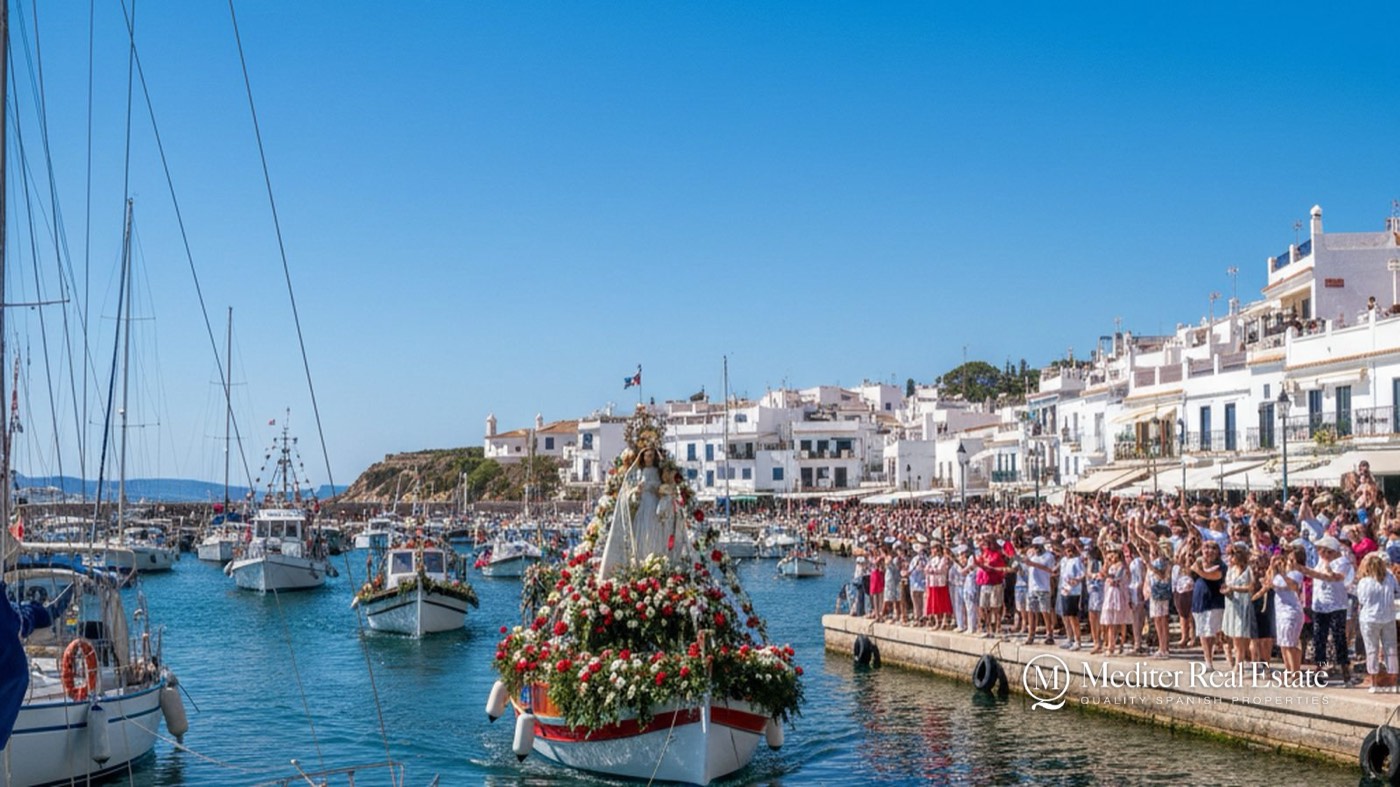
The single biggest waterfront fiesta across Costa Blanca, Costa Cálida, Costa del Sol and Costa Almería is the Virgen del Carmen on 16 July 2026, when nearly every fishing port carries the patron saint of seafarers out to sea on a decorated boat — you will find a procession in Torrevieja, Santa Pola, Águilas, Fuengirola, Estepona, Garrucha and dozens more. Beyond that, the calendar runs all year: Moros y Cristianos re-enactments on the beaches of Alicante province, the Mar Menor's summer fiestas in Murcia, Málaga's and Marbella's ferias, and Almería's quieter pueblo blanco festivals. This guide maps the headline dates by costa so you can time a visit — or plan life as an owner.
Festivals are not a footnote to coastal life here — they are the calendar. If you are weighing up where to buy, the rhythm of a town's fiestas tells you a great deal about its community, and whether it keeps its soul in August or empties out of season. For the practical side of ownership, see our guides to cost of living on the costas and the big-picture comparison of the four coasts.
The Virgen del Carmen is Spain's maritime patron saint, and on and around 16 July her image is carried from the parish church down to the harbour, placed on a fishing or pleasure boat, and sailed out to sea in a flotilla while onlookers line the quays. It is the one tradition shared by every fishing port across all four costas, and it is the single best way to see a coastal town at its most authentic.
The format varies in scale. In the larger ports — Torrevieja and Santa Pola on the Costa Blanca, Águilas on the Costa Cálida, Fuengirola, Estepona and Marbella on the Costa del Sol — the procession draws thousands, with brass bands, fireworks over the water and boats following the saint out of the marina. In smaller pueblos like Garrucha or Carboneras on the Costa Almería, it is more intimate but no less heartfelt. Many towns combine the religious procession with a week of concerts, food stalls and a beach party.
The Costa Blanca's signature tradition is Moros y Cristianos (Moors and Christians), a theatrical re-enactment of the medieval reconquest with elaborate costumes, mock battles and, in the coastal towns, a dramatic "landing" of the Moorish army on the beach. The best-known coastal version is in Villajoyosa (La Vila Joiosa), held around late July, where costumed boats storm the shore at dawn.
Alongside the Moros y Cristianos, the Costa Blanca packs in:
If the south of the province is on your shortlist, our area guides to Torrevieja and Santa Pola explain what daily life and prices look like between the fiestas.
The Costa Cálida's calendar revolves around the Mar Menor and the port town of Águilas, whose February Carnaval is one of only three in Spain declared of International Tourist Interest — expect days of flamboyant parades, Brazilian-style costumes and all-night street parties in late February 2026. In summer, Águilas and Cartagena stage major Virgen del Carmen processions on 16 July.
Cartagena's extraordinary Carthagineses y Romanos (Carthaginians and Romans) in the second half of September re-enacts the Punic Wars across the city and harbour, with Hannibal's camp set up by the water — a Costa Cálida answer to the Costa Blanca's Moros y Cristianos. Around the Mar Menor, resort towns such as Los Alcázares and San Javier hold their own summer fiestas and the San Javier jazz festival in July. For the ownership numbers in this region, see our guides to Costa Cálida holiday-home taxes and buy-to-let yields in Murcia and Almería.
The Costa del Sol's flagship is the Feria de Málaga in mid-August — nine days of daytime feria de día in the old town and nighttime fairground at the Cortijo de Torres, with flamenco, fino sherry and horses. Almost every town on this coast then holds its own August feria, and all the fishing ports keep the Virgen del Carmen on 16 July, with particularly big sea processions in Fuengirola, Estepona, Marbella and Benalmádena.
Benalmádena and Estepona both combine a working marina with a strong fiesta calendar — read our guides to living in Benalmádena and Estepona property.
The Costa Almería is the quietest and most traditional of the four, and its festivals reflect that — smaller, warmer and firmly rooted in the pueblos blancos behind the coast. The Feria de Almería in late August is the city's week-long celebration of its patron, the Virgen del Mar, who is herself a maritime figure carried in procession. The fishing villages of Garrucha, Carboneras and Roquetas de Mar all hold Virgen del Carmen sea processions on 16 July.
Mojácar's Moros y Cristianos in June and the Noche de San Juan bonfires on the beaches of Roquetas and Mojácar round out a low-key but genuine summer. If this unspoilt coast appeals, start with our pueblo blanco village-house guide and the overview of coastal living further west in Cádiz for comparison.
Here is the headline calendar for 2026. Dates for saint's-day and solstice festivals are fixed; ferias and re-enactments shift by a few days each year, so confirm with the local ayuntamiento before travelling.
| Festival | Costa | Where | When 2026 |
|---|---|---|---|
| Carnaval de Águilas | Costa Cálida | Águilas | Late February |
| Semana Santa | All four | Málaga, Cartagena, Lorca | Early April |
| Moros y Cristianos (Mojácar) | Costa Almería | Mojácar | June |
| Feria de Marbella (San Bernabé) | Costa del Sol | Marbella | ~11 June |
| Hogueras de San Juan | Costa Blanca | Alicante city | 20–24 June |
| Noche de San Juan (beach bonfires) | All four | Coast-wide | 23 June |
| Virgen del Carmen (sea procession) | All four | Every fishing port | 16 July |
| Habaneras choral festival | Costa Blanca | Torrevieja | Late July |
| Moros y Cristianos (La Vila Joiosa) | Costa Blanca | Villajoyosa | Late July |
| Feria de Málaga | Costa del Sol | Málaga | Mid-August |
| Feria de Almería (Virgen del Mar) | Costa Almería | Almería city | Late August |
| Carthagineses y Romanos | Costa Cálida | Cartagena | Second half September |
Festivals are a lifestyle plus, but they have practical consequences for owners near the waterfront. A procession route or feria ground next to your building means noise and road closures for a few days a year; conversely, a property within walking distance of the harbour and the fiestas is exactly what short-let guests want in July and August. If you plan to let, factor fiesta week into your pricing and check the rules first in our tourist-rental licence guide.
Many buyers drawn by the maritime culture also want a berth for their own boat. Moorings are scarce and sold or leased separately from the home — our boat mooring and marina berths guide covers how that works on the Costa Blanca. And if you are buying genuinely close to the sand, read the beachfront checklist and our note on Ley de Costas setback zones before you commit.
Mediter currently lists 15,695 properties for sale across Costa del Sol, Costa Blanca South, Costa Blanca North, Costa Cálida, Costa de Almería and Mallorca. That spread means we cover the port towns behind almost every festival in the table above — from the Virgen del Carmen harbours of Torrevieja and Santa Pola on the Costa Blanca to the fishing villages of the Costa Almería. Our area guides to each town explain current prices alongside the local lifestyle.
Where you buy decides your purchase tax, and the four costas differ. On a resale home, ITP (property transfer tax) is 9% on the Costa Blanca (Comunidad Valenciana, reduced from 10% for deeds signed from 1 June 2026 under Ley 5/2025, with an 11% band above €1M), 7.75% on the Costa Cálida (Murcia, under Ley 3/2025), and 7% on both the Costa del Sol and Costa Almería (Andalucía). A new build carries 10% IVA plus AJD stamp duty of 1.4% in Valencia, 1.5% in Murcia and 1.2% in Andalucía. Note that the Agencia Tributaria taxes the higher of your price or the cadastral valor de referencia. Budget roughly 10–13% on top of a resale and 12–15% on a new build once notary, Registro de la Propiedad, lawyer and gestoría fees are added — the lower end in Andalucía, the higher end in Valencia.
The feast day is fixed on 16 July 2026. Most fishing ports hold the sea procession on that evening or the nearest weekend, often as the climax of a week of concerts and food stalls.
The most spectacular coastal version is in Villajoyosa (La Vila Joiosa) on the Costa Blanca in late July, famous for the dawn "landing" of costumed boats on the beach. Mojácar on the Costa Almería holds a smaller version in June, and Cartagena's Carthaginians and Romans in September offers a related harbourside spectacle on the Costa Cálida.
The Costa Blanca and Costa del Sol are the busiest — Alicante's Hogueras, Villajoyosa's Moros y Cristianos and Torrevieja's Habaneras on one coast; Málaga's and Marbella's ferias on the other. The Costa Cálida peaks with Águilas Carnaval and Cartagena's re-enactment, while the Costa Almería is quieter and more traditional.
Only for a handful of days a year. A home on a procession route or beside a feria ground will see noise and closures during fiesta week, but proximity to the harbour and the celebrations is a strong draw for short-let guests and resale appeal alike.
Yes. Águilas Carnaval falls in February, Semana Santa (Easter) in early April 2026 brings major processions in Málaga and Cartagena, and Cartagena's Carthaginians and Romans runs into late September — so the four costas offer waterfront traditions well beyond July and August.
Whether you dream of watching the Virgen del Carmen sail out of your local harbour, joining the Moros y Cristianos crowds, or simply owning a home in a town that keeps its traditions alive, Mediter Real Estate can help you find it across the Costa Blanca, Costa Cálida, Costa del Sol and Costa Almería. Contact us at info@mediter.com or +34 744 719 499 and tell us which coast — and which fiesta — speaks to you.
Ciò che ci racconti qui lo usiamo solo per risponderti. Privacy
Usiamo i cookie necessari al funzionamento del sito. Con il suo consenso usiamo anche i cookie di Meta (Facebook) per misurare i nostri annunci e mostrarle immobili simili a quelli che ha guardato. I cookie di Google Analytics, anch’essi solo con il suo consenso, contano le visite e ci mostrano quali pagine sono utili.
Politica dei cookie