 Автор Nicki Price, CEO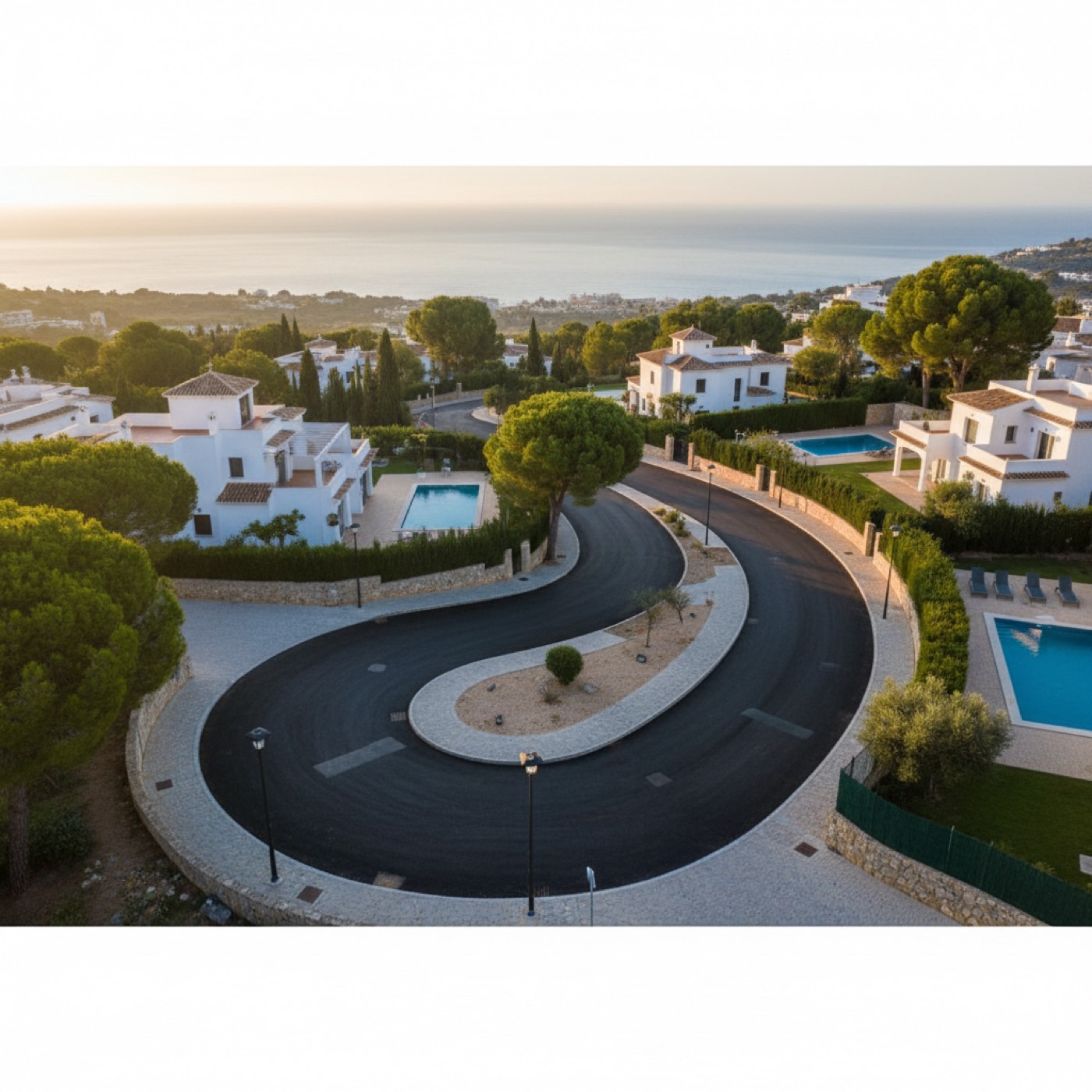
Most villas and townhouses sold to international buyers on the Costa Blanca — and across the Costa Cálida, Costa del Sol and Costa Almería — sit inside an urbanisation (urbanización): a purpose-built residential estate with its own roads, street lighting, water and drainage mains, and often shared pools and gardens. The single most important thing to establish before you sign is who legally owns and maintains those roads and services, and who pays for them. Get it wrong and you can inherit an annual bill you never expected, or buy into a half-finished estate the town hall refuses to adopt.
In short: on the Costa Blanca a road can be public (adopted by the ayuntamiento), in which case the town hall maintains it from your council taxes; or private (unadopted), in which case the owners pay for it, usually through an entidad urbanística de conservación or the property's community of owners. A "finished" urbanisation is one the developer has formally handed over to the town hall; an unfinished urbanisation has never been legally completed, which is where the real financial and legal risk lies. Below we explain exactly how to check which situation you are buying into.
An urbanisation is a tract of land that was rezoned and developed for housing under a formal urban-planning scheme (a plan parcial). The developer is legally obliged to install the urbanisation infrastructure — roads, pavements, street lighting, potable water mains, sewage and stormwater drainage, and green zones — before or alongside building the homes. Only when that infrastructure is complete and certified can the developer hand it over to the town hall.
Costa Blanca hotspots such as Jávea, Moraira, Calpe, Dénia, La Nucía, Rojales (Ciudad Quesada) and the Orihuela Costa are dominated by urbanisations, many built in successive waves from the 1970s to the 2020s. Because they span decades, their legal status varies enormously from street to street. The same pattern applies inland of Torrevieja on the Costa Cálida, around Marbella and Mijas on the Costa del Sol, and across Vera and Mojácar on the Costa Almería.
The pivotal question is whether the estate's roads are públicas (adopted) or privadas (unadopted).
Neither is automatically "bad", but they behave very differently. Public roads mean predictable low running costs but you have little control over standards. Private roads can be beautifully kept and gated, but the bill lands on you — and if the estate is large, it can be substantial.
Where an urbanisation's infrastructure has not been adopted by the town hall, Spanish planning law allows (and often requires) the creation of an entidad urbanística de conservación — a conservation entity, sometimes shortened to entidad urbanística or entidad de conservación. This is a public-law body, registered with the town hall, made up of all the plot owners in the scheme. Its job is to maintain the shared urban infrastructure: roads, pavements, public lighting, drainage and green zones.
It is crucial not to confuse this with an ordinary community of owners (comunidad de propietarios) under the Horizontal Property Law, which we cover in our guide to community fees in Spain in 2026. Key differences:
| Feature | Entidad urbanística de conservación | Comunidad de propietarios |
|---|---|---|
| Legal nature | Public-law body linked to the planning scheme | Private-law body under Horizontal Property Law |
| What it maintains | Roads, street lighting, mains drainage, public green zones | The building's shared areas: pool, lifts, gardens, façade |
| Membership | Compulsory for all plot owners in the scheme | Compulsory for owners of units in the building |
| Non-payment | Debts can be collected via the town hall (vía de apremio), like a tax | Community can sue and place a charge on the property |
| Debt on the property | Attaches to the plot — the new owner can inherit arrears | Up to the current year plus previous 3 years attaches |
The sting in the tail is enforcement: because an entidad urbanística is a public body, unpaid conservation charges can be pursued through the same aggressive administrative collection route (vía de apremio) used for unpaid taxes, and the debt sticks to the plot. Always ask your lawyer to obtain a certificate of zero debt from the entidad before completion.
There is no single figure — it depends entirely on what is private, how large the estate is and what facilities it includes. As a practical guide for the Costa Blanca and neighbouring costas:
| Type of charge | What it covers | Indicative annual cost |
|---|---|---|
| IBI (council tax) | Payable in every case; higher where roads are adopted | €300–€1,200+ depending on cadastral value |
| Entidad de conservación fee | Private roads, lighting, drainage, green zones | €150–€800 |
| Comunidad fee (villa estate) | Shared pool, gardens, security gate | €400–€1,500 |
| Comunidad fee (apartment complex) | Pool, lifts, communal cleaning, insurance | €700–€2,500+ |
| Basura (refuse) — where separate | Bin collection in some municipalities | €60–€200 |
A detached villa on a gated, well-maintained hillside estate near Moraira might pay both an entidad fee and a comunidad fee, whereas an older villa on a road the town hall has adopted might pay almost nothing beyond IBI. Ask for the last two years of accounts before you commit. For a full picture of the recurring taxes that sit alongside these charges, see our guide to second-home tax in Spain for 2026.
An unfinished urbanisation in Spain is one where the developer never completed the infrastructure to the standard required by the plan parcial, or completed it but never formally handed it over — so the town hall has refused to adopt it. This is not rare on parts of the Costa Blanca and Costa Cálida, particularly on schemes launched just before the 2008 crash where the developer went bust.
The consequences for an owner can include:
Before you buy on any estate — especially a partially built one where empty plots sit between finished villas — ask your lawyer to confirm, in writing, whether the urbanisation has been legally received (recepción) by the town hall and, if not, what the plan and cost is to complete it. This due diligence sits alongside the standard checks in our guides to the nota simple and to off-plan versus resale on the Costa Blanca.
In an urbanisation with adopted, finished infrastructure, mains water, electricity and sewage are all in place and legally connected. In older or unfinished schemes you may find private water tanks, shared boreholes or septic tanks (fosas sépticas) rather than mains drainage. This matters both for cost and for legality — a property on a fosa séptica cannot be legalised as if it were on mains sewage. If the home relies on a private supply, read our guide to rural property water, boreholes and connections before proceeding.
Once you complete, transferring the utility contracts into your name is a separate process; our guide to setting up utilities after completion walks through it. Confirm before signing that the supplies are contracted and paid up, and that the meters serve your property and not a neighbour's.
Urbanisation status does not change your purchase tax, but the type of property does. For 2026:
| Region | Resale (ITP) | New build |
|---|---|---|
| Costa Blanca (C. Valenciana) | 9% (from deeds signed 1 June 2026; 11% above €1M) | 10% IVA + 1.4% AJD |
| Costa Cálida (Murcia) | 7.75% | 10% IVA + 1.5% AJD |
| Costa del Sol (Andalucía) | 7% | 10% IVA + 1.2% AJD |
| Costa Almería (Andalucía) | 7% | 10% IVA + 1.2% AJD |
Two points buyers often miss. First, on the Costa Blanca the ITP rate is now 9% for deeds signed from 1 June 2026, and it is the notary signing date — not the date of your arras (deposit) contract — that decides which rate applies. Second, the tax is calculated on the higher of the price or the cadastral valor de referencia, so a bargain purchase can still be taxed on a higher official value. Budget roughly 10–13% on top of the price for a resale and 12–15% for a new build, including notary, land registry, lawyer (~1% + IVA) and gestoría. Our full breakdown lives in the complete guide to taxes when buying property in Spain in 2026.
It is a compulsory public-law body of all the plot owners in an urbanisation whose roads and services have not been adopted by the town hall. It funds and manages the upkeep of private roads, street lighting, drainage and green zones. Because it is a public body, unpaid charges can be collected like a tax and the debt attaches to the plot.
Your lawyer can confirm at the town hall whether the developer's infrastructure was formally received (recepción). If it was not, the estate is unfinished, and owners may face special levies to complete roads, lighting or drainage. Empty plots between finished villas and poor road surfaces are warning signs.
No. Community fees (comunidad de propietarios) cover a building's shared areas such as the pool, lifts and gardens. Urbanisation charges (entidad de conservación) cover the estate's roads, lighting and drainage. A villa can be liable for both, so check each separately before buying.
The owners do, through the entidad de conservación or the community budget. If the road is public (adopted), the town hall pays from municipal funds and your IBI. Always ask which applies, as private-road estates carry ongoing and sometimes unpredictable maintenance costs.
Yes — this is the key risk. Debts to an entidad urbanística attach to the plot, and community debts for the current year plus the previous three years also pass to the new owner. Insist on zero-debt certificates from both bodies before completion.
Whether it is a hillside villa near Moraira, a golf home on the Orihuela Costa or an apartment on the Costa Cálida, our team checks the road status, entidad urbanística and finished-scheme paperwork before you commit — so there are no surprises after completion. Contact Mediter Real Estate today for honest, region-specific guidance on buying in an urbanisation across the Costa Blanca, Costa Cálida, Costa del Sol and Costa Almería.
Те, що ви розповісте тут, ми використовуємо лише щоб відповісти вам. Privacy
Ми використовуємо файли cookie, потрібні для роботи сайту. З вашої згоди ми також використовуємо cookie Meta (Facebook), щоб оцінювати нашу рекламу й показувати вам об’єкти, схожі на ті, що ви переглядали. Cookie Google Analytics, теж лише з вашої згоди, рахують відвідування й показують нам, які сторінки корисні.
Політика cookie