 Автор Nicki Price, CEO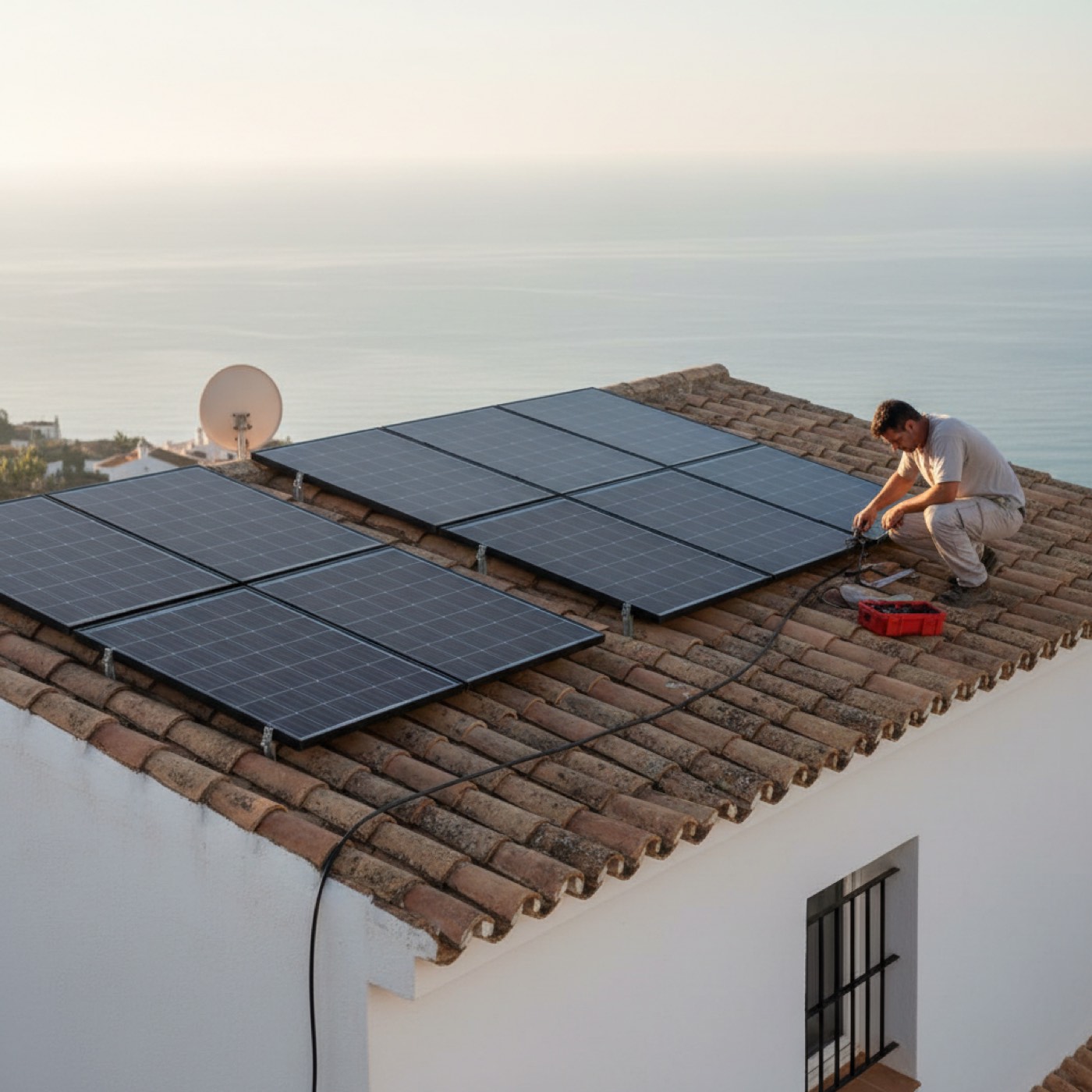
If you are buying or selling on the Spanish coast in 2026, you legally need a valid energy performance certificate (EPC) — in Spanish, the certificado de eficiencia energética — before the property can be advertised or signed at the notary. It is the seller's responsibility, it must be registered with the regional energy authority, and it costs roughly €90 to €350 for a typical coastal home depending on size and region. No valid certificate means you cannot legally complete the sale.
Solar panels are a separate but closely related question. Across the Costa Blanca, Costa Cálida, Costa del Sol and Costa Almería, self-consumption solar (autoconsumo) is now straightforward, IBI discounts are common, and — most importantly for buyers — a good solar setup can lift a property's EPC rating and its resale value. Below we cover exactly what applies in each of our four regions, with the real numbers you can act on.
The certificado energético is a legally mandatory document (Royal Decree 390/2021) that rates a property's energy efficiency on a scale from A (most efficient) to G (least efficient), based on estimated annual energy consumption and CO₂ emissions. A qualified technician — an architect, engineer or authorised surveyor — visits the property, measures insulation, glazing, orientation, heating and cooling systems, and issues the certificate.
You need a valid EPC to:
The certificate is valid for 10 years (or 5 years for a G-rated property in some regions), after which it must be renewed. It is registered regionally — with the Generalitat Valenciana for the Costa Blanca, the Región de Murcia for the Costa Cálida, and the Junta de Andalucía for the Costa del Sol and Costa Almería.
The technician's fee is unregulated, so prices vary. On top of the fee, most regions charge a small registration fee to log the certificate officially. Below are realistic 2026 ranges for a typical apartment or villa in each of our regions.
| Region | Registering authority | Typical apartment | Typical villa |
|---|---|---|---|
| Costa Blanca (C. Valenciana) | Generalitat Valenciana | €90–€150 | €150–€300 |
| Costa Cálida (Murcia) | Región de Murcia | €90–€140 | €140–€280 |
| Costa del Sol (Andalucía) | Junta de Andalucía | €100–€160 | €160–€350 |
| Costa Almería (Andalucía) | Junta de Andalucía | €90–€150 | €150–€320 |
As a buyer you should never pay for the certificate — it is a seller's legal obligation. Do, however, ask to see it and check the rating, because it tells you a great deal about running costs and future upgrade needs.
Here is the reality most buyers are surprised by: the vast majority of resale property on all four costas rates E, F or G. Spain's mild climate historically meant homes were built with minimal insulation, single glazing and no central heating — features that score badly on the certificate even if the home feels comfortable for most of the year.
What tends to push a rating higher:
A poor rating is not a legal barrier to buying, but it signals higher electricity bills and a likely renovation to-do list. Factor that into your price negotiation.
For standard rooftop self-consumption (autoconsumo) systems on an existing home, the process is far simpler than it used to be. The infamous "sun tax" was abolished back in 2018, and Royal Decree 244/2019 made self-consumption and surplus compensation the norm across Spain.
In practical terms, for a typical villa or townhouse on the Costa Blanca, Costa Cálida, Costa del Sol or Costa Almería you will usually need:
Beware in protected zones. Panels on a historic building, inside a conservation area, or on a Ley de Costas setback zone plot may face extra restrictions on placement and visibility. A reputable installer handles the paperwork end to end, and your Spanish lawyer can confirm any listing or heritage limits before you buy.
The costas are among the sunniest places in Europe — Almería and the Murcian coast see some of the highest solar irradiation figures on the continent — so payback periods here are shorter than almost anywhere else in the EU.
| System size | Suits | Typical installed cost | Rough annual saving |
|---|---|---|---|
| 3 kW | Apartment / small townhouse | €3,500–€5,000 | €500–€800 |
| 5 kW | Average villa | €6,000–€8,500 | €900–€1,400 |
| 5 kW + battery | Villa wanting evening/night self-supply | €9,000–€13,000 | €1,200–€1,800 |
Payback typically lands between 5 and 8 years without subsidy, and faster with grants or IBI discounts. Given the region's sunshine and the ability to run air-conditioning through the hottest months on your own generation, solar is one of the highest-return upgrades a coastal owner can make — see our guide to setting up utilities after completion for how to coordinate this alongside your electricity contract.
This is where the four regions genuinely differ, so ground your expectations regionally rather than assuming one national scheme.
Andalucía has been among the most active regions for the solar subsidy Andalusia buyers ask about, channelling EU Next Generation funds through its energy agency (Agencia Andaluza de la Energía). These programmes typically cover a meaningful share of the cost of self-consumption systems and batteries, though funding is released in tranches that open and close as budget is exhausted — so timing matters. Many Andalusian municipalities also grant IBI (council tax) reductions of up to 50% for several years after fitting solar, plus reductions on the ICIO building tax. Check the specific town hall, as terms vary between, say, Marbella, Estepona and Almería city.
The Generalitat Valenciana runs periodic renewable-energy aid programmes for self-consumption and storage, and a large number of Costa Blanca councils offer IBI bonuses of up to 50% and ICIO discounts for homes that install solar. As in Andalucía, national Next Generation funding has topped these up in recent years. Deadlines and available budget change frequently, so confirm the current call before committing.
Murcia likewise operates regional self-consumption aid and several coastal municipalities offer IBI rebates for solar installations. If you are weighing a holiday home here, our guide to Costa Cálida holiday-home taxes explains how the IBI discount interacts with your annual bill.
Important: subsidy amounts, percentages and deadlines change from one funding round to the next, and are often first-come-first-served. Always confirm the live figures with the regional energy agency or your installer at the moment you buy — do not rely on a percentage quoted in an old article.
A better energy rating and installed solar increasingly move the needle on price and desirability, especially with Northern European buyers who are used to reading an EPC before making an offer. Concretely:
If you are still deciding where to buy, our Costa Blanca vs Costa del Sol comparison and the complete Costa Blanca guide put energy and lifestyle factors side by side.
Yes. A valid, registered certificado energético is mandatory to advertise and to sign the escritura at the notary. It is the seller's responsibility and is handed to the buyer on completion.
Generally 10 years from the date of registration. Some regions require earlier renewal for the lowest (G) ratings, and you should renew if you make significant energy improvements such as installing solar or replacing the heating system.
No. Most resale homes on the costas rate E, F or G and are bought and sold normally. A poor rating simply means higher running costs and potential upgrade work — useful leverage when negotiating the price.
On a shared roof you need the community of owners' approval by vote. On a private terrace or your own roof it is easier, but you still notify the town hall. Check your comunidad statutes before assuming you can proceed.
Both Andalucía (Costa del Sol and Costa Almería) and the Comunidad Valenciana (Costa Blanca) have run generous self-consumption grants plus IBI discounts of up to 50%, with Murcia (Costa Cálida) offering similar municipal rebates. Because funding is released in limited tranches, the best deal depends on what is open when you buy — always confirm current terms.
Yes, in most cases. Solar reduces estimated consumption and emissions, which is exactly what the certificate measures. Combined with efficient heating and glazing, it can lift a home a full letter grade or more — worth commissioning a fresh certificate after installation.
Whether you are weighing an energy-efficient new build or planning solar upgrades on a resale villa, our team knows exactly how EPC rules and solar incentives work across the Costa Blanca, Costa Cálida, Costa del Sol and Costa Almería. Contact Mediter Real Estate today and let us help you find — or improve — a home that is comfortable, efficient and easy to resell.
Те, що ви розповісте тут, ми використовуємо лише щоб відповісти вам. Privacy
Ми використовуємо файли cookie, потрібні для роботи сайту. З вашої згоди ми також використовуємо cookie Meta (Facebook), щоб оцінювати нашу рекламу й показувати вам об’єкти, схожі на ті, що ви переглядали. Cookie Google Analytics, теж лише з вашої згоди, рахують відвідування й показують нам, які сторінки корисні.
Політика cookie