 Автор Nicki Price, CEO
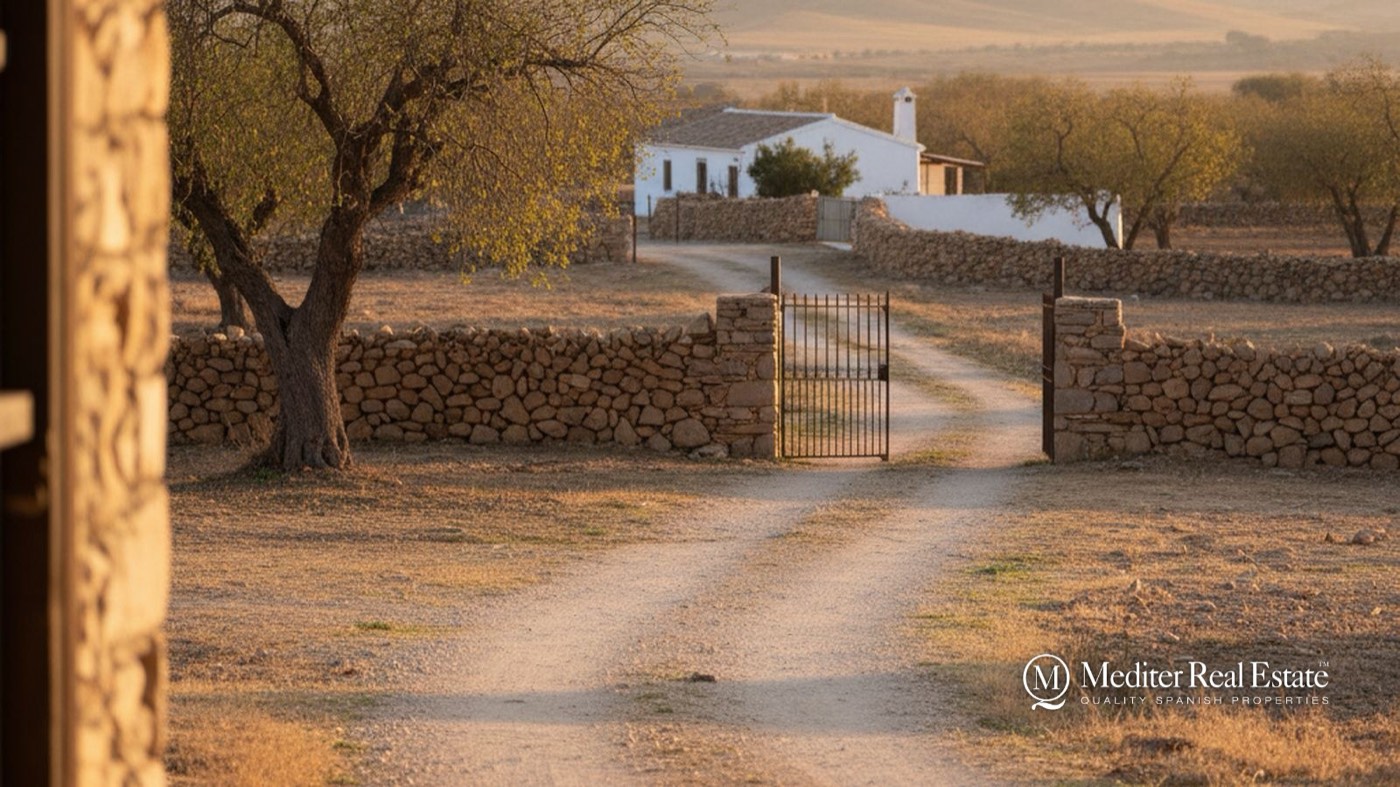
A servidumbre de paso is a legal right of way that lets one plot cross another to reach a public road, a water source or a utility line, and on the rural Costa Almería it is extremely common, because many cortijos and fincas in the Almanzora Valley, the Tabernas foothills and inland from Mojácar were never served by a public road. Before you buy, you need to confirm in writing that the property either fronts a public road or has a recorded, registered right of way that is not expiring and not disputed. If access depends on crossing a neighbour's land with nothing in the Registro de la Propiedad, treat it as a serious defect, not a detail.
Get it right and a servidumbre is harmless, you simply have a documented route in and out. Get it wrong and you can own a beautiful landlocked house you cannot legally reach by car, which is close to unsellable and unmortgageable. This guide, grounded in how rural property actually trades on the Costa Almería, shows you exactly what to check in 2026.
A servidumbre de paso is an easement: a permanent burden on one property (the predio sirviente, serving plot) for the benefit of another (the predio dominante, dominant plot). It is governed by the Código Civil (articles 530 onwards), which specifically provides that an owner of a finca enclavada, a plot with no adequate exit to a public road, has the right to demand a way across neighbouring land, in exchange for compensation. The route should take the shortest practical path that causes the least damage to the serving plot.
Crucially, that legal right only becomes a clean, enforceable asset when it is written into a deed and registered. An unwritten "everyone's always driven through here" arrangement is a dispute waiting to happen when a neighbour sells, dies or falls out with you.
The Costa Almería interior is agricultural land that was carved into small plots over generations, almond terraces, olive groves and huertas divided between heirs. Houses were built to serve the farm, not a road network, so the only way to many a restored cortijo near Albox, Arboleas, Zurgena, Cantoria or Lubrín is a track that crosses one or more neighbours' land. Add the region's rustic land rules and frequent AFO / rural build questions, and access is often tangled up with wider legalisation issues on the same property.
The same situation appears on the inland Costa Blanca (around the Hondón valleys and Vega Baja fincas), the Costa Cálida (the Murcian campo near Fortuna or the Río Chícamo), and in the Andalucían hills behind the Costa del Sol, but Almería's sparsely-roaded interior is where buyers meet it most often.
Check three documents and, ideally, walk the route. A registered servidumbre should appear in all of the first two, and the physical track should match what is written.
| Document / source | What it tells you | What a red flag looks like |
|---|---|---|
| Nota simple (Registro de la Propiedad) | Whether a servidumbre is legally registered as a benefit to, or burden on, this plot (cargas section) | Access needed, but no servidumbre entry at all |
| Escritura (title deed) | The wording that created or transferred the easement, its route and any conditions | Deed silent on access, or route described vaguely ("the usual path") |
| Catastro plan | Plot boundaries and whether your plot physically touches a public road | Plot wholly enclosed by other private plots (classic finca enclavada) |
| Site visit | Whether the real track matches the paper, who maintains it, gates/chains | Locked gate, hostile neighbour, or a route that differs from the deed |
Insist your independent lawyer orders the nota simple and reads the escritura specifically for access. A good lawyer will also request a certificación from the Catastro to confirm whether the plot adjoins a camino público (public track). If it does, you may not even need a servidumbre. This is a standard part of the wider non-resident buying process, do not let it be skipped.
A finca enclavada is a landlocked plot with no legal access to a public road. Under the Código Civil the owner can claim a servidumbre de paso across a neighbour, so it is not hopeless, but if that right has never been formalised, you are buying a lawsuit-in-waiting. Establishing a new right of way by agreement needs a cooperative neighbour and a notarised deed; establishing one by force through the courts is slow, costly and sours relations with the very person whose land you must cross daily.
Our firm rule for buyers: if the plot is enclavada and there is no registered servidumbre, make your purchase conditional on the seller formalising and registering the access before completion, or walk away.
A clean, registered right of way with good physical access barely affects value. An unresolved access problem should cut the price hard, because the buyer takes on legal risk and possibly the cost of creating the easement. Either way, the purchase taxes are the same, a servidumbre does not change the tax base.
On the Costa Almería (Andalucía) a resale attracts 7% ITP, charged by the Junta de Andalucía on the higher of the price or the Catastro valor de referencia, worth remembering on cheap rural plots, where the reference value can exceed a low sale price. A rare new build on rustic land would instead carry 10% IVA plus 1.2% AJD. Here is how Almería compares across our regions:
| Region | Resale ITP | Governing law / body |
|---|---|---|
| Costa Almería (Andalucía) | 7% | Junta de Andalucía |
| Costa del Sol (Andalucía) | 7% | Junta de Andalucía |
| Costa Cálida (Murcia) | 7.75% | Ley 3/2025 |
| Costa Blanca (C. Valenciana) | 9% (from deeds signed 1 June 2026; 11% above €1M) | Ley 5/2025 |
On top of ITP, budget the usual notary (~0.2-0.5%), Registro de la Propiedad (~0.1-0.25%), lawyer (~1% + IVA) and gestoría (~€300). For a resale in Andalucía that puts total buying costs around 10-11% on top of the price. With a tricky servidumbre you may add surveyor or legal fees to pin down the route.
Across all our coasts Mediter Real Estate currently lists 8,422 properties, with dedicated stock on the Costa de Almería. Rural homes there span the full range, from inexpensive village and country properties needing legal tidy-ups to turnkey restored cortijos, exactly the segment where access and servidumbre questions come up most. For village alternatives with road frontage, our Costa Almería village house guide is a useful companion read.
Most rural access disputes on the Costa Almería fall into a handful of patterns. Knowing them before you sign lets your lawyer close the gap in the contract.
Because rural access so often sits alongside build-legality questions, pair this check with a look at the AFO certificate position and, if you plan works, the rural renovation permit rules.
A registered right of way with proper vehicular access usually does not stop a lender, though rural rustic property is harder to mortgage than coastal apartments in any case. A finca enclavada with no registered access is a different matter: the bank's valuer (tasación) will flag it, and most lenders will decline or lend very conservatively. If you need a non-resident mortgage, resolve access on paper first.
Resale value hinges on clean, documented access. When you come to sell, your buyer's lawyer will run exactly the checks above; an unresolved access question will knock your price or kill the sale. The cheapest time to fix a servidumbre is before you buy, ideally at the seller's cost, not years later when you are the one trying to sell.
A properly constituted servidumbre should appear in the cargas (charges) section of the nota simple from the Registro de la Propiedad, either as a burden on the serving plot or a benefit to the dominant plot. If access is clearly needed but nothing appears, that is a red flag to investigate before buying.
Not if it is registered and used within its terms, a registered right of way is enforceable, and blocking it (a locked gate, a wall) can be challenged legally. An unregistered "customary" route, however, can be closed off much more easily, which is why formalising it in a notarised deed matters so much.
Under the Código Civil, maintenance generally falls on the owner of the dominant plot who benefits from the access, unless the deed or a written agreement says otherwise. Because this is a frequent source of friction, agree it in writing when the servidumbre is created.
Yes. The owner of a finca enclavada has a legal right under the Código Civil to a way across neighbouring land in exchange for compensation. The clean route is a notarised agreement with the neighbour, registered at the Registro de la Propiedad; failing agreement, a court can impose one, but that is slow and costly.
No. On the Costa Almería you pay 7% ITP to the Junta de Andalucía on the higher of the price or the Catastro valor de referencia, regardless of any easement. A servidumbre affects legal risk and value, not the tax base.
Access and servidumbre questions are solvable, but only if they are checked before you sign. Mediter Real Estate sells across the Costa Almería, Costa Cálida, Costa Blanca and Costa del Sol, and can help you find rural and village property with clean, documented access, working alongside an independent lawyer who verifies the right of way on your behalf. Contact our team to talk through a specific property or to see what fits your plans.
Те, що ви розповісте тут, ми використовуємо лише щоб відповісти вам. Privacy
Ми використовуємо файли cookie, потрібні для роботи сайту. З вашої згоди ми також використовуємо cookie Meta (Facebook), щоб оцінювати нашу рекламу й показувати вам об’єкти, схожі на ті, що ви переглядали. Cookie Google Analytics, теж лише з вашої згоди, рахують відвідування й показують нам, які сторінки корисні.
Політика cookie