 Skriven av Nicki Price, CEO
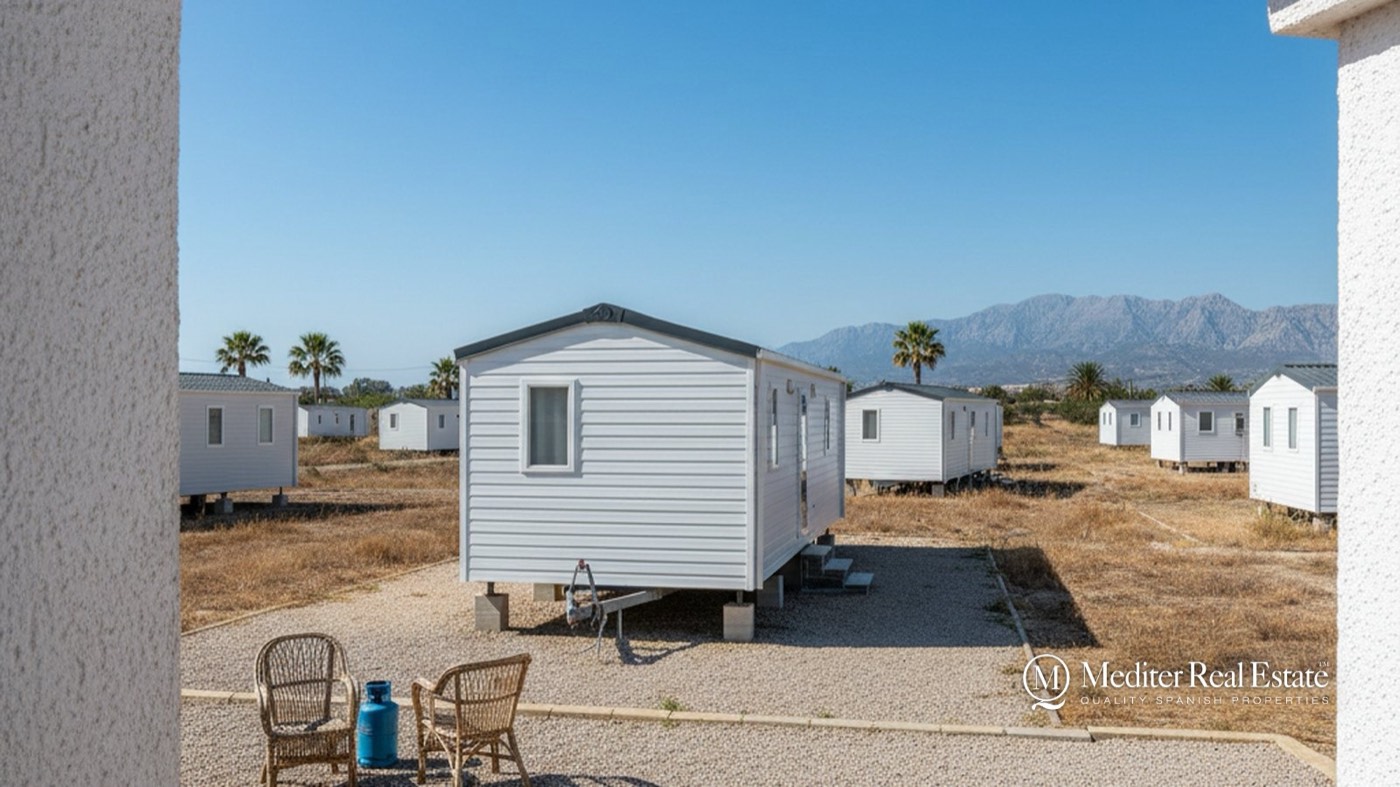
Can you legally buy a mobile or park home to live in on the Costa Almería? The short answer: the home itself is legal, but you almost never own the land under it, and living in one permanently is only lawful on land zoned and licensed for residential use, which the typical cheap "park home plot" is not. In Andalucía (which covers both the Costa Almería and the Costa del Sol), a static caravan on rural land, or on a licensed camping/caravan park, is legally a movable object or a seasonal tourist installation, not a house. That single fact drives every risk below: you cannot register it at the Registro de la Propiedad, you cannot normally get a cédula de habitabilidad for it, and reselling it is far harder than reselling bricks and mortar.
This guide explains what you are really buying, where it is and isn't legal, how it differs from a conventional home across our four coasts, Costa Blanca, Costa Cálida, Costa del Sol and Costa Almería, and the specific traps that catch international buyers. The Costa Almería (Vera Playa, Los Gallardos, Turre, Mojácar area) has more mobile-home plots on the market than any of our other coasts, so we treat it as the main example throughout.
A mobile or park home is a factory-built, transportable dwelling, a static caravan ("caravana"), a wooden chalet-style casa móvil, or a modular cabin, placed on a plot but, crucially, kept legally "movable": it rests on wheels, jacks or a light base rather than being bolted into permanent foundations. Spanish planning law treats it as personal property, not as a building on the land, provided it stays genuinely removable.
That distinction is the whole game. The moment you pour concrete foundations, add a fixed porch, a brick skirt, a solid roof extension or mains connections that make it non-removable, planning authorities can reclassify it as an edificación (a building), and then it needs the same licences as any house. On rural land it usually cannot get them, which is how owners end up with an illegal build facing a demolition or fine. Our guide to the AFO certificate for illegal rural builds explains that parallel problem in more detail.
It depends entirely on how the land is zoned. On urban land (suelo urbano) a static home is usually fine as a temporary fixture but pointless, you could build a real house there instead. The contested cases are on rural land (suelo rústico / no urbanizable), where the plots are cheap and the sellers are most active. Here the rule in Andalucía is: you may place a genuinely movable caravan for your own occasional, non-permanent use on agricultural land, but you may not establish a permanent dwelling or create a new "urbanisation" without a planning change that almost never comes.
Understanding the zoning is step one, and it is the same principle we set out for the Costa Blanca in suelo rústico vs urbano. On the Costa Almería, demand the nota simple and the land classification before you pay anything, a nota simple reveals whether the plot is even registered and free of charges. If a seller says "everyone lives here all year, the town hall turns a blind eye", treat that as a warning, not a reassurance: an informal tolerance is not a legal right, and it does not transfer to the next owner.
Permanent residence requires a dwelling with a cédula de habitabilidad (habitation certificate) and a legal address. A movable caravan on rústico land cannot normally obtain a cédula de habitabilidad, which means you cannot register it on the padrón as your official home, which in turn complicates NIE-based paperwork, utility contracts and residency applications. You can physically sleep there; you cannot easily make it your lawful, registered home.
Yes, and this is the safest version. Licensed holiday parks ("camping-caravaning") on the Costa Almería and Costa Blanca sell or rent long-term pitches for your static home. Here the land is already licensed (as a tourist installation), the park holds the permits, and services are legitimate. But read what you are signing:
The appeal is obvious: a static home can cost a fraction of a cheap apartment. But the comparison below shows what you give up, and why the purchase tax rules that normally apply to property barely feature here.
| Feature | Mobile / park home | Bricks-and-mortar home |
|---|---|---|
| Legal nature | Movable object; not real estate | Real property (inmueble) |
| Land ownership | Rarely, usually rented/licensed pitch | Yes, the plot is yours |
| Registro de la Propiedad entry | No | Yes (escritura + registration) |
| Cédula de habitabilidad | Usually not obtainable | Yes |
| Purchase tax | No property ITP/IVA on the unit as real estate; treated as a movable-goods sale | Resale ITP 7% (Andalucía); new build 10% IVA + 1.2% AJD |
| Mortgage finance | Very hard to impossible | Available, incl. non-residents |
| Resale market | Small, cash-only, depreciating | Broad, financeable, can appreciate |
On the Costa del Sol and Costa Almería, resale ITP on a normal second-hand home is 7% (Junta de Andalucía); a new build is 10% IVA plus 1.2% AJD stamp duty. Because a mobile home is not real estate, it does not attract property ITP in the same way, but do not read that as a bonus. It is a symptom of the core problem: the state does not regard what you bought as a house. On the Costa Blanca (C. Valenciana) the equivalent resale rate for a real home is 9% (reduced from 10% for deeds signed from 1 June 2026 under Ley 5/2025), and on the Costa Cálida (Murcia) 7.75% under Ley 3/2025, figures that matter only if you buy something that is actually registrable property.
Spanish banks lend against registered real estate they can place a charge on at the Registro de la Propiedad. A movable caravan with no registry entry gives them nothing to secure, so you will not get a standard property mortgage against it, not as a resident, and not under the non-resident mortgage terms. Mobile-home purchases are therefore cash transactions, which also shrinks the pool of future buyers to those who can pay cash. That is a major reason resale is slow.
This is where international buyers lose money. The risks compound:
Compare that with the exit route on a normal purchase, set out in our guide to selling property in Spain: a registered inmueble with a clean nota simple sells to financeable buyers and, on the coast, has historically held or gained value.
Before any deposit, get an independent Spanish lawyer (budget around 1% + IVA) to verify the following in writing, never rely on the seller's description:
Across Mediter's current stock of 9,718 properties on the Costa del Sol, Costa Blanca South, Costa Cálida, Costa Blanca North, Costa de Almería and Mallorca, we focus on registrable real estate, homes with an escritura, a registry entry and, where relevant, a cédula, precisely because those are the ones that finance, hold value and resell. If a low budget is drawing you towards a park home, it is worth comparing against the genuine entry-level registered homes we list on the Costa Almería and inland Costa Blanca South before committing to something that cannot be mortgaged or easily sold on.
Rarely. A movable caravan on rural land cannot normally obtain a cédula de habitabilidad or be registered as a dwelling, so it cannot lawfully be your official permanent home. Licensed parks may also restrict year-round residence under their tourist licence. Physical occupation is not the same as legal residence.
Usually not. In most cases you buy the home as a movable object and rent or hold a licence for the pitch it sits on. The land stays with the park or landowner, which is the single biggest difference from buying a house and plot.
Effectively no. Spanish banks lend against real estate registered at the Registro de la Propiedad and a mobile home has no registry entry to secure the loan against. These are cash purchases, which also limits who can buy it from you later.
Because it is treated as movable goods rather than real estate, it does not attract property ITP or IVA in the way a house does (Andalucía resale ITP is 7%; new build 10% IVA + 1.2% AJD). That is not a saving to celebrate, it reflects that the law does not regard your purchase as a home.
As an investment, no. It depreciates like a vehicle, you miss out on the land-driven capital growth that defines coastal property, and the cash-only resale market is thin. It can suit a buyer who wants a cheap holiday base and fully understands the risks, not someone seeking a secure asset or a permanent home.
Informal tolerance is not a legal right. It does not survive a change of policy or mayor, it is not guaranteed to a future owner, and it can be reversed by an enforcement action. Always rely on the written land classification and licences, verified by your own lawyer.
Before you put down a deposit on a mobile or park home, let Mediter Real Estate show you what your budget buys in genuine, registrable property across the Costa Almería, Costa Cálida, Costa Blanca and Costa del Sol, homes you can finance, register and resell with confidence. Contact our team at info@mediter.com or call +34 744 719 499 for honest, region-specific advice.
Det du berättar här använder vi bara för att svara dig. Privacy
Vi använder cookies som behövs för att webbplatsen ska fungera. Med ditt samtycke använder vi också cookies från Meta (Facebook) för att mäta våra annonser och visa dig bostäder som liknar dem du har tittat på. Cookies från Google Analytics, också bara med ditt samtycke, räknar besök och visar oss vilka sidor som hjälper.
Cookiepolicy