 Escrito por Nicki Price, CEO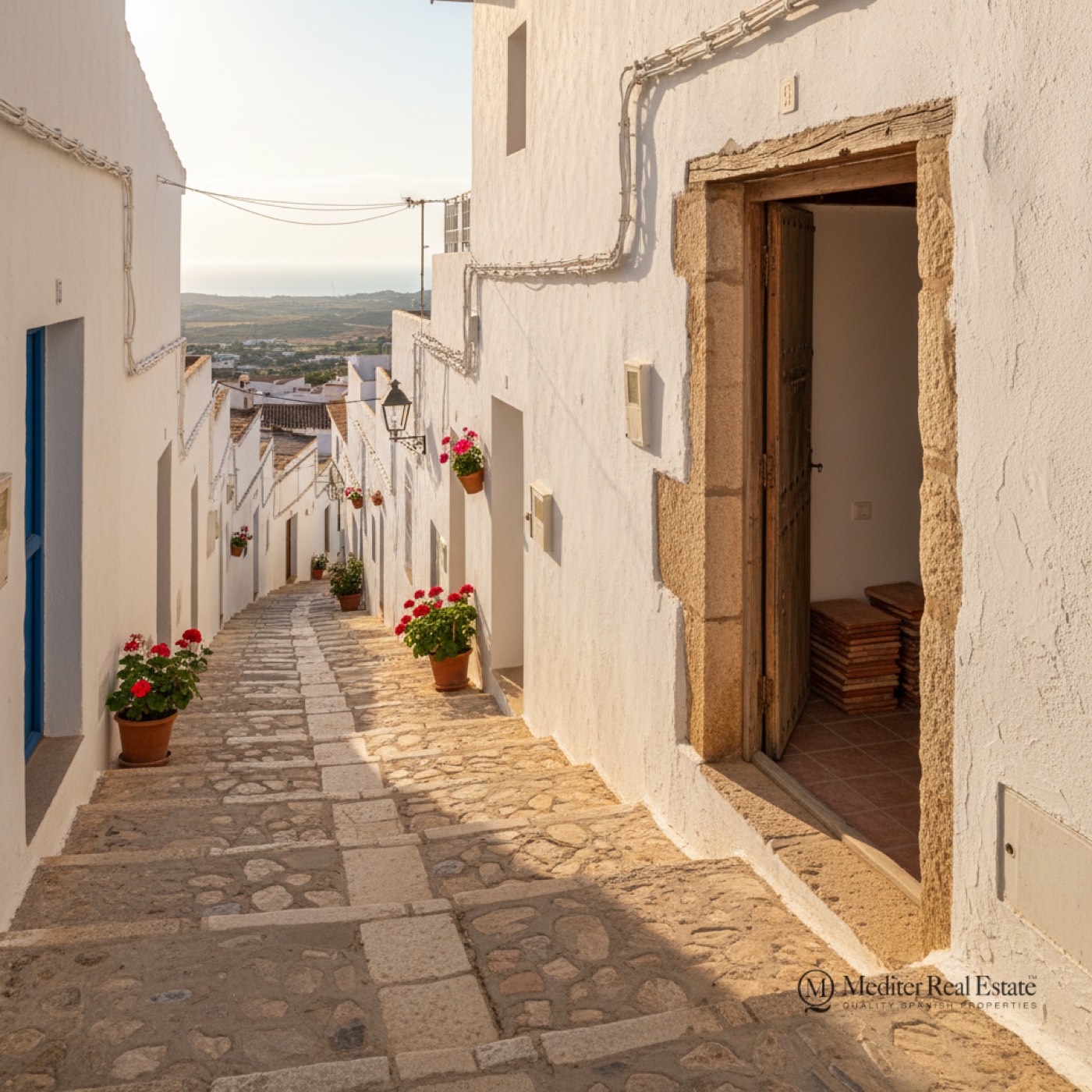
A traditional casa de pueblo in one of Costa Almería's whitewashed hill villages is one of the best-value entry points into Spanish coastal property: you can still buy a habitable two- or three-bedroom village house in areas around Mojácar Pueblo, Bédar, Turre, Lubrín, Sorbas or Vélez-Blanco from roughly €50,000–€130,000, a fraction of what a coastal apartment costs. In Andalucía (which covers both Costa Almería and the Costa del Sol) the resale transfer tax (ITP) is a flat 7%, the lowest of our four regions, and total buying costs typically land around 10–11% on top of the price. That combination is exactly why these pueblo blanco properties attract restoration-minded international buyers.
But a village house is not a coastal apartment. Three things decide whether your dream is a bargain or a money pit: access (can you actually get to it, park near it and get materials in?), party walls (medianeras shared with neighbours on one or both sides), and the real scope and cost of restoration. This guide walks through each, grounded in how things actually work in the province of Almería, so you buy with your eyes open.
A casa de pueblo is a house built within the historic core of a village, usually terraced (sharing walls with neighbours), often with two or three storeys, thick masonry or rammed-earth walls, a flat or lightly pitched roof, and frequently a small patio, roof terrace or "cámara" (an unconverted top storey once used for storage or drying). Unlike a rural finca out in the campo, a village house sits on urban land (suelo urbano) inside the village boundary — which is generally good news for legality, utilities and future permits.
This matters. Many rural properties in Almería carry planning irregularities that require an AFO certificate to regularise. A genuine urban village house usually avoids that problem entirely — but you should never assume. Always confirm the property's classification and building status on the nota simple and check for outstanding debts, embargos or charges before you commit.
Andalucía's flat 7% ITP on resale purchases is a genuine advantage over our other Costas. Crucially, ITP is charged on the higher of the purchase price or the cadastral "valor de referencia" — a reference value the tax office assigns to every property. Village houses are the classic case where a low, negotiated purchase price can sit below the valor de referencia, meaning you pay tax on the reference figure, not what you actually paid. Ask your lawyer to check the valor de referencia before you agree a price so there are no surprises.
| Region | Autonomous community | Resale ITP | Approx. total costs on top of price |
|---|---|---|---|
| Costa Almería | Andalucía | 7% | ~10–11% |
| Costa del Sol | Andalucía | 7% | ~10–11% |
| Costa Cálida | Murcia | 7.75% | ~10–12% |
| Costa Blanca | C. Valenciana | 9% (from 1 June 2026; 11% above €1M) | ~11–13% |
On top of ITP, budget for notary (~0.2–0.5%), land registry (~0.1–0.25%), a lawyer (~1% + IVA) and a gestoría (~€300). On a €90,000 village house that's roughly €9,000–€10,000 in costs — but note that percentages feel heavier at the bottom of the market, because minimum notary and registry fees don't shrink to zero. Because most casas de pueblo are resales, IVA and AJD stamp duty (which apply to new builds) don't come into it.
This is the question buyers underestimate most. Pueblos blancos grew up around donkeys and footpaths, not delivery vans. Before you fall in love with a house, walk the route to it as if you were carrying a fridge.
Some village houses are reached across a neighbour's patio, up a shared stair, or via a passageway (a "servidumbre de paso" — legal right of way). These arrangements can be perfectly fine but must be written into the escritura and shown on the nota simple, not just "the way it's always been done". Verbal, undocumented access is a red flag your lawyer must resolve before completion.
A terraced casa de pueblo typically shares a medianera (party wall) with the house on one or both sides, and sometimes shares roof lines, gutters, a drain or even structural beams that run between two properties. Under Spanish civil law, a party wall is generally presumed to be jointly owned by both neighbours, and both have obligations to maintain it. This has real consequences:
Practical protection: commission an independent survey (informe técnico) from a local arquitecto técnico or aparejador that specifically assesses party walls, roof junctions and shared drainage. It costs a few hundred euros and is the single most valuable thing you can buy before a village purchase. A good real estate lawyer will also insist on it.
Most buyers want to restore rather than simply refresh. In Spain, renovation works fall broadly into two permit categories, and getting this right keeps you legal and avoids fines.
Village houses within a protected historic centre may also fall under heritage/aesthetic rules: the ayuntamiento can dictate render colour (that famous white!), window styles, ironwork and even roof materials. In some conjuntos históricos you'll need extra sign-off. This isn't a reason to avoid these houses — it's a reason to ask the town hall what applies before you buy. Our full renovating property in Spain guide walks through the permit process and typical timelines in detail.
Costs vary enormously with access and ambition, but as rough 2026 guidance for a village house in Almería:
| Scope | What it covers | Rough €/m² guide |
|---|---|---|
| Cosmetic refresh | Paint, minor plaster, tiling, fittings | €250–€450 |
| Full modernisation | Rewire, replumb, new kitchen & bathrooms, floors, damp treatment | €500–€900 |
| Full structural restoration | Roof, beams, damp-proofing, layout changes, new services | €900–€1,500+ |
Add a contingency of at least 15–20% — old houses always hide something behind the plaster. Common hidden costs in Almería's villages include damp rising through solid masonry, obsolete or absent damp-proofing, rotten timber beams, single-skin walls with no insulation, and old lead or galvanised plumbing.
Most urban village houses have mains electricity and water, but connections can be old and under-specified. Confirm the electrical supply capacity (older homes may only have 3.45kW — not enough for a modern kitchen and heat pump). If any part of the property draws on a well or shared water source, read our guide to rural property water in Spain. Once you complete, you'll need to transfer or set up supplies — our post-completion utilities guide for Andalucía applies equally in Almería. Any restoration will also need an updated energy certificate, and thick masonry walls actually make village houses surprisingly cool in summer.
Restored pueblo houses can make characterful holiday rentals, but Andalucía requires a tourist licence (VFT) to let short-term legally, and some historic centres have their own rules. Read our tourist rental licence guide and, if yield is your priority, our buy-to-let yields analysis for Costa Cálida and Almería before committing. Managing a village house from abroad also needs thought — see our absentee owner's guide.
Andalucía charges a flat 7% ITP on resale purchases, applied to the higher of the purchase price or the cadastral valor de referencia. With notary, registry, lawyer and gestoría fees, budget around 10–11% on top of the price.
Under Spanish civil law a medianera (party wall) is generally presumed to be jointly owned by both adjoining owners, who share maintenance obligations. Structural changes usually need your neighbour's consent, so always establish ownership and condition in writing before buying.
Yes. Cosmetic and non-structural work needs a minor-works licence (obra menor); structural changes, roof works or layout alterations need a major-works licence (obra mayor) with an architect's project. Houses in protected historic centres may also face heritage and aesthetic rules from the town hall.
Many pueblo blanco houses are on pedestrian-only streets. It's legal and liveable, but it significantly increases restoration labour costs because materials must be carried in. Walk the delivery route and get builders to confirm access before you buy.
They offer the lowest entry prices of our four Costas and the lowest resale tax (7%). Restored well and in the right village they hold value and can let seasonally with a VFT licence — but returns depend heavily on realistic restoration budgeting and choosing a house without access or party-wall problems.
A genuine casa de pueblo inside the village core is normally on urban land (suelo urbano), which usually avoids the planning irregularities and AFO issues common to rural fincas. Always verify the classification on the nota simple rather than assuming.
Buying a pueblo blanco property rewards local knowledge — of which villages hold value, which streets have real access, and which houses hide expensive surprises behind the whitewash. Mediter Real Estate works across Costa Almería, Costa Cálida, Costa del Sol and Costa Blanca and can help you find, assess and safely buy the right village house. Get in touch with our team to tell us what you're looking for.
O que nos contar aqui é usado apenas para lhe responder. Privacy
Usamos os cookies necessários para o site funcionar. Com o seu consentimento, usamos também cookies da Meta (Facebook) para medir os nossos anúncios e mostrar-lhe imóveis semelhantes aos que viu. Os cookies do Google Analytics, também só com o seu consentimento, contam as visitas e mostram-nos que páginas ajudam.
Política de cookies