 Scritto da Nicki Price, CEO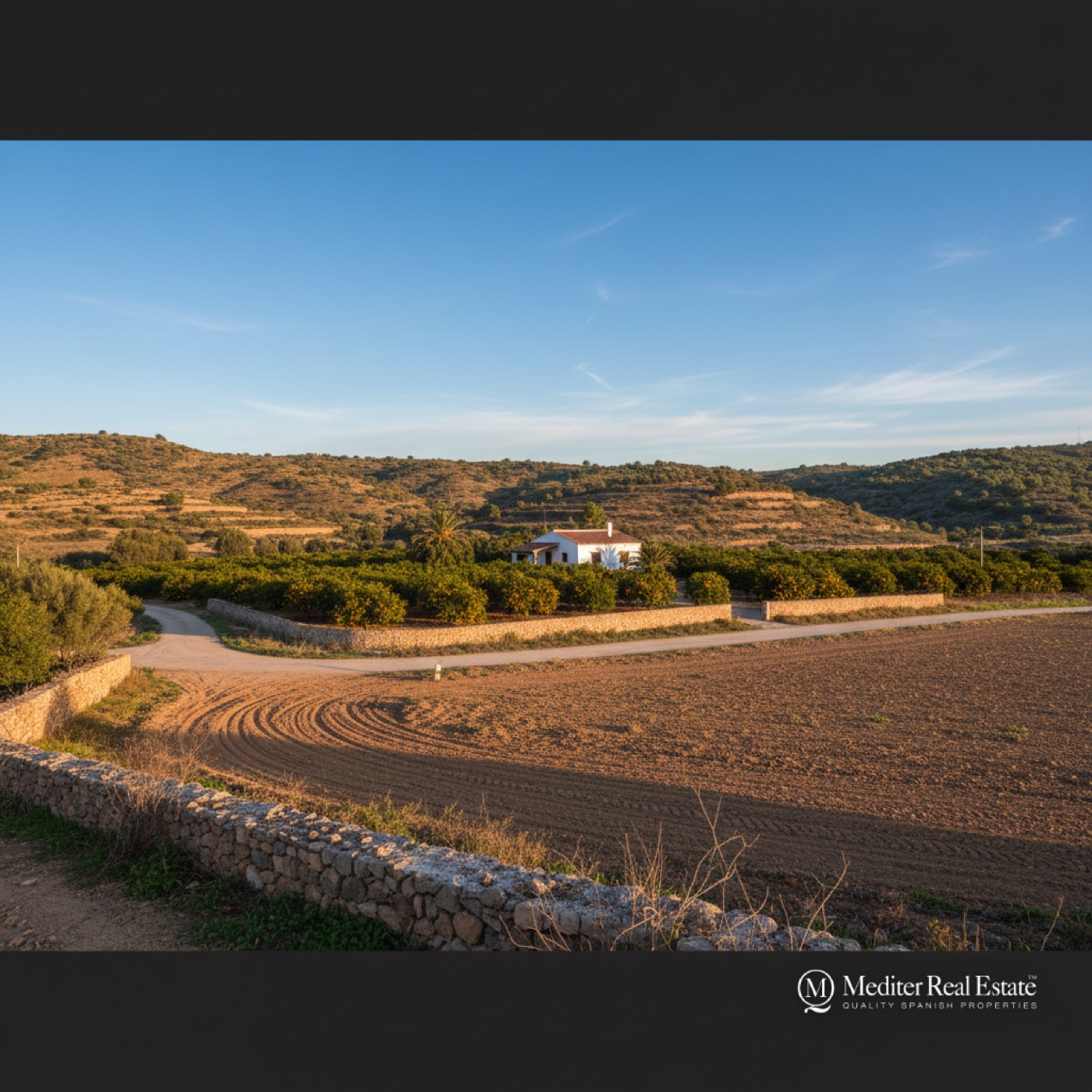
The single most important question when you view a country property on the Costa Blanca — or anywhere on the Costa Cálida, Costa del Sol or Costa Almería — is not the price or the view. It is: how is the land classified? On suelo urbano (urban land) you can build, extend and connect to mains services more or less freely, subject to the local plan. On suelo rústico (rustic/rural land), you generally cannot build a home at all, and much of what you can do requires special regional authorisation. Get this wrong and you can buy a "villa" that is legally invisible, unmortgageable and unsellable.
In short: before you sign anything, obtain the official clasificación del suelo from the town hall (ayuntamiento) and cross-check the catastro. A plot's classification — not the estate agent's description — determines whether you have bought a buildable dream or an agricultural field with a house that may never be legalised. This guide explains the four main land categories, what you can realistically build on each in our four coastal regions, and the specific traps international buyers fall into.
Spanish urban planning divides all land into legal categories that dictate what may be built. The exact names vary slightly between autonomous communities — the Comunidad Valenciana (Costa Blanca) and the Región de Murcia (Costa Cálida) use one framework, Andalucía (Costa del Sol and Costa Almería) another — but the practical logic is the same across all four coasts:
You confirm the classification through the ayuntamiento's certificado urbanístico and by reading the plot on the catastro and, for rural parcels, the SIGPAC agricultural map. A nota simple from the Land Registry tells you who owns it and whether it is charged with debts — but it does not tell you the planning classification. That is a separate check, and it is the one most foreign buyers skip.
Here is how the categories stack up in day-to-day terms for a buyer looking at property inland from Denia, Jávea, Orihuela Costa or in the Murcian and Andalusian interior.
| Feature | Suelo urbano | Suelo urbanizable | Rústico común | Rústico protegido |
|---|---|---|---|---|
| Build a new home? | Yes, under local plan | Only after development approved | Very restricted / usually no | No |
| Mains water & electricity | Connected/available | Planned, not guaranteed | Often none — boreholes, solar, deposits | Rarely available |
| Minimum plot size | Small, plot-by-plot | Set by plan | Large (typically 10,000 m² / 1 ha region-dependent) | N/A |
| Mortgage availability | Good | Cautious | Limited / lower LTV | Very difficult |
| Resale liquidity | High | Moderate | Lower, niche buyers | Very low |
| Purchase tax (resale ITP) | Same as any resale: C. Valenciana 9%, Murcia 7.75%, Andalucía 7% | |||
Two things to note on the tax row. First, resale ITP does not change because the land is rural — but the tax base is the higher of the price paid or the cadastral valor de referencia, and on cheap rural plots the reference value can exceed a bargain purchase price, pushing your tax bill up. Second, the Costa Blanca ITP fell to 9% for deeds signed from 1 June 2026 (Ley 5/2025) — it is the notary signing date that matters, not the arras. Costa Cálida sits at 7.75% (Ley 3/2025; ignore the old 8% figure still circulating online), and both Andalusian coasts are at 7%.
Usually not a normal dwelling. The philosophy behind rustic classification is to keep the countryside for agriculture, livestock and nature, not villas. What the law does sometimes permit on rústico común is:
Minimum plot sizes are the gatekeeper. Across the Costa Blanca interior a buildable rustic parcel commonly needs to be around 10,000 m² (one hectare), and even then permission is discretionary and often refused. In Andalucía (Costa del Sol and Costa Almería) the thresholds and rules differ by municipality and by whether the land is protected. Never assume "big plot = you can build" — verify with the town hall's planning department in writing.
Thousands of rural homes across all four coasts were built on rustic land without a proper licence, especially in the boom years. That does not automatically make them worthless — but it makes due diligence essential. Many can be regularised through an AFO certificate (Asimilado a Fuera de Ordenación) in Andalucía, or through equivalent "out of ordinance" recognition elsewhere, which lets an old rural build stay standing and be sold — but usually without full building rights and sometimes without legal mains connections. A property flagged as fuera de ordenación is not the same as one with a valid first-occupation licence.
This is exactly the kind of situation where an independent Spanish property lawyer earns their fee many times over. Do not rely on the seller's or agent's word; commission a formal planning search.
Even a fully legal rustic home rarely comes with the services a town property takes for granted. Many country properties on the Costa Blanca and Costa Almería rely on private boreholes or delivered water into a deposit, septic tanks rather than mains drainage, and off-grid solar rather than a grid connection. Before you fall for the view, read our detailed guide to rural property water in Spain and factor in the cost of solar and storage under the current solar panel rules.
A special layer of restriction applies near the sea. Under the Ley de Costas, a public-domain strip and a setback zone run inland from the shoreline, and much coastal land is additionally classified as protected rustic to prevent development. This affects buyers on all four coasts — from beachfront plots on the Costa Blanca to the wilder stretches of the Costa Almería. If a plot lies within a protected coastal band, no classification appeal will make it buildable. Understand the rules first in our Ley de Costas setback zones guide and the wider coastal flood and Ley de Costas risk guide.
Governed by Valencian planning law (LOTUP). Inland Marina Alta and Vega Baja have abundant rustic land, large minimum plot sizes for any dwelling, and a history of unlicensed builds now handled as fuera de ordenación. Popular with buyers wanting olive and orange groves — but classification checks are essential.
Extensive agricultural rustic land inland from the Mar Menor and around Lorca and the Guadalentín valley. Similar restrictions; strong protection around wetlands and the Mar Menor itself. Remember holiday-home running costs — see Costa Cálida holiday-home taxes.
The Andalusian LISTA planning law and the AFO route dominate the rural picture in the hills behind Marbella, Estepona and Mijas. Protected land near the Sierra de las Nieves and the coast is off-limits for building.
Vast, cheap rustic land in the interior and near Cabo de Gata's protected natural park. Many attractive-looking cortijos are unlicensed or fuera de ordenación. See our Costa Almería village house buyer's guide for the safer suelo urbano alternative in the pueblos blancos.
If you want the freedom to build or extend, an easier resale later and simpler financing, suelo urbano is almost always the safer buy. Rustic land can be wonderful — space, privacy, countryside — but only go in with your eyes open and a specialist lawyer on your side. Compare the coasts before you choose in our four-coasts comparison and read the fuller Costa Blanca buying guide.
Generally no. Rustic land is protected against urban development. In limited cases a single dwelling linked to agricultural use may be authorised on a very large plot (often around 10,000 m²) through a special regional procedure, but permission is discretionary and frequently refused. Always confirm with the town hall in writing first.
It can be, if the house is legal or has been regularised as fuera de ordenación or via an AFO certificate, and services are in place. It is risky if the build is unlicensed with no path to legalisation. Never proceed without an independent lawyer running a full planning search.
Yes — resale ITP is the same regardless of classification: 9% on the Costa Blanca (deeds from 1 June 2026), 7.75% on the Costa Cálida, and 7% on both Andalusian coasts. But the tax is calculated on the higher of the price or the cadastral valor de referencia, which can exceed a cheap rural purchase price.
It is harder. Many banks lend cautiously or only on lower loan-to-value ratios for rustic property, and some decline protected land entirely. Check eligibility before signing an arras contract — see our non-resident mortgage guide.
Fuera de ordenación means an existing building falls outside current planning but is tolerated. In Andalucía the AFO (Asimilado a Fuera de Ordenación) certificate is the formal document that recognises this status, allowing the property to be registered, sold and insured — usually without granting full new building rights.
Land classification is where good rural bargains and expensive mistakes part ways. At Mediter Real Estate we help international buyers across the Costa Blanca, Costa Cálida, Costa del Sol and Costa Almería verify exactly what a plot is — and what you can legally do with it — before a euro changes hands. Get in touch with our team to view properties with the classification already checked and the paperwork clear.
Ciò che ci racconti qui lo usiamo solo per risponderti. Privacy
Usiamo i cookie necessari al funzionamento del sito. Con il suo consenso usiamo anche i cookie di Meta (Facebook) per misurare i nostri annunci e mostrarle immobili simili a quelli che ha guardato. I cookie di Google Analytics, anch’essi solo con il suo consenso, contano le visite e ci mostrano quali pagine sono utili.
Politica dei cookie