 Scritto da Nicki Price, CEO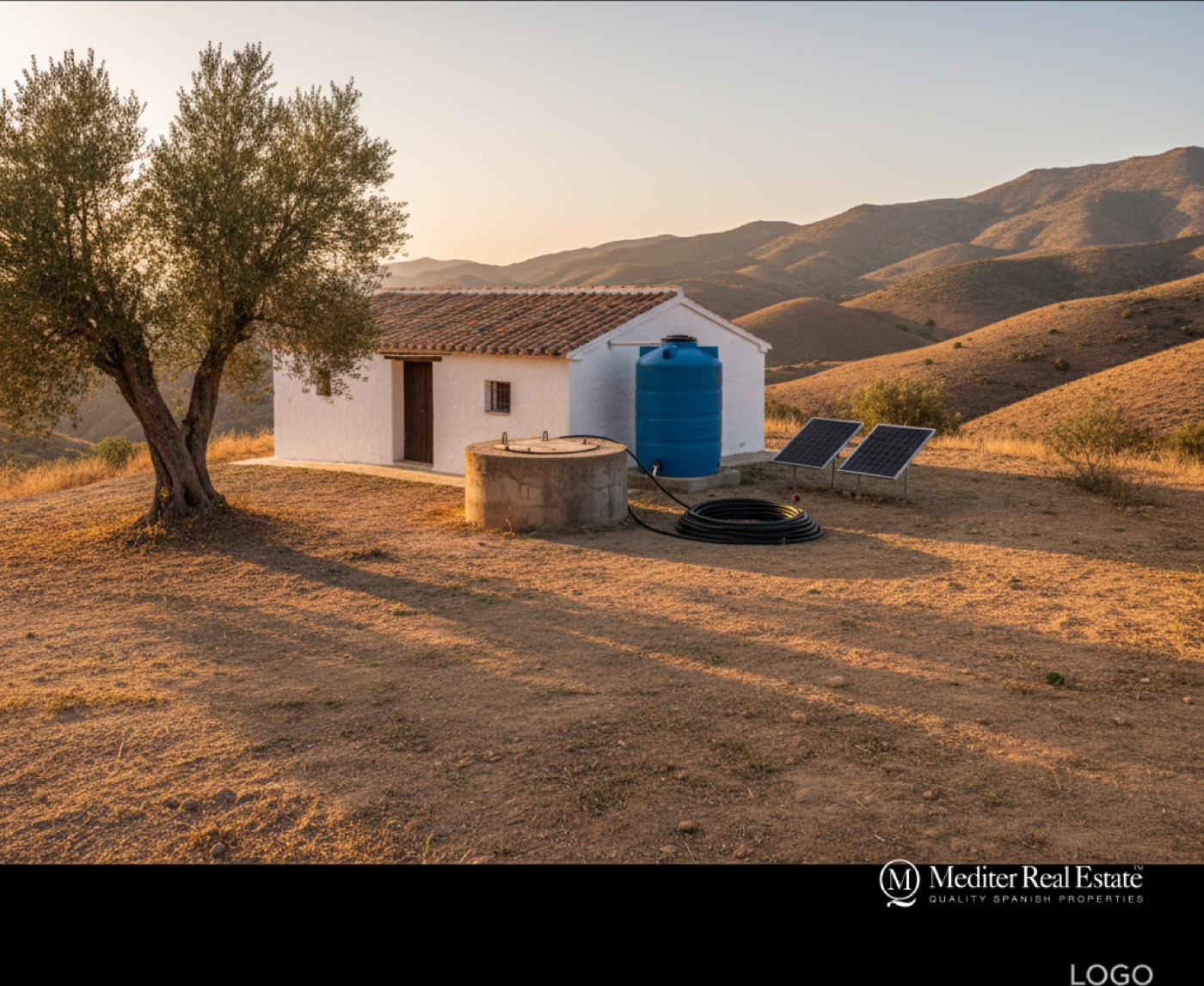
Before you buy that dream cortijo or finca in the hills behind Mazarrón, Lorca, Vera or the Almanzora Valley, ask one question before any other: where does this property actually get its water, and is that source legal? On the Costa Cálida (Murcia) and Costa Almería — the two driest corners of mainland Spain — water is the single issue most likely to sink an otherwise perfect rural purchase. A house with no legal, documented water supply is very hard to insure, mortgage, resell or live in comfortably, whatever the estate agent's brochure says.
The short answer: rural properties here are typically fed by mains water, a licensed borehole (pozo or sondeo), a rainwater cistern (aljibe or depósito), a private water-lorry delivery, or a community/irrigation-network share — and each one comes with a specific document you must see before signing. Below we walk through every source, the exact paperwork to demand, realistic costs for 2026, and the red flags that mean "walk away". This is deliberately region-specific: the rules and realities differ from a well-watered huerta to an arid Almería rambla.
These two provinces sit in Europe's most arid climate. Almería's Tabernas is officially semi-desert; much of inland Murcia receives under 300 mm of rain a year. Water is scarce, tightly regulated and, increasingly, contested. The Confederación Hidrográfica del Segura (Costa Cálida) and the Confederación Hidrográfica del Sur / Cuenca Mediterránea Andaluza (Costa Almería) control who may extract groundwater and how much. You cannot simply drill a hole in your land and pump — that requires a concession or, for small volumes, at minimum a registration.
This matters for buyers because a large share of the countryside stock — pretty stone cortijos, olive farms, off-grid renovation projects — was built decades ago with informal or undocumented water arrangements. Sorting genuine legal supply from a hopeful hose running off a neighbour's tank is the core of rural due diligence. It sits right alongside the other rural-buyer minefield: whether the house itself is legally built. Read our guide to the AFO certificate and illegal rural builds alongside this article, because water legality and build legality often travel together.
The gold standard. If the property connects to the municipal network (Aqualia, Hidrogea, and local operators serve much of Murcia; Galasa and municipal firms cover parts of Almería), you have a metered, potable, regulated supply. Ask to see a recent water bill (recibo del agua) in the seller's name and confirm the meter (contador) is registered to the property's cadastral reference. Many isolated fincas simply have no mains within reach — extending it can cost tens of thousands of euros and require crossing neighbours' land.
Very common inland. A borehole is legal only if it is registered with the relevant Confederación Hidrográfica and, for anything beyond minimal domestic use, holds a water concession (concesión de aguas) or is entered in the Registro de Aguas / Catálogo de Aguas Privadas. Key documents to demand:
An unregistered "black" borehole is a liability: the authorities can seal it, and you inherit the problem. Never accept "everyone round here has one" as reassurance.
Traditional cortijos often store rainwater or delivered water in an underground aljibe or a plastic/fibreglass depósito. This is legal and useful, but rarely sufficient alone for a full-time modern home. Check tank capacity, cleanliness and whether it feeds a filtration/UV system if used for drinking.
Where there is no mains and no viable borehole, many owners buy water by the lorry-load into a storage tank. It works, but it is an ongoing cost and a logistics commitment — factor it into your budget and confirm a supplier serves that exact location.
In agricultural zones — the Almanzora Valley, the Guadalentín, parts of the Bajo Almanzora — properties may hold a share in an irrigation community. This water is often intended for crops, not necessarily potable, and rights are tied to specific hours/volumes. Confirm exactly what the share entitles you to and whether it transfers automatically with the sale.
| Source | Key legal check | Rough cost | Buyer verdict |
|---|---|---|---|
| Mains (red) | Recent bill + registered meter on the cadastral reference | Standing charge + usage; connection new: often €1,500–€10,000+ if network is nearby | Best. Prioritise these properties. |
| Legal borehole | Confederación concession/registration + potability analysis | New drilling €4,000–€12,000+ (depth-dependent); plus pump/permits | Good if fully documented. |
| Cistern / aljibe | Capacity, cleanliness, filtration if potable | Depósito €800–€4,000 installed | Fine as backup/support supply. |
| Tanker delivery | Supplier serves the location; storage tank in place | Roughly €40–€90 per delivery, recurring | Workable but ongoing cost. |
| Irrigation community | Share transfers with sale; potability status | Annual community fee (varies) | Often non-potable — verify use. |
Costs are indicative and vary widely with terrain, depth and distance to the network; always get local quotes rather than relying on averages.
This is where a specialist local lawyer earns their fee. The process, in order:
Because so much of this overlaps with land and build legality, treat water as one strand of a wider rural check. Our buying land in Spain guide and the reasons you genuinely need a real estate lawyer both apply doubly to rustic property.
Sometimes — but never assume it. Both the Segura and Andalusian Mediterranean basins have zones under water-scarcity restrictions where new extraction permits are limited or effectively frozen. To drill legally you generally need:
Do not buy a waterless finca on the promise that "you can just drill a well". Verify the legal possibility before committing, ideally with a condition in the reservation contract. If drilling is part of a wider renovation, our renovating in Spain permits and costs guide covers how these consents stack up.
Rural buyers should budget for the whole off-grid or semi-grid picture, not just water. Many inland cortijos are also off the electricity grid, making solar-plus-battery the norm rather than the exception. When you add up mains extension (if any), a borehole or tank system, solar installation and a septic tank (fosa séptica), a rural "utilities package" can run to €15,000–€40,000+. These figures sit on top of the purchase taxes.
On the Costa Cálida, resale transfer tax (ITP) is 7.75% for 2026 (Murcia's Ley 3/2025 — many websites still wrongly quote the old 8%), while the Costa Almería, in Andalucía, applies 7%. Note the tax base is the higher of the price or the cadastral valor de referencia — see our full breakdown in the taxes on buying property in Spain 2026 guide. For ongoing running costs, our Costa Cálida holiday-home taxes guide and the cost of living by region article help you model a realistic annual figure.
Yes, provided the borehole is registered with the Andalusian Mediterranean basin authority (or holds a valid concession), the water is potable or filtered to potable standard, and the flow is adequate year-round. A borehole with no paperwork is a serious risk — insist on the Confederación certificate before signing.
If the municipal network already runs close to the plot, a new connection commonly costs somewhere between €1,500 and €10,000 depending on distance and works. If the network is far away, extension costs can be far higher and may require permissions to cross other land — sometimes it is simply not viable.
Only after an accredited potability analysis confirms it is safe. Groundwater in Murcia and Almería can carry high nitrate or salinity levels. Many owners fit filtration and UV treatment, or reserve borehole water for the garden and use mains or bottled water for drinking.
Not always automatically. Concessions and irrigation-community shares often require a change of ownership to be registered with the relevant authority. Your lawyer should confirm the transfer is possible and complete it — never assume it passes silently with the deed.
The Costa Cálida (Murcia) falls under the Confederación Hidrográfica del Segura. The Costa Almería falls under the Andalusian Mediterranean basin authority. Both regulate groundwater extraction, and both operate scarcity restrictions in over-exploited aquifers — which is why new drilling is not guaranteed.
Absolutely. Build a clause into the reservation or arras contract making completion conditional on documented, legal, potable water supply. It is one of the most valuable protections a rural buyer can negotiate.
Buying a cortijo or finca on the Costa Cálida or Costa Almería can be one of the best-value lifestyle moves in Europe — but only when the water, the build and the paperwork all check out. Mediter Real Estate specialises in coastal and inland property across the Costa Blanca, Costa Cálida, Costa del Sol and Costa Almería, and we work with local lawyers who know exactly which certificate to request from which authority. Contact Mediter Real Estate today to find a rural property with genuinely legal, secure water — and to have every source verified before you commit.
Ciò che ci racconti qui lo usiamo solo per risponderti. Privacy
Usiamo i cookie necessari al funzionamento del sito. Con il suo consenso usiamo anche i cookie di Meta (Facebook) per misurare i nostri annunci e mostrarle immobili simili a quelli che ha guardato. I cookie di Google Analytics, anch’essi solo con il suo consenso, contano le visite e ci mostrano quali pagine sono utili.
Politica dei cookie